By Pamela Okano
NAP Contributor
Continuation from NAP May 22 issue
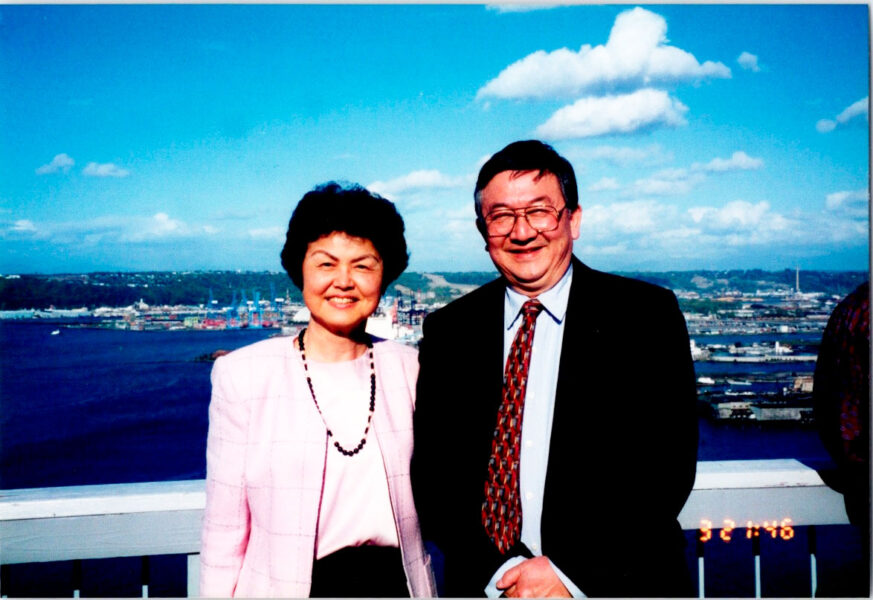
Ellen and Don Nakata. Location and date unknown. Photo courtesy of Susan Allen.
Bainbridge Island has long been subject to power outages during the winter months. The store purchased a small generator in the 1970s just enough to keep the lights going and run the cash registers. For refrigeration during power outages, store personnel would open the front and back doors of the store to let the cold air in then open the refrigerator doors. During such times, customers would often flee their cold houses to come to the store where they would be provided with free hot coffee, cookies, and water while supplies lasted. But the blizzard in 1990 topped them all. Some islanders were without power for a week! One customer later said, “I want to thank [the store] for going the extra mile when we need it most, for remaining open during storms and power outages, and for providing that warm cup of coffee, a place to gather and nourishment in every sense of the word.”
Meanwhile, Ballard Market in Seattle had hired a new produce manager whose job was to bring in the best produce possible to differentiate the store from others in the neighborhood. The new manager said, “A wholesaler said to me, ‘You just have to work for the Nakatas. They’re the best people on the planet.’” Noting that produce is the “last great commodity that is still exciting.” He went on to explain, “It’s susceptible to supply and demand swings, and is affected by the weather, soil conditions, and sunshine. If you don’t move it, it rots, and every season it’s a bit better or a bit worse.” Of course, what he said then is still true today.
In the early 1990s, two new stores joined the T&C brand: Shoreline Price Chopper and Greenwood Price Chopper in north Seattle. The Greenwood store, in particular, became part of the community as staffers learned to greet customers by name and pitched in to help local schools, churches and Little League teams. But Don had a much bigger plan in mind. He wanted to create a destination store.
In August 1995, Central Market opened in Poulsbo, Washington. Its 69,000 square feet easily made it the largest store in the T&C group. It was the first green commercial building in the state and, most likely, in the nation given its size and scale. The produce, meat, seafood, and natural food departments were larger and more open to interacting with the public. And there was a pizza and hot dog stand.
What happened to Poulsbo Market Place? The original plan had been to close it down once the new store opened. But there were still nine years left on the lease. Many older customers said they would not shop at the new store. So at least for the time being, it was left open.
Central Market eventually became a destination store for Kitsap and Jefferson County residents in Washington. It became known for its special events and promotions. For example, every year, a farmer who had harvested his corn just hours before was invited to sell corn on the cob from his truck. One year, a man showed up with his Volkswagen Beetle and said, “Fill it up with as much as you can.” He did not mean just the trunk.
Fishermen who had left their boats only a few hours before would also show up to sell their catch. The younger set were not left out either. Farmer Jo, a store meat cutter, would wear overalls and a straw hat to teach children about food safety, organic produce, and the food pyramid. He had a tractor to which a hay wagon was attached and would give the kids rides so their parents could shop in peace.
Not all was well in the T&C universe. The Shoreline store had never done well even after it evolved from a discount store into a full-service format. Shoreline was a growing community but the store was quite small. Furthermore, its neighbors in the shopping mall were leaving. Don decided to create another destination store. T&C was able to negotiate deals with the departing businesses to take over their spaces. The goal was not to simply recreate the Poulsbo Central Market. The planning team aimed to capitalize on their new slogan, “Celebrating Fresh.”
In January 2000, the new Central Market Shoreline opened. At 57,500 square feet, it was more than twice as large as the original store. There was a 10,000 square foot produce section, a food court featuring Asian and Mexican food, a 52-ft. long meat counter, demonstration kiosks, sushi bar, pizzeria, and deli. Customers were calling their friends urging them to come to the new store. Although, as with all stores, it took several months for the Shoreline store to find its footing. Don could rest easier knowing they had finally found the winning formula for that location.
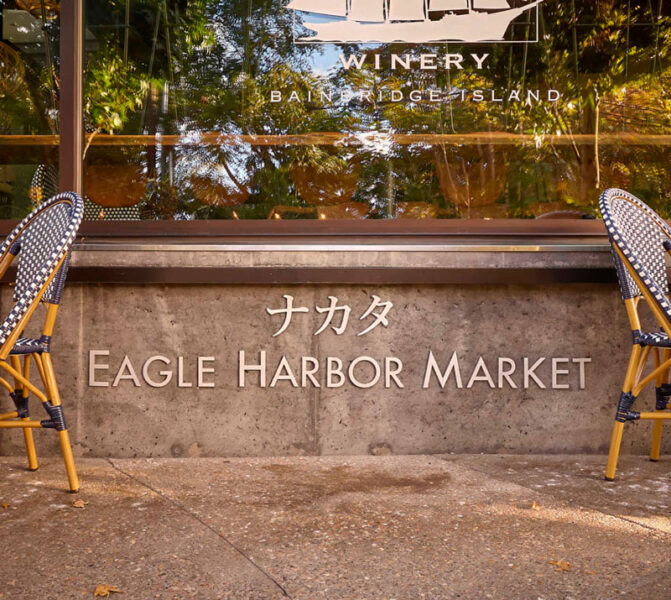
Currently, Fletcher Bay Winery on Bainbridge Island, WA. Formerly location of the Nakata Eagle Harbor Market. Undated. Photo credit: Pamela Okano.
Shoreline joined its sister stores in sponsoring charitable and philanthropic activities. For Ellen, Don’s wife, finding a cure for breast cancer was a personal matter. She, Kay Jensen, and three employees assembled a team that walked or ran in the annual Susan G. Komen Race for the Cure. In September 2000, she and Don won the Komen Foundation’s Community Hero Award. In 2001, T&C’s team of 1,014 was the largest ever to participate in the race.
Don and Ellen’s elder daughter, Susan Allen, had joined T&C in 1993, several months after giving birth to her parents’ first granddaughter, Katy. When Katy was old enough to spend time with her grandfather, Don would babysit taking her to meetings and store visits. He was also beginning to think about retirement. He had had bypass surgery in June 2000 so retirement at the end of that year sounded like a good idea.
In early October 2000, Don and Ellen went on a vacation to Louisiana. On October 2, Don went to bed and never woke up. He had passed away from a massive stroke.
Don’s cousin, Larry Nakata, became T&C president. It was not a good time for the company. The teamwork and collaboration that had been the hallmark of Don’s business style was needed more than ever. Larry and the board of directors (his brother Ron, Susan Allen, Wayne Loverich, and Greg Johnson) provided it. As a result, 2001 turned out to be an excellent year financially.
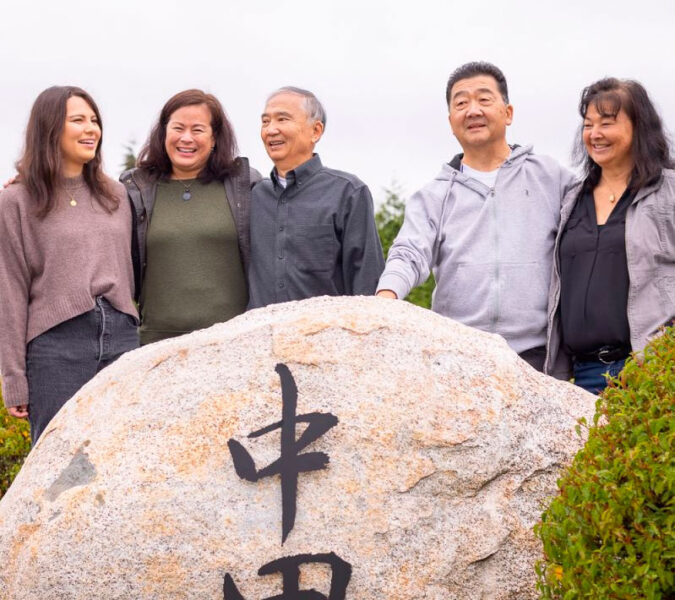
Left to right: Katie Nakata Allen, Julie Nakata Bowman, Larry Nakata, Ron Nakata, and Susan Nakata Allen at the Middlefield farm with “Nakata” rock at its entrance, 2025. Photo courtesy: Pamela Okano.
In October 2001, T&C Markets purchased the original Nakata farm property from John and Mo’s sons to preserve the land. The company decided to return the farm to its roots—farming and the land was christened “Middlefield Farm.” (Middlefield is the English translation of “Nakata.”) Initially, zucchini, corn, beans, squash, pumpkins, sunflowers, and tomatoes were grown in five greenhouses. The produce was brought to either the Winslow or the Poulsbo store for sale.
Change was in the air. In 2002, T&C brought its long association with the Thriftway marketing program to an end. The corporate name was changed to Town & Country Markets, Inc., to reflect the multiple stores under the T&C umbrella. The Ballard neighborhood had changed from retired Scandinavians to more upscale techies. Consequently, the Ballard store was significantly expanded to emphasize produce, seafood, meat, deli, and food service. The Greenwood store was also remodeled.
It was time to build another Central Market. Larry and the board had their sights set on Mill Creek in Washington. The thought was that the new Central Market could form part of a massive town center on city property. The Mill Creek City Council, however, knew little about T&C, the Nakatas, or the Loveriches. Larry made a presentation to the council. When he finished, an elderly gentleman on the council noted that when he was a boy, he used to go to a butcher shop on Bainbridge Island run by Larry’s uncle, John. The man said that John was one of the finest people he had ever met. He personally knew the Nakata and Loverich families, stating that “they are the best of the best.” It turned out that the gentleman had grown up across the street from the Nakatas.
Central Market Mill Creek opened in September 2004. The store’s special feature was its deli—–-one much larger than in other stores and filled with gourmet goodies.
By this time, the end was near for Poulsbo Market. Not only was the lease going to expire but a Walmart Supercenter was scheduled to open nearby. The North Kitsap Herald noted, “It is a store that gained itself a loyal following, evidenced by the large groups of shoppers and lunch-time gatherings still taking place one week from the final day.” On the last day of business, Susan Allen, Ron Nakata, and Wayne Loverich—T&C’s board, worked as checkers. The very first customer from 1974 showed up, wearing the same outfit she had worn then to share memories.
August 2007 marked the golden anniversary of T&C. Customers in all the stores were given strips of canvas and asked to decorate them as they chose. When returned, the strips were made into chains that were strung up in each store.
On Bainbridge Island, the celebration was even bigger. T&C rented a public park close to the store and served hot dogs, sodas, and cake to the community. The evening ended with fireworks over the harbor.
Big changes, however, were coming. Wayne Loverich retired in 2010 and Greg Johnson, another shareholder, sold his T&C shares to the Nakata family shareholders. Consequently, the Nakata family, alone, now owned the company. In addition, Larry was planning to retire in 2011. Neither Susan nor Ron Nakata, Larry’s younger brother, was interested in becoming the CEO. So Larry went back to Bill Weymer, who had acted as Don’s partner in the purchase of the Ballard and Overlake stores. Bill agreed to become CEO.
Sadly, in 2012, the Greenwood store lost its lease and a large Fred Meyer would end up in its place. After the last merchandise was sold on the store’s final day, 150 customers and employees came to have cake, coffee, and conversation. Ultimately, a significant number of customers switched their allegiance to the Ballard or Shoreline stores.
By 2014, it was clear that the original Bainbridge Island store was again ready for a much-needed remodel. There was some thought to building a new store on property owned by the Nakata family just outside of downtown Winslow. However, it seemed certain that if the store left Winslow, the town would be nothing but a tourist hub and only in good weather months. The company decided to stay. Not only that, but the decision was made to stay open during the massive remodel which lasted 19 months!
Because the remodel essentially meant building a new store on top of the old store, items had to be moved several times. One employee remembered, “One thing that will always stand out in my mind is the fact that our customers were more worried about how we were dealing with the stress of the remodel than they were bothered by things being moved.” In addition, T&C became the first private business in the nation to use a federal bond program for energy upgrades that won the LEED Gold designation from the U.S. Green Building Council. At the grand opening in September 2015, customers enjoyed free food and commemorative shopping bags. In 2024, the name “Central Market” came to an end and all stores became known as “Town & Country Market.”
Today, there are six T&C Markets: the original Bainbridge Island store and one each in Poulsbo, Seattle (Ballard), Bellevue (Lakemont), Mill Creek, and Shoreline. Over the years, approximately 25 Nakata family members have worked at one or more stores and nine are currently serving. The Mill Creek and Lakemont stores boasts an in-house restaurant and the Poulsbo store got one in early 2025.
Middlefield Farm has seen changes as well. In 2024, a new well was dug at Middlefield and zucchini, tomatoes, radishes, romaine, sunflowers and winter squash were grown outside the greenhouses for the first time. For logistical reasons, the fresh vegetables grown on the farm are only available at the Bainbridge and Poulsbo stores. In 2025, the farm expected to grow enough vegetables to supply the restaurants in the Poulsbo, Lakemont, and Mill Creek stores.
Thus, on July 6, 2024 the Nakata family had plenty to celebrate when, after a several-year hiatus due to the COVID-19 pandemic, they gathered for a family reunion at Middlefield Farm. Larry Nakata, Ron Nakata, and Brian McWhorter who has been the farm managers from the beginning of T&C’s ownership, all spoke. There was a slideshow of the history of the family and the farm. There is now a large rock at the entrance to the farm inscribed with the kanji (Japanese script) for “Nakata.”
A month before his unexpected death, Don Nakata penned a mission statement for the family with respect to Middlefield Farm: “To offer a sense of belonging, the pride of association, the comfort of connectedness and the power of idealistic purpose by encouraging and supporting each other in the special values of our family heritage.” Little did he know that 100 years after his grandfather had purchased the property, the family would gather together on the farm to celebrate a centennial of family ownership.
Community Leaders: Don Nakata was not only a business leader but was also a leader in the Bainbridge Island Japanese American Community (BIJAC). In the 1970s, he, his cousin Ron Nakata (Larry’s younger brother), longtime friends Frank Kitamoto, Junkoh Harui, and John Sakai urged BIJAC to begin taking oral histories of Bainbridge Island Nisei. Although BIJAC had been formed many years before, primarily as a social club for island Japanese Americans (JAs), it was now well on its way to becoming an important repository for island JA history.
It was also Don’s idea to take the small family mochitsuki (rice-pounding) equipment that originated in the dry cleaning shop of his uncle, Phil Okano, to a higher level. The mochitscelebration had already graduated to a Bainbridge Island Japanese community event with a potluck dinner at the end. It would now be a fundraiser for BIJAC and open to the public. For over 30 years, the mochitsuki festival has been one of the island’s most popular events, drawing people from Seattle, Bellevue and the Kitsap Peninsula. Nowadays, there are two taiko (Japanese drum) performances, an origami (Japanese paper folding) class, Obon (Japanese Buddhist festival honoring ancestors) dance lessons, and historical displays about Bainbridge Island JAs. Everyone is welcome to help pound rice into mochi cakes. Although some of the rice is cooked in rice cookers in the kitchen, much of it is cooked the old-fashioned way—steamed over a fire. Omochi, both plain and filled with anko (sweetened bean paste), is available for sale. The number of visitors can range from 1500-3000 possibly making it the largest mochitsuki festival in the country.Don, Frank, and Junkoh also actively encouraged the Bainbridge Island School District to name a new middle school after an Issei—in this case, Sonoji Sakai, Kay Nakao’s father.
Don felt strongly that the legacy that the Issei left—their hard work and honesty—had rebounded to the benefit of their descendants. The three men were also behind the effort to build the Bainbridge Island Japanese American Exclusion Memorial located at the very site where in 1942, Bainbridge JAs (including Don and Frank) had walked onto the ferry to be transported to Manzanar Incarceration Camp in California. Over the last 20 years that memorial has gradually taken shape. By 2025, the ground was broken for the final phase, a Visitor Center. Sadly, none of the three lived to see the memorial’s completion.
T&C Values: For many years, T&C’s vision has been “Nourishing the Quality of Life.” The three components of this vision are food, people, and love. The food component embraces the stores’ commitment to quality, value, flavor, local producers, and culture. The people component reflects the friendliness, authenticity, respect, and sense of community shared by T&C staff, suppliers, and customers. Love is shown through these relationships.
Don also incorporated Japanese concepts of gaman, kaizen, and umami into his business philosophy—a philosophy that continues to guide the company to this day. Gaman stands for perseverance and patience. Kaizen means continuous improvement. And umami signifies the peak of perfection. Emblematic of these concepts is the sailboat that is part of the markets’ logo. The sailboat can sail in different seas and conditions requiring gaman and kaizen to bring it safely to shore. Umami reflects the goal of total customer satisfaction.