
From Shikoku to Seattle The Tsuyoshi and Yayoi Inouye Family History
By Geraldine Shu
NAP Contributor
Tsuyoshi Inouye was born and raised in Ehime Prefecture, Japan, in a rural area called Oiye where his family had a mikan (Japanese orange) farm. He was the elder of two sons and attended high school in Yawatahama. At the age of 18, he decided that he did not want to be a farmer. Instead, he adopted the neighbor’s son, who changed his family name to Inouye, and gave the land to him.
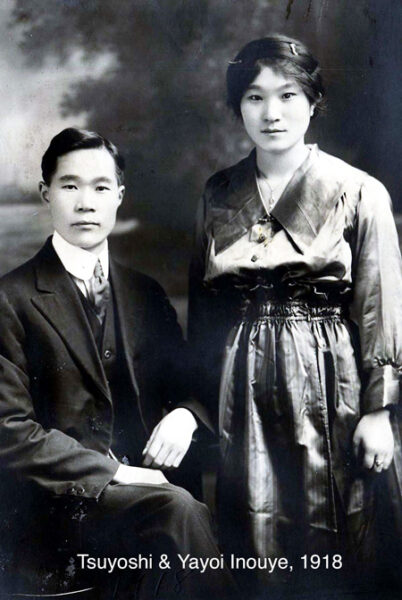
Tsuyoshi Inouye immigrated to Seattle, Washington, in 1907 when he was 20. He attended Stevens Elementary School as a fifth grader to learn English but within a week was promoted to the sixth grade. After one and a half years, he completed an eighth grade education. While he was in school, Inouye worked as a schoolboy for a Caucasian family, tending to their furnace.
Even after learning adequate English, it was difficult for Inouye to obtain a high-level job, due to growing tensions between American and immigrant workers. He started to work in a friend’s restaurant. Members of a ken (prefecture) often offered jobs and support to newcomers, providing training for certain occupations. Many people from Ehime-ken were in the restaurant business. By the age of 30, Inouye was operating his own place. Unlike many of his Issei (first generation Japanese American) counterparts, his restaurant was not in the International District, but rather in downtown Seattle serving many Caucasian workers. This was considered by many of his friends to be a bold step.
The State Cafe was on the southwest corner of First Avenue and Madison Street, in the heart of Seattle’s business district. The Frederick & Nelson department store was just a block or two away, and ships carrying Bremerton, Washington, sailors docked nearby. This meant catering to primarily non-Japanese customers and preparing American food such as bacon and eggs, sandwiches, and potatoes. He worked hard from early morning until 8 or 9 p.m. as a combination cook, waiter, cashier, buyer, and dishwasher. The State Cafe made money from the beginning due to Inouye’s hard work and its excellent location. Business profits allowed purchase of new equipment and expanded quarters. Inouye was not a very sociable person, but he had many friends in the Seattle area from Japan. He was a very smart man, and many people came to him for advice.
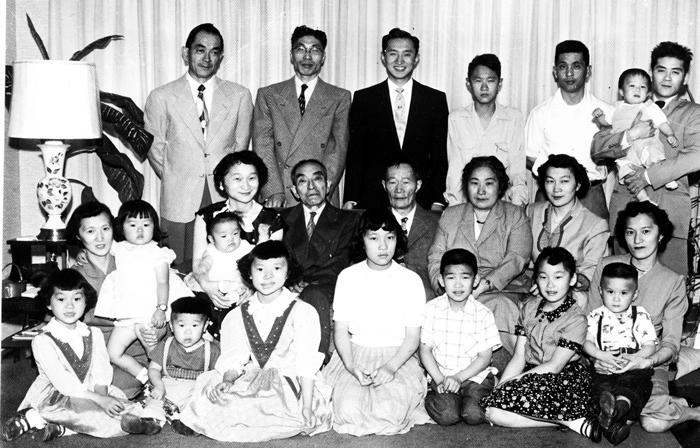
Inouye Family 1955. Photo courtesy: Geraldine Shu.
Once he had established himself financially, Inouye began to think about starting a family. His family in Japan arranged for an omiai (arranged marriage) between picture bride Yayoi Iseka and Inouye. Their marriage was faciliated by their two families and a baishakunin (go-between). In Japan, Iseka’s name was recorded in the Inouye koseki-toho (family history record) which lists all family births and marriages and is filed with the town clerk. In this way, though no ceremony was performed, Iseka was already a bride before leaving Japan. Though she had never met Inouye, she dutifully traveled to Kobe, Japan, and boarded a ship called the S.S. Kashima Maru, arriving in Seattle two and a half weeks later. She turned 18 in the middle of the Pacific Ocean, which allowed her to legally enter the United States in 1918.
Iseka was the eldest of six children, also from a family of mikan farmers in a small village called Mitsukue in Ehime Prefecture. Her mother died of typhoid when she was 15 years old. Her stepmother complained when the younger siblings cried at night, so Iseka would put the baby on her back and go outside for a walk to keep it quiet. After finishing grade school, Iseka attended a girls’ school to be trained in household duties for about six months. Her life was not that of a carefree child. So, it is easy to imagine how becoming a picture bride provided the possibility of a life of her own.

Immediately after arriving in Seattle, Yayoi Inouye had to adjust to the American way of living. She thought “making the bed” in the morning meant folding up all the bed sheets and blankets and putting them away in the closet. In another instance, she was instructed to raise the window shade. Not realizing that a gentle tug of the shade would be sufficient, she removed the roller from the brackets, rolled it by hand, then returned it to the window. For whatever reason, Tsuyoshi Inouye did not teach her many of the relatively simple household tasks. A relative and neighbor, Mr. Yamamoto, took it upon himself to teach Yaoyi Inouye many of the American ways. She was also put to work in her husband’s restaurant making at least 40 sandwiches every morning. Workers who stopped for coffee or breakfast also picked up a sack lunch to take with them. Tsuyoshi Inouye taught her the value of U.S. coins, how to use the cash register, and how to make change for customers. During these early days, the restaurant consumed all their time, being open morning to night, seven days a week. There was little time for socializing because every day was a work day.
A GROWING FAMILY
The family had six children, four girls followed by two boys. Since the Japanese were not allowed to become U.S. citizens nor allowed to own property, the Inouyes purchased a house in their eldest daughter’s name where they lived until the evacuation in 1942.
Bessie, the oldest daughter, was very popular as a baby with her parents’ many bachelor friends. They rented rooms from families and often worked in the Inouye restaurant. As an infant, Bessie was placed in a cardboard box next to the cash register. Wherever parents went for social gatherings, the children were taken along, even to funerals.
As the family grew, everyone was put to work. Yayoi Inouye and the four girls were waitresses, working on weekends and holidays. Howard, the fifth child, was the dishwasher. The restaurant provided food on the table and cash flow from the daily business, even during the Depression years. In the 1930s, the union became active, and the restaurant had to close one day a week to allow the workers a day off. On Sundays and holidays, it was always open, and the family worked together. Christmas was always celebrated on Christmas Eve because the restaurant was open on Christmas Day. No matter how hard things were, Tsuyoshi Inouye always insisted that each of them be given a gift. For many years in a row, they each opened their new nickel pencil boxes and were truly delighted with them.
Before the children started school, Japanese was spoken at home; but as each child learned English and started to speak it at home, the younger siblings would also converse in English. Tsuyoshi Inouye was very encouraging in his children’s school performance and helped them with their reading. He rewarded the older children with a dollar for each “A” at report card time until he realized that they were all good students.
After regular grade school, which ended at about 3 p.m., the children would stop at home to pick up oyatsu (snack) then continue to the Japanese Language School 4-5 p.m. in the winter time or until 5:30 p.m. as the days got longer. Every Saturday, the children were sent to the Seattle Public Library to check out books and spent much of their free time reading.
As the eldest son, Tsuyoshi Inouye was responsible for caring for his parents in Japan. So, in 1935, when his father became ill, he sent Bessie, who was 16 years old, to help because he was unable to leave the restaurant. After her grandfather died, Bessie went to Tokyo to spend time with her uncle, the second son of Tsuyoshi Inouye’s family. Tsuyoshi Inouye had sent money to Japan for his younger brother to attend a university in Europe. In 1937, Bessie returned to Seattle and continued her education at Broadway High School. She attended summer school to catch up on the time she had spent in Japan and graduated in three and a half years in 1938. Ruby, the second eldest, stayed in high school for four and a half years until 1939. This allowed Bessie to start at the University of Washington (UW), one year ahead of Ruby.
Tsuyoshi Inouye expected all his children, male or female, to attend college. Many of his friends’ children were not expected to do so due to financial burdens or due to the need for help at home. However, when it was the third daughter Frances’ turn to start college, Yayoi Inouye was pregnant with their sixth child. Frances was asked to help at the restaurant to replace her mother as a worker. Frances and Lillian (the fourth daughter) also did well in school, like Bessie and Ruby, and would have attended college if the circumstances had allowed. Since Frances made this sacrifice, it was understood that she would inherit the restaurant.
In college, Bessie took courses in economics and Ruby started out in home economics. Tsuyoshi Inouye would wake Ruby at 4:30 a.m.; then they walked from home to the restaurant. Ruby went to an upstairs loft and slept while her father started up the stove and prepared breakfast items such as oatmeal or pancakes. Before opening the restaurant for customers at 7 a.m., Tsuyoshi Inouye woke Ruby, who was the waitress. In the meantime, brown bag lunches were made for workers to bring to work. Many customers ate breakfast, bought a lunch, and took the ferry at First Avenue and Marion Street to go to work in nearby Bremerton. Meanwhile, Bessie went to the UW from home, attended her classes, then took a streetcar to the restaurant, arriving around noon. Subsequently, Ruby would leave the restaurant, take the street car to the UW, and attend her classes.
Yayoi Inouye used to wear a heavy, purple Indian head cotton uniform at work. In the evening, she and Frances would work at the restaurant with a hired cook while Tsuyoshi Inouye went home at about 2 p.m. to prepare supper for the family. Each child did homework around the kitchen table where the coal stove kept the room warm. There was no central heating in the house.
Yayoi Inouye was not a good housekeeper, so she had the girls divide the house by rooms which each was responsible for keeping clean.
Ruby’s job was to iron the uniforms, which was not a very likeable task. Yayoi Inouye was very good at teaching her children how to sew, make crafts, play family games, and sing Japanese songs. The family took Saturday night baths by heating the water in the kitchen. The children loved to lie down next to Yayoi Inouye in the tub because she was fat and the water level would be higher when she was in it. Before they got out of the tub, they would recite the Japanese alphabet as a song — i-ro-ha-ne-ho-he-to,etc.; at the end, when they said ‘n,’ they would jump out of the tub.