Tadaima Exhibit and New Nikkei Memorial Sculpture by Miya Sukune
By Barbara Mizoguchi
NAP Editor-in-Chief
Local artist Miya Sukune was busy completing an exhibit for the Museum of History and Industry (MOHAI) in Seattle, Washington and a piece of artwork in Ober Park on Vashon Island. Both are a tribute to the Japanese immigrants and Japanese Americans (JAs) in the area who were forced into incarceration camps by the U.S. government in 1942. The works are completely different in size, look, and materials. Usually, an artist has a style or works in one medium that is recognizable wherever their pieces are located. Sukune’s work is diverse yet her themes are deeply meaningful.
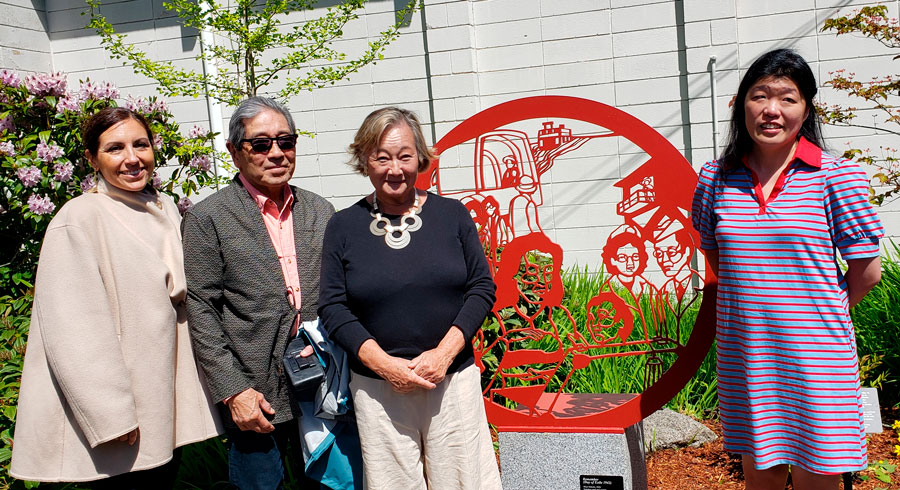
Left to right: King County Council Teresa Mosqueda; survivor John Okimoto; former Friends of Mukai Board of Directors President, Rita Brogan; and artist Miya Sukune standing in front of new artwork by Sukune at Ober Park, Vashon Island, WA. Photo credit: Barbara Mizoguchi.
Originally from the East Coast of the U.S., Sukune read about the Hinamatsuri Day dolls that were at Bailey Gatzert Elementary School in Seattle for Japan’s Girls’ Day. Due to World War II and the U.S. naval station at Pearl Harbor being bombed in 1942, Japanese immigrants and JAs on the West Coast were forced into incarceration camps. They hurriedly sold, got rid of or stored their personal belongings. Many families in the Seattle area had the school store their delicate, handmade, silk hinamatsuri dolls; however, after the war many did not return to the area nor reclaim their dolls. Later, the school entrusted MOHAI to keep the dolls safe.
In 2024, MOHAI’s curator fellow researched the dolls and by 2025, the museum decided to display them in an exhibit. It then commissioned Sukune to do the artwork. She noticed the traditional backdrop for the dolls was missing and painted a new one that became a series of portraits. Later, the project evolved to Sukune becoming the guest curator for “TADAIMA: I’m Home” exhibit. It includes her recent research with incarcerees and descendants.
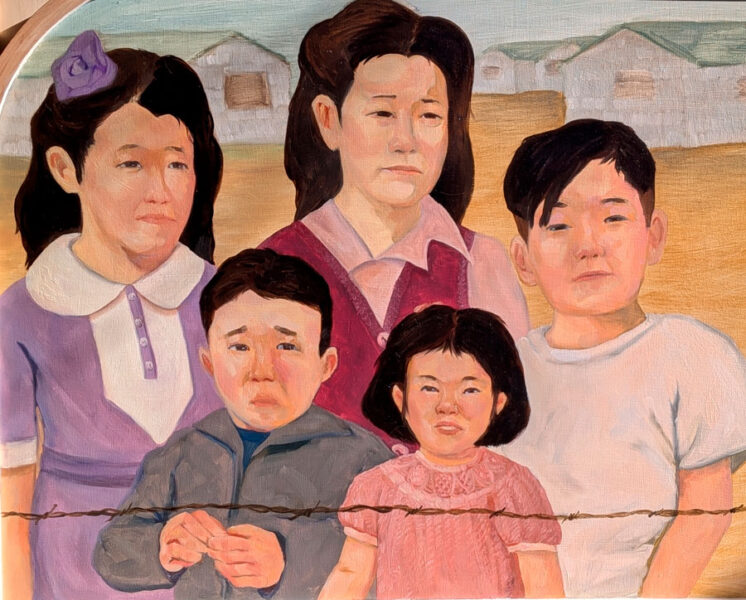
Family standing behind barbed wire in an incarceration camp, 1942-1945. Oil on wood panel by artist Miya Sukune, 2026. Part of MOHAI’s “Tadaima” exhibition. Photo credit: Eugene Tagawa.
Sukune also included Wing Luke Museum’s handmade dolls and the community’s handmade flowers by having workshops at Mukai Farm & Garden on Vashon Island, the INScape building (former Immigration and Naturalization Service building) in Seattle, and Nikkei Manor in the Chinatown-International District. She wanted to bring people together and connect them to JA history and World War II incarceration. Sukune was influenced by her own experience of Hinamatsuri Day growing up in Japan. Her mother and grandmother would make handmade decorations for the community festival. Her mother’s hometown was known for elaborate displays created by many in the community. The “idea of many hands contributing to a shared celebration became an important throughline for me in this project,” said Sukune. The overall flower display references the Seattle Nihonmachi windows where many JA families lived and worked. It is about everyday life and the history before the camps.
It is poignant that Sukune acknowledges the history of Japanese immigrants and JAs forced into incarceration camps when it was not taught in her school growing up. She did not learn about it until she was an adult. However, she discovered the dichotomy of the dolls representing family life—the symbols of celebration such as hinamatsuri dolls and separation during the incarceration. Sukune found a photograph of a baby sitting in front of her hinamatsuri dolls and another photograph of the same family standing in front of their vandalized garage after the war. It is “the hope and tenderness of a cherished family moment, and the trauma reflected in the aftermath” of the war.
Sukune continued the same theme with her Nikkei memorial sculpture called, “Remember (Day of Exile 1942).” It was unveiled in Ober Park during the annual “Day of Exile” on Vashon Island in May. The program began in front of the Vashon Island Park District office building with Friends of Mukai Farm & Garden Executive Director Jade Agua welcoming approximately 100 guests. She thanked descendants, partners, and volunteers who helped with the project. Former Mukai Board of Directors President Rita Brogan said they wanted to commemorate the site so the injustice would not occur again. Then Abbot Koshin Christopher Cain from the Puget Sound Zen Center on Vashon Island, blessed the ceremony with, “Let us remember today the suffering of the islanders who were taken from their homes because of their ethnicity. May the remembrance of that suffering guide us toward wise choices and compassionate action in our daily lives and in our civic lives; and may this sculpture standing here in front of us carry that remembrance forward to those who come after.”
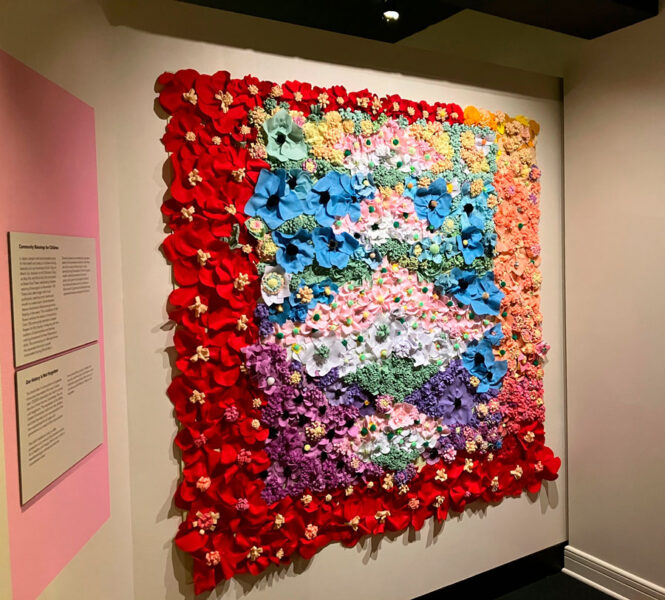
Individual, handmade flowers made by the Japanese American (JA) community. It forms a Seattle Nihonmachi window where many JA families lived and worked before the incarceration. Photo credit: Eugene Tagawa.
Sukune started with a 1942 photograph of the Sakai family for inspiration. It was taken on the same day that they were forcibly removed from the island due to the incarceration. Sukune says, “This deeply vulnerable image made it possible to create a memorial grounded in personal history and lived experience.”
In a different kind of medium, Sukune created a five-foot tall, circular sculpture that is red with metal cutouts of family scenes from the incarceration. Sukune drew the design and with the help of other professionals, she was able to have it cut, painted, and mounted. In the center is a depiction of Sumi Sakai packing a suitcase with her younger brother having a look of uncertainty. Viewing the artwork clockwise, next is a representation of the 111 Vashon and Maury Island residents walking toward Ober Park. They depart on U.S. Army trucks then a ferry to incarceration camps. Next is a watchtower representing the camps and being watched “ … but also the consequences of fear, racism and the failure to protect civil liberties,” said Sukune. Lastly, is a representation of the women and men who left camp to serve in the military. Mary Matsuda left camp early and joined the U.S. Cadet Nurse Corps. Her brother Yoneichi Matsuda enlisted in the U.S. Army 442nd Regimental Combat Team. It was a segregated JA unit and became the most decorated in history. “Their stories reflect extraordinary resilience during a time of profound injustice,” says Sukune. As the war ended, only 12 families returned to Vashon Island.
The overall artwork is circular due to the story not having an ending. It is meant to be a place of remembrance, conversation, and for future generations. Sukune wants the artwork to remind viewers that the historic event also happened in their own local community. It is a remembrance of the injustice and perseverance of the Japanese immigrants and JA people during that time.
King County Councilmember Teresa Mosqueda said remembering is a choice and responsibility. We need to stand up and take action for the injustice from the past and today. She gave an example of the Mukai family. They were immigrants who came to Vashon Island and farmed strawberries, built a barreling plant, and helped build an agricultural community despite discriminatory laws barring Japanese immigrants from owning land.
At the end of the program, incarcerated survivor John Okimoto read each family name that was exiled. Abbot Cain struck a Bonshõ (large,bronze, hanging bell usually found in Buddhist temples throughout Japan) once with a wooden mallet between each name.
Last year Sukune created the “Matsuda Family” series, also cut metal designs which were on display near the program site. It consists of several metal, rectangular panels about three feet tall with cutouts of various Japanese immigrants and JA life from before and during World War II. Also, on display were six-foot panels about the history of the Japanese immigrants and JAs from 1900 through 1942 on Vashon Island. Attendees varied from descendants to friends to residents. Mark Hoshi, who is deaf, attended the program with his interpreter Suzanne Greenberg. He said his former family farm was located northeast of the island.
Miya Sukune lives on Vashon Island. However, she has been busy with numerous exhibitions, artist-in-residencies, public art, honors, grants, and publications across the U.S., Japan, and Finland. When asked how she got into the arts, Sukune mentioned she enjoyed watching PBS (Public Broadcasting Service) stations with cultural programs, “documentaries about museums, travel, theater, and performances as well as British dramas and comedies.” It gave her a window into a broader creative world. When asked what is next for her, she wants to first rest from these two projects while working as a research aide on the Acetate Project which is preserving and digitizing 1930s-1950s acetate recordings of the JA community. For her own projects, she is researching ideas such as burial rites, craftwork, and her family’s history in the food industry.
For more information about Miya Sukune, see: www.miyasukune.com.
Museum of History and Industry
“Tadaima: I’m Home” exhibit extended through July 12.
860 Terry Avenue North Seattle
Website: https://mohai.org
Hours: daily 10 a.m. – 5 p.m.
Telephone: 206-324-1126. Email: information@mohai.org
Ober Park
17130 Vashon Highway Southwest Vashon
Website: https://vashonparks.org/ober-park
Telephone: 206-463-9602