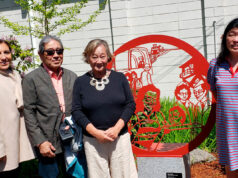
A Lively Speaker at JET Reception
By Barbara Mizoguchi
NAP Editor-in-Chief
In February, Consul General of Japan in Seattle Makoto Iyori and his wife Yuko hosted a reception at their official residence welcoming home participants of the Japan Exchange and Teaching Program (JET). The guest speaker was Zack Davisson. He wore a blazer with goggles on top of his head while guests were wearing suits, ties, and dresses. His talk was direct, blunt, and honest. Mrs. Iyori mentioned that I must meet him since he is an interesting person. After asking about his goggles, Davisson said it is his schtick or gimmick for the audience to remember the speaker and what was said. He turned out to be quite funny and intelligent.
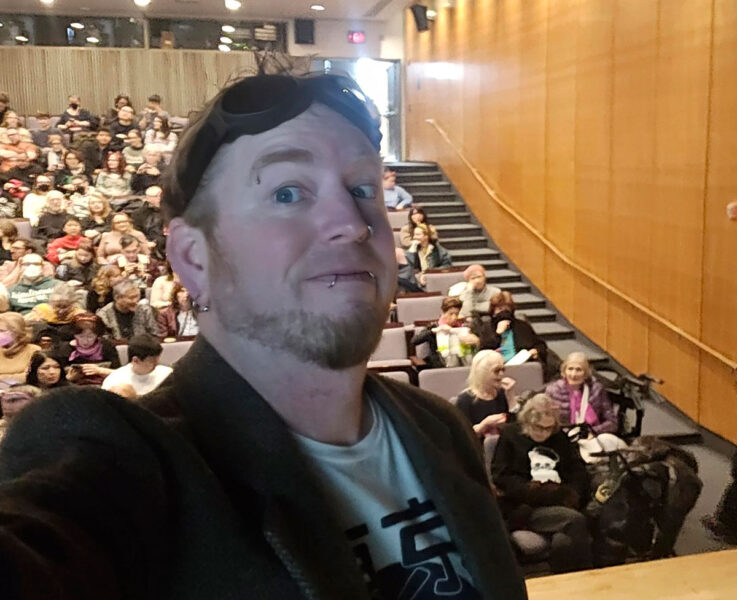
Zack Davisson at Japan Society of New York, Japan Cat Day Event, 2025. Photo credit: Zack Davisson.
Born in California, Davisson grew up in Spokane, Washington and graduated from Cornish College of the Arts in Seattle. He earned his master’s degree in Japanese Studies, became a JET participant then alumnus, and began writing for Japanese magazines. Davisson then translated a manga series and lectured on manga, folklore, and translation at universities and in Italy. In addition, Davisson has published translated works and books.
As Davisson was later interviewed, his answers revealed his natural personality – raw, honest, and humorous.
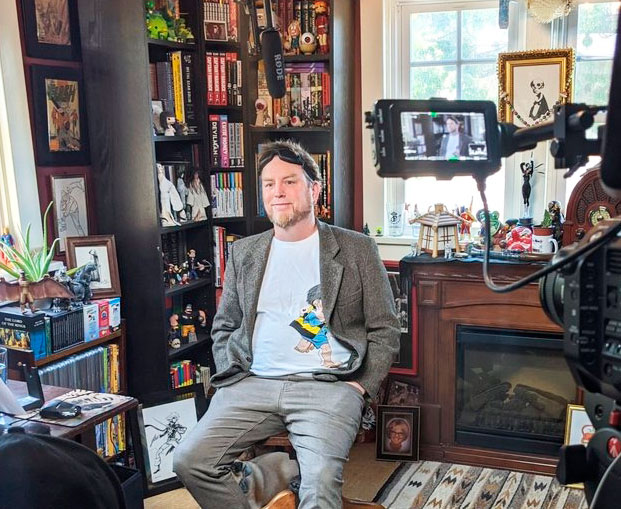
Davisson being filmed in his Seattle home for the documentary of Yokai Monsters Blu-Ray, 2021. Photo courtesy: Zack Davisson
What is your undergraduate degree? Did you receive it at Cornish?
I moved to Seattle from Spokane to go to school at Cornish. All my life I had dreamed of being an artist and drew all the time. It was Cornish or nothing for me. Fortunately, they accepted me and I loved going to school there–an amazing faculty, incredible students. Unfortunately … it was at Cornish I was forced to realize that I didn’t have what it takes to be an artist. I was good … very good, even … but the art world has no room for very good. Not when exceptional is an option.
There was a teacher at Cornish, Kimbal MacKay, who taught the elective writing courses. He was my John Keating (Dead Poet’s Society movie reference for the youth. Go watch it). It was in his courses I realized that while I was not a great artist, I was a d— good writer. It was under his guidance that I began pursuing where my talent lead me–to writing.
A very long answer to your question. I received a BA (bachelors) in Fine Arts at Cornish.
The University of Sheffield is located in England. Did you study in England or was there a satellite program in Hiroshima?
I was fortunate at the time that the University of Sheffield ran a satellite program in Hiroshima in partnership with the David English House. I can’t remember exactly how I discovered it probably a pamphlet at a JET event.
When I moved to Japan on the JET program, I made a promise to myself I would learn the language. I knew this was the greatest chance I would ever have, and if I didn’t come home bilingual, I would have no one but myself to blame. I did the CLAIR (Council of Local Authorities for International Relations) programs offered free to JETs up to Advanced Japanese. But I found them unsatisfying. I had a piece of paper saying I knew Japanese, but I knew that I didn’t.
I enrolled in the University of Sheffield program in Japanese to learn more. It was a distance learning program which in the age of instantaneous internet is almost comedic to talk about now. They would literally mail me giant binders of study material and homework which I would then finish and mail back to them. Exams were done over the phone. Then in summers, we would go to Hiroshima for intensive lessons and exams. I loved it, loved the teachers, loved the feeling that I was finally, truly learning Japanese. And when I finished their language program I applied to their MA (masters) program, and was accepted. I did my focus on Japanese religious studies, writing my thesis on yurei, Japanese ghosts. That became my first book and the turning point of my life.
I am constantly amused that I am now on the faculty at NYU (New York University), also through distance learning. I graduated from a school I have never been to and now teach at a school I have never been to.
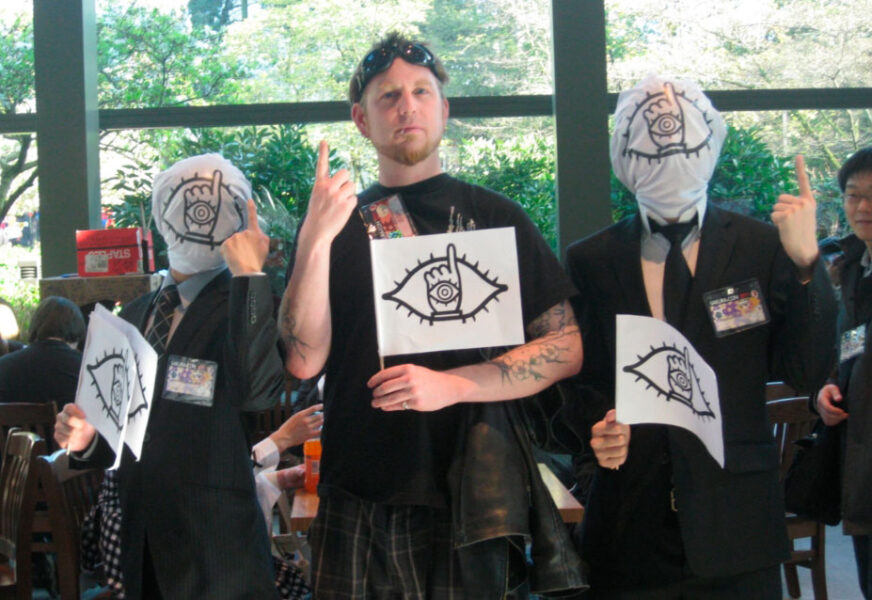
Davisson at the 2017 Sakura Con in Seattle. Unknown cosplayers from the comic 21st Century Boys. Photo courtesy: Zack Davisson.
What interested you about Japan, the language, etc.?
My interest really began through a somewhat odd origin story. When I was eight, my mother convinced me to go to a local arts theater and see a showing of Akira Kurosawa’s Seven Samurai. Because what every eight-year-old boy wants to see is a three and a half hour, black and white, foreign language film, right? But once in the darkened theater, I was enthralled. As a small town kid, it was the most immersive experience I ever had in a foreign language. I remember being fascinated. I wanted to know what it was like in their heads. Did those sounds make sense? Did they think in that language?
From there, it was really a lifelong fascination. I tried taking Japanese classes in high school and community college, but never really achieved much. With no opportunity to practice, the best I managed was a few memorized phrases. I gave up.
How did you get involved with JET? Are you still active with the organization?
I remember the moment vividly. I was in my early 30s working at Amazon as a project manager, and I sat at my desk one day, dissatisfied. I hated the job. Didn’t care about the work I was doing. As I sat at my computer, I thought, “Is this all I get? Is this the life I have to lead?”
I had previously lived in Glasgow, Ireland on the BUNAC (British Universities North America Club) program. I wondered if there was anything similar in another country. I went searching and found the JET program. It reawakened my old interest in Japan and the Japanese language. I applied, got accepted, and that was it. I quit my job, threw away everything I knew, and got on a plane to a country I had never been to. No single moment has changed my life more than that.
I am not openly active in JET but always answer the call when they need me. I went to the 30th and 35th anniversary events as a speaker. I think—as one of the JET program’s “great successes”—I am a bit of good advertising. But it is a role I happily accept and will preach how amazing JET is and encourage everyone to apply. When I give talks at universities and conventions, I often hear people say I was lucky to go to Japan. I tell them all that luck had nothing to do with it—it was the JET program.
Where did you live in Japan (during JET)? What was your experience?
I lived in Nara for three years then Osaka for two. I was a rare multi-prefecture JET. At the time, JETs could only stay for three years but they offered a special two-year role which you could apply for teaching exclusively at elementary and pre-schools. There was only one slot per prefecture, and the role had a language requirement and a separate application process. My friend Lucas Clarkson and I both applied for the Nara role. Lucas was hired. I was not. BUT… Osaka prefecture had no qualified applicants, so they asked their Kansai (region) neighbors for recommendations. From there… I was sent to Ikeda, Osaka. As for what it was like… God… how can I possibly encapsulate something that so completely changed my life and who I am?
I usually describe JET as an opportunity. JET opens a door for you. What you do with that open door is entirely up to you. There are those —most, in fact — for whom JET is not life changing. It is just a thing they did once when they were young, a year lived in Japan and becomes a fond (or hated) memory. There are those I call “Goldfish JETs,” who basically go to Japan like fish in a bowl, carrying their own country and culture with them at all times. They never truly engage. They stay in tourist mode for their entire stay. This is the easiest path. JET is designed for this, to bring people to Japan, show them a good time, then send them home to become living tourist advertisements.
And the rare ones, like me, decide to make going to Japan their entire lives. We smash the fishbowl and dive in as deep as we can. I threw myself into everything. I developed a love for matsuri, Shinto (religious) festivals celebrating invisible deities and odd gods. Many of these matsuri were physical crucibles. I’ve been burned black carrying massive torches that rained fire on me. I heaved mikoshi on my back that weighed as much as a small car. I fought naked in a field of ten thousand men to wrench out sacred sticks that I still have sitting on a shelf, stained with my blood. I found the love of my life, got married, and am still married twenty years later.
So yeah… JET… not easy to give a soundbite for.
How did you meet Consul General Iyori of Japan in Seattle?
I’ve met several Consul Generals over the years, although Iyori-san and his wife are the ones I know the best. I believe Iyori-san was given a list of “people he should know that have strong Japan connections in Seattle” or something similar when he first took the role. Whatever the reason, I was invited to dinner at the consulate along with my friend Jay Rubin and some others. We had a delightful time.
How did you become a speaker at the Con. Gen.’s JET reception?
The Consulate had reached out to me previously about speaking at a JET event but I was unavailable. So, when they reached out to me again, I was thrilled. I am always happy to give back to JET.
Tell us about your speech – the practical realities of becoming a JET alum, etc.
I thought a lot about how it felt to come home from Japan after all those years and how I felt like a foreigner in my own country. I tried to think about what advice I could give and to let them (JET alumni) know others had gone through the same thing and came out fine. You often came home to a different country than the one you left. And these JETs were coming back in a time of particular turmoil.
I also like to set realistic expectations. To me, as an educator, this is important. I am not going to b——- you about options. I remember going back to Japan thinking I had all these valuable skills, these language abilities … but all employers saw was a decade gap on my resume. It was hard. But I eventually found my niche. It took time. It took persistence. But I found it.
I wanted to say what I wish someone had said to me — no one likes an insufferable jerk who leads every conversation with “In Japan, they …” Seriously, that was me. My American friends would meet for pizza and I would start in with “In Japan, they put corn and mayonnaise on their pizza!” No one cares. Absolutely no one. Don’t be that guy.
But mostly, I thought about how much JET had changed me and that I hoped the participants had allowed it to change them, too. What a shame it would be to go through such an amazing experience and come home exactly the same person.
How did you become a translator, writer, and editor? What does it take to become one?
Just like how I was determined to learn Japanese during my time in Japan, I was determined to become a writer. I started writing for local newsletters. Then (I) applied to and was accepted to writing for pay for Japan-based magazines like Japanzine and Kansai Time-Out. I took random jobs, writing tourist pamphlets for the Osaka government. I found everything around me entirely fascinating and tried to share that fascination. I wrote about travel, food, local religion, and folklore. My biggest accomplishment was writing perhaps the first English-language article on Aokigahara, the famed Suicide Woods of Mt. Fuji (Japanese mythology of yurei – ghosts of the dead located on the northwestern flank of the Mount Fuji on the island of Honshu.) I had been teaching English as a side gig at a local forestry institute in Nara where I heard stories of Aokigahara. Then I wrote about it for Japanzine.
Being a translator was more complicated. I never really wanted to be a translator per se, so much as I wanted to translate someone specific. In Japan, I had fallen in love with the genius manga artist Mizuki Shigeru. I was astounded that someone so important to Japanese and world culture was virtually unknown in the West. One night, I got drunk at a friend’s bar in Osaka, climbed on a table, and vowed I would be the one to bring Mizuki Shigeru to the West! It took me a long time to keep that promise– a lot of blind emails, a lot of building networks and reputation. But finally, my chance came and my first professional translation was Mizuki Shigeru’s SHOWA: A HISTORY OF JAPAN in 2011.
What does it take? Willpower. Determination. Persistence. Not a single door will be opened for you. You have to bash in every single door or find a way around it. The entire world will tell you to give up and you have to decide not to.
How did you get the various jobs/contracts that you had? What are you currently doing?
The most difficult job you will ever get is your first one. No one wants to take the chance on unproven talent, especially when there is an excess of experienced, qualified folks easily available. For me, it was a slow build. I wrote articles on comics for comic news publications. I did panels on manga and local conventions. I created a blog where I translated Edo period literature. I made contacts with editors and industry folks. And eventually, one of those editors gave me a shot. The key is, when you get that shot, you have to knock it out of the park. There is no room for mediocre. You have to prove they made the right decision, giving you a chance. And once you have that first success on your resume, you can move on to the next one. Eventually, you build a body of work and reputation that you don’t have to reach out to publishers, they reach out to you. It takes years and years. This kind of thing is a marathon, not a sprint.
Currently, I just got off a two-year run on the X-Men for Marvel Comics. I’ve contracted on a new folklore book on kitsune, Japanese supernatural foxes. That means I am throttling down on translation work for only my main clients to free up writing time.
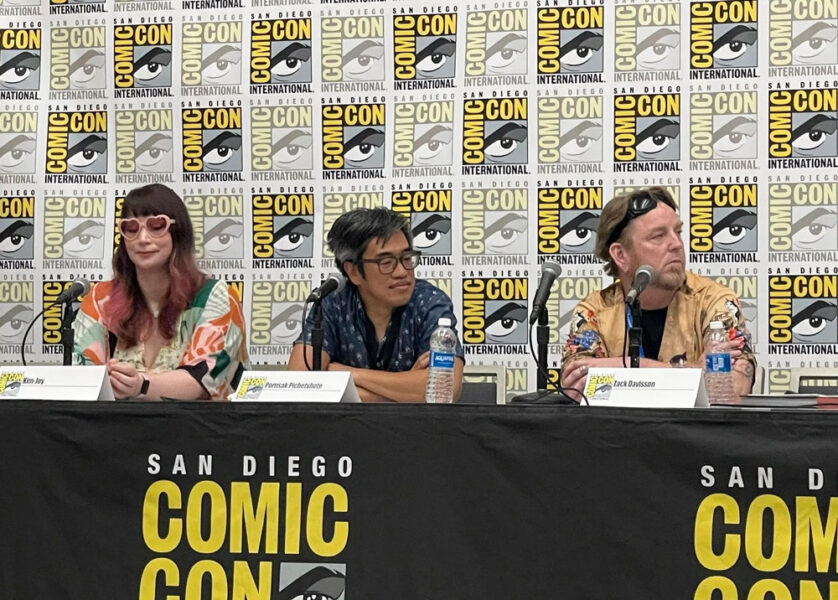
Cats & Comics panel at the 2024 San Diego Comic Con. Left to right: Kim Joy, Pornsak Pichetshote, and Zack Davisson. Photo courtesy: Zack Davisson.
How did you get into cartoon/manga work?
Pop culture and folklore really parallelled my career. I published my first book, YUREI: THE JAPANESE GHOST at the same time I did my first manga translation of SHOWA: A HISTORY OF JAPAN. They, fortunately, balance each other out. People interested in manga are often interested in learning more about Japan including the country’s folklore.
Most people know me for either one or the other. To me, they are equally important. I will do both for as long as I can.
One of your books is on cats. Is it based on your cat Mochi?
Mochi is our dog! Our cat is Shere Khan. And no, nothing so specific. It actually started because I was working on a comic called WAYWARD, doing back-up articles on Japanese culture. One of the characters was a Neko Musume, as sort of transforming cat. I started researching Japan’s catlore and fell in deep. After months of researching and writing on Japan’s catlore, my publisher told me I had written my next book without even knowing it. That became KAIBYO: THE SUPERNATURAL CATS OF JAPAN which remains the most popular thing I have ever written. A book about magic Japanese cats. Go figure.
What would you say to future JET participants? What would you like to see in participants when they return?
I would say what I said before—JET is an opportunity. What you do with that opportunity is entirely up to you. It can change your life or just be a nice, strange memory of an adventure you had once when you were young. I encourage people to make the most of it. As a Regional Advisor on JET, I saw multitudes of JETs come and go. The ones that brought their own cultural baggage with them were the ones who had the most difficult time.
In JET, you have the chance to learn that “this is different” and “this is wrong” are not the same thing. Living in a foreign country is challenging. There are differences of morals and manners, and often things you were taught was “right” in Japan is considered “wrong” (elsewhere). And vice-versa. But if you can get over that, and allow yourself to learn something new, it is an incredible experience. When you come home, well… cling to what you learned. Stay active. Stay interested. Society will try to blunt you, to shape you back into the nice little cog it needs to run the machine. But you don’t have to do that. You can be interesting. You can be different. Let the experience change you — if it is worth it.
Anything else you would like to share?
Nothing. Clearly, I am not much of a talker.
To learn more about Davisson, see: www.zackdavisson.com.