
Janice Eng and Akiko Sakai-Kinney
NAP Contributors
In these times of uncertainty and rapid change, it is more important than ever that the voices, experiences, and wisdom of Asian Americans are recognized and valued. Yet many of us may not fully realize how deeply our voices have been shaped — or silenced — by social conditioning and historical marginalization. This silencing can influence how we see ourselves, how we are seen by others or what we believe is possible, and whether we can recognize opportunities when they arise.
Asian American history includes enduring much discrimination and exclusion — from immigration restrictions and wartime incarceration, to property and labor exploitation and denial of full citizenship rights. Even today, Asian Americans are often perceived as “perpetual foreigners” regardless of how many generations one’s family has lived in the United States or the extent of their loyalty, contributions and service. At the same time, the many distinct cultures and identities that comprise Asian Americans, are reduced to a single narrative.
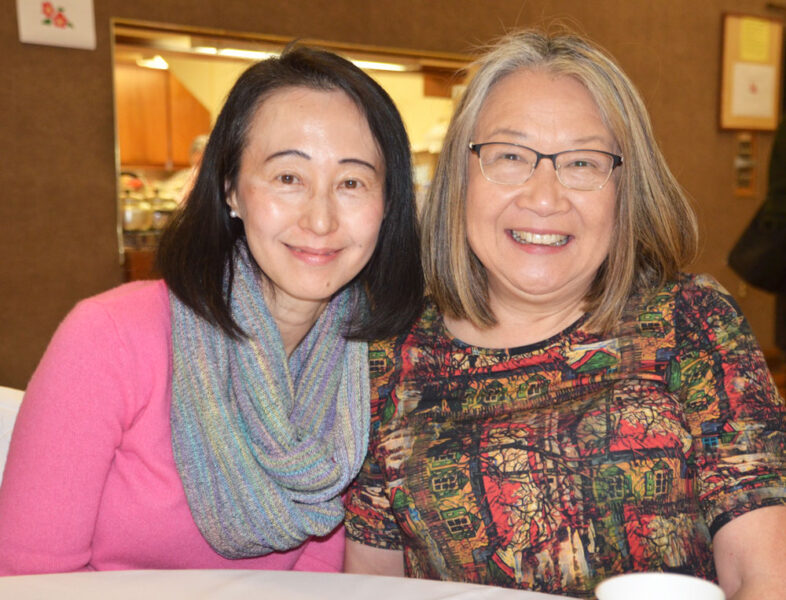
Left-right: Akiko Sakai-Kinney and Janice Eng, 2026. Photo credit: David Yamaguchi.
The “model minority” stereotype further complicates this experience. While it portrays Asian Americans as hardworking and successful, it can also create division with other communities of color. It reinforces the idea that Asian Americans do not face significant barriers while many cultures do. At the same time, it imposes limiting expectations — valuing diligence and compliance while overlooking leadership, creativity, and voice. In professional and academic settings, many encounter the “bamboo ceiling” where their contributions are not acknowledged and their leadership potential is under-estimated.
Cultural conditioning can also create internal challenges. Many Asian cultures emphasize collectivism, family and societal responsibility, and harmony. White American society often prioritizes individualism and self-assertion. Navigating these differing values can lead to self-doubt, over thinking, and uncertainty about how to act “correctly.” This tension can subtly undermine a sense of personal clarity and confidence.
Historically, adapting to these cultural and social dynamics has been essential for survival. However, an important question emerges: how do we show up for ourselves and move beyond adaptation into greater authenticity? How can we honor our cultural roots while also listening to our own inner voice? And how can we make choices aligned with our values without being held back by fear?
We believe the process begins with an internal shift — recognizing that we have choice and that we carry the resilience and capacity to act on what is true for us.
Janice Eng and Akiko Sakai-Kinney are mental health professionals and communication coaches dedicated to supporting this process. With many years of experience, they help individuals reconnect with their voice, values, and inner wisdom. Their work focuses on providing practical tools to move beyond internal and external barriers, allowing for fuller self-expression and more meaningful connection.
To address this topic, two introductory workshops will explore Asian American conditioning and what has shaped its beliefs and expectations. Tools will be learned to re-connect with and to, trust our own voice, and to gain clarity in making decisions that are right for us.
The workshops will be presented at the Japanese Baptist Church, 160 Broadway, Seattle on:
Sunday, May 17; 1:00-2:30 p.m.
Personal Authority for anyone who identifies as Asian American.
$30 – Register at: https://forms.gle/FaTep21gdZWK2Q8J7.
Sunday, July 19; 1:00-2:30 p.m.
Personal Authority for anyone who identifies as Asian female.
$30 – Register at: https://forms.gle/WKJjC8T7tyhSvtxc6.
For more information, call or text: 206-706-1895 or e-mail: janice.eng2@gmail.com.
Janice Eng, a second-generation Chinese American, became a counselor through her own journey of overcoming self-doubt. She is trained in multiple healing modalities to support individuals in embodying their authentic selves. She also taught Nonviolent Communication for over 20 years including a decade of work within the Washington State prisons.
Akiko Sakai-Kinney came to the United States alone at the age of 16 and became a U.S. citizen in 2012. After earning a Master’s degree in piano performance, she began to question the concept of “performance” itself, seeking a more genuine way of living. This led her to become a Jungian psychotherapist. She has also taught Nonviolent Communication in the Washington State prisons supporting others in finding their voice and courage.