
From Issei Hands to Yonsei Hearts:
The Living Legacy of Sumida Farm, Vol.1
By Jessica Yamamoto
NAP Contributor
This is a continuation from the August 28, 2026 NAP issue.
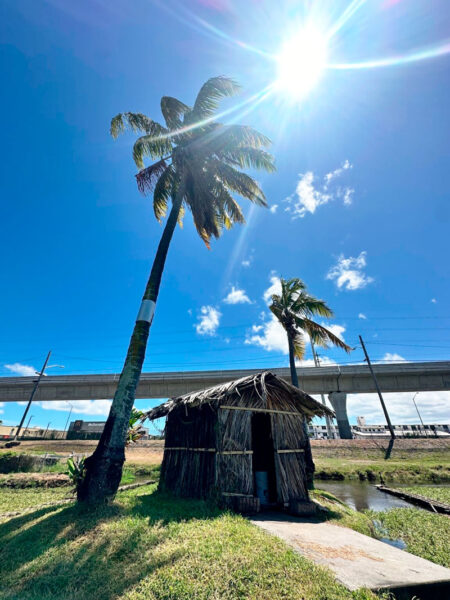
The iconic Sumida Farm grass shack that can be seen when driving down Kamehameha Highway in Aiea, Hawai’i. Photo credit: Jessica Yamamoto.
Sansei: Reestablishing Community Connection
Masaru and Norma had four children: Charlotte, Stephen, David, and Barbara. As the eldest son, Stephen once thought he would take over the family farm but his career in education took him in a different direction. The youngest two, David and Barbara, stepped up to manage and operate the farm as its third generation of caretakers in the early 1980s.
Trained by her mother, Barbara became the farm’s president and general manager while David served as operations manager. David discovered a passion for welcoming Hawai‘i’s students to the farm. Emi Suzuki shares, “Uncle Dave loved doing school field trips and tours. He realized and truly believed that the keiki (children) of Hawai‘i are the future and pivoted the farm to focus on educating them about the land through school tours.”
Yonsei: Carrying the Farm’s Legacy Forward
Born and raised in Pullman, Washington, Emi is the daughter of Stephen Sumida and Gail Nomura. Though raised outside of Hawai‘i, she spent much of her life traveling back and forth to visit during school breaks.
In 2018, Emi and her husband, Kyle Suzuki, officially stepped forward to become the fourth generation of caretakers of the farm. Emi recalls having a “lightbulb” moment while reading an airline magazine article about Hawai‘i farms. She realized that she and Kyle did not need to start a new business from scratch — the Sumida family’s multi-generational farm already reflected the values they cherished. They wanted to build a life and business grounded in kindness, integrity, and care for the ‘āina (love of the land) and community.
The values instilled in Emi by her father are ones she hopes to pass on to her own children. In a blog post about her father, she wrote: “As I grew older, and especially once I decided to take over management of Sumida Farm, the stories evolved into more serious history lessons and conversations. He wanted to ensure I understood the deep and long history of not just our farm but of the ‘āina. He was the first to tell me, ‘Our family’s farm story is just a blip in the long history of the ‘āina, we must respect that history.’ Kyle and I have truly come to understand this sentiment, and it has become central to how we educate partners, customers, and students who visit Sumida Farm.”
By 2020, Emi and Kyle were learning all they could from Barbara and David to prepare for the transition. But when Barbara suddenly became ill and passed away in February 2020 — just as the COVID-19 pandemic began — the couple’s nine-year transition plan quickly became a two-year one.
Reflecting on the experience, Emi describes it as “unexpected.” She shares, “There are days when it’s challenging and hard, but I wouldn’t change it. I never thought I would be in this position … I’m really fortunate that not only do I love it but I also have Kyle — my husband, business partner, and coworker.”
The pandemic, she says, was a blessing in disguise. It gave their family time to work side by side on the farm while their children — Clare, Alice, and Margaret — attended school virtually from Hawai‘i (to Seattle). “This is one of the most fulfilling things I’ve ever done,” Emi reflects. “Nothing I do for corporate America will ever touch the impact we get to make through carrying on the legacy of the farm.”
Since stepping into their new roles, Emi says, “The farm embodies so many things we care about — the environment, the people, food, nourishment, education, art. There are not many jobs in this world that align so completely with your values. I love that we get to carry that on.”
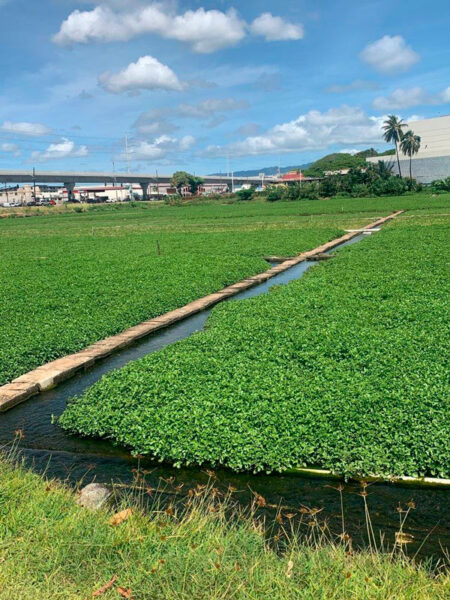
Narrow pathways between the plots allow workers to move wheelbarrows full of watercress with ease. Built by Nisei family Masaru and Norma Sumida, 1950s. Photo credit: Jessica Yamamoto.
Looking Ahead to the Next 100 Years
Reflecting on almost 100 years of history, Emi is in awe. She explains that “thinking about the sacrifices made by previous generations, it’s inspiring to see … our family was not rich — they were hardworking, working-class people who ensured that they made the right decision so that their children could build their own lives here. I think about that and the privilege we have now as Yonsei (fourth generation Japanese American). All that we have is built on the sacrifices of the previous generations and I also think about the future generations …That was really what inspired Kyle and me to step up — if no one steps up to face the challenge today then no one else will.”
She explains that “the farm is this dream that Kyle and I are chasing. My kids are just along for the ride … I hope that in the long run, they realize how unique and special this upbringing is and that they look back fondly on it.” Emi smiles as she recounts what it’s been like watching her girls experience life on the farm.
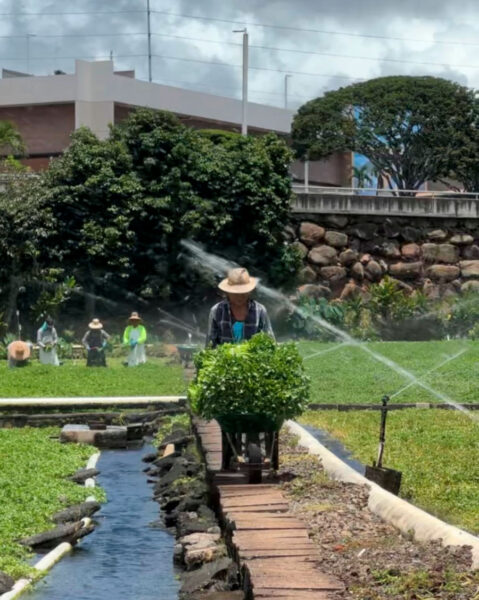
Load of watercress in a wheelbarrow being rolled down the narrow pathway along the spring water on the Sumida Farm in Aiea, Hawai’i. Photo credit: Jessica Yamamoto.
“The coolest part is when they get to share the farm with their friends — and I think they see it [the farm] with new eyes.” Emi says she thinks about the future generations and hopes that they “see as much of the beauty and unique opportunity that is here at the farm and how special it is so that they carry it on.”
The family is looking forward to celebrating the farm’s centennial anniversary in 2028. Reflecting on almost 100 years of history, legacy, and stories, Emi beams that her family is excited to continue sharing the farm with the community. “That’s the cool thing about the farm — it’s so much bigger than just my family and even the community we’re aware of … it humbles you really quickly — sometimes I’m not even aware of how much this farm means to other people!”
As for the future of the farm, the family hopes to continue sharing and honoring the farm’s stories and its legacy but with a 21st century twist. “Through social media and through all the awesome collabs with other local businesses, we’re able to expand our community outside of school tours through social media platforms.”
“Our mission is to nourish the islands … we purposefully don’t include watercress or farming in that statement because where we’re going in the world — there’s a lot outside of our control. And without that true control over the future, we have to be realistic and know that there might be a day where the springs dry up or the sun is too hot or there might be a day where our farm is covered in salt water. Because of that, our goal is to nourish the islands and there are a lot of ways we can do that especially by sharing the farm’s story. Whether that’s through education, a storefront, there are a lot of ways that we can continue what we’re doing but in a little bit of a different way. I hope that, at least through my generation, we can continue farming and build on that.”
When Emi and Kyle first began dreaming about what they envisioned managing the farm and what they wanted their legacy to look like, the couple says they had a list of dreams and goals for collaborations, partnerships, and people they wanted to meet and share the farm with. “We feel we are lucky to be able to say we’ve been able to tick off a lot of what we set out to do.”
Take a gander at Sumida Farm’s Instagram (@sumidafarm) and you will see that they have over 21,000 followers — an impressive count considering they only started posting four years ago. The farm’s virtual feed is full of colorful images and videos ranging from shared stories to recipes that they feel are important to their family and community. A fan-favorite are recipes shared by Chef Elijah, the farm’s operations assistant. In addition, the farm’s feed features personal stories and photographs from the Sumida family, and recollections and connections to famous chefs of Hawai’i such as Colin Hazama, Jeremy Shigekane, and Mark Noguchi, all of whom share their own personal favorite watercress recipes and stories of the importance the farm played in their lives. Through the years, the farm has been able to partner with local businesses like Beer Lab, Zippy’s, Nature Waikiki, Feast, Kaimuki Shokudo, and Pig and the Lady to create unique island-inspired dishes, beers, and even ice cream!
“The biggest honor and most amazing part about what I get to do is, I get to work with some of the hardest-working people in the world, the best crew and the best employees you could ever ask for. In addition to the people we work with, the people we’ve met have been amazing!”
With so much admiration and respect for their team and community, Emi says that “none of this is possible without support from the community and people who care about the farm. They don’t have to care about me or my family, just the farm because without their support we cannot continue. And that’s true not just for our small business or farm but for all small businesses and farms. The support of the community and the collective desire that we can all continue on is so important. I hope that we can continue that and keep going.”
“Eat Plenty Watercress.” Check out the farm’s Instagram and website — a treasure trove of knowledge from personal notes to ‘ono family recipes. Sumida Farm shares recipes and stories about the farm’s 100-year history at: sumidafarm.com or @sumidafarm on Instagram.
Emi and Kyle Suzuki live in Seattle, Washington and are members of Blaine Memorial United Methodist Church. Emi’s parents, Stephen Sumida and Gail Nomura, are Professors Emeritus at the University of Washington. Stephen was also awarded the Foreign Minister’s Commendation by the Japanese government for his decades of dedication to promoting academic exchange between the U.S. and Japan.