
From Issei Hands to Yonsei Hearts:
The Living Legacy of Sumida Farm, Vol.1
By Jessica Yamamoto
NAP Contributor
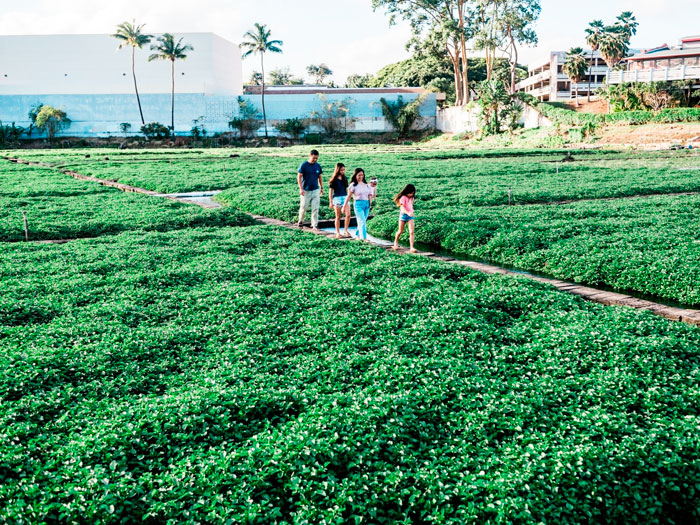
Family walking through the Sumida Farm in Aiea, Hawaii. Photo credit: Jessica Yamamoto.
In an island landscape transformed by urban growth, one family farm has remained a steadfast reminder of Hawaiʻi’s agricultural roots. For nearly 100 years, the Sumidas have cultivated more than watercress—they have nurtured a legacy.
In 1928, Kamehameha Schools Bishop Estate granted Makiyo and Moriichi Sumida a lease for five acres of land on Kalauao Springs. Nearly a century later, the Sumida ʻohana continues to uphold the tradition of growing watercress and the values instilled by their Issei (first-generation American immigrant) ancestors.
Today, Sumida Farm is one of the last watercress farms in Hawaiʻi producing about 70 percent of the state’s recorded crop. The farm sits at 98-160 Kamehameha Highway—a vibrant stretch of green wetland surrounded by Honolulu’s growing urban landscape.
The grass hale (traditional, Hawaiian, architectural building) and tall coconut tree that stand atop a small patch of lawn along the highway have become familiar landmarks for drivers who pass by each day.
Now in its fourth generation of family stewardship, the farm is managed by Emi Suzuki (née Sumida) and her husband, Kyle, who are in their eighth year as caretakers.
“My role is to carry on the legacy built by previous generations to ensure the farm and business can continue—hopefully, for more generations beyond me,” Emi said.
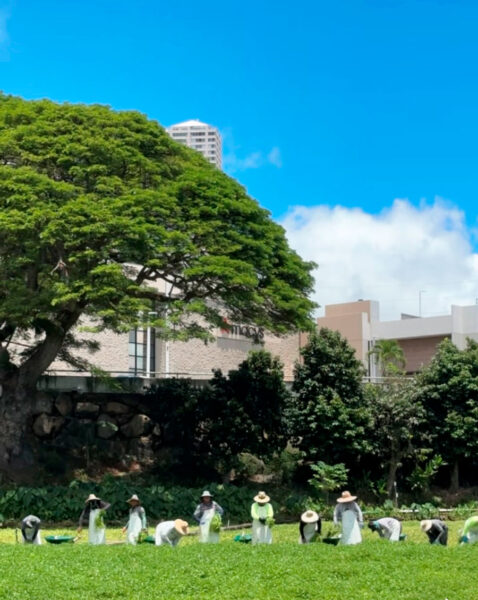
Workers cutting watercress on the Sumida Farm in Aiea, Hawaii. Photo credit: Jessica Yamamoto.
Issei: Establishing the Farm
Makiyo and Moriichi Sumida immigrated to Hawaiʻi from Hiroshima, Japan, in the early 1900s. Before finding their calling as watercress farmers, the Sumida family worked on a dairy farm, in the sugar mills, and on pineapple plantations, like so many immigrants seeking opportunity on the islands. Their path eventually led them to a five-acre parcel of land in ʻAiea, Hawaiʻi—a place that would become both their livelihood and their legacy.
At a time when the sugar and pineapple industries reigned supreme across Hawaiʻi, Makiyo and Moriichi chose a different crop. Watercress can thrive only in pure spring water, and in those days, the tiny, peppery greens were among the few fresh vegetables grown locally. Kalauao Springs proved to be the perfect setting. Located near the shores of Pearl Harbor, the area is nourished by two natural springs of cool, percolating water. In ancient times, these springs sustained loʻi kalo (taro terraces), nurtured rice paddies, and eventually, the delicate greens that would define the Sumida family’s story for generations.
Nisei: Protecting the Farm
In 1952, Masaru and Norma Sumida became the second generation to steward the farm. With a blend of dedication and innovation, they expanded the family’s five-acre operation to ten acres and introduced new agricultural techniques that improved both efficiency and crop health. Pebbles laid in the spring beds helped water from Kalauao Springs flow more evenly through the fields. Narrow pathways between plots allowed workers to move wheelbarrows with ease. Masaru even designed, built, and installed a vacuum cooling machine to extend the watercress’s freshness. A sprinkler system he implemented helped ward off the destructive diamondback moth.
Emi recalls that her grandfather’s greatest achievement and his self-proclaimed ikigai, or life’s mission, was protecting the farm from being erased by development. In a true David-versus-Goliath story that unfolded throughout the 1970s, Masaru Sumida went head-to-head with Pearlridge Shopping Center in a battle over urban expansion. Developers had proposed plugging the Kalauao Springs and paving over the farmland to make way for a parking lot.
For more than a decade, Masaru worked tirelessly alongside local farmers, legislators, and then-Hawai’i Governor John Burns to defend the land and preserve its agricultural use. His perseverance paid off. The Sumida family’s small, watercress-filled fields triumphed against overwhelming odds—a testament to the power of conviction and the enduring value of standing up for what you believe.
(Continues in the next NAP issue.)