
By John Dekhane
NAP Contributor
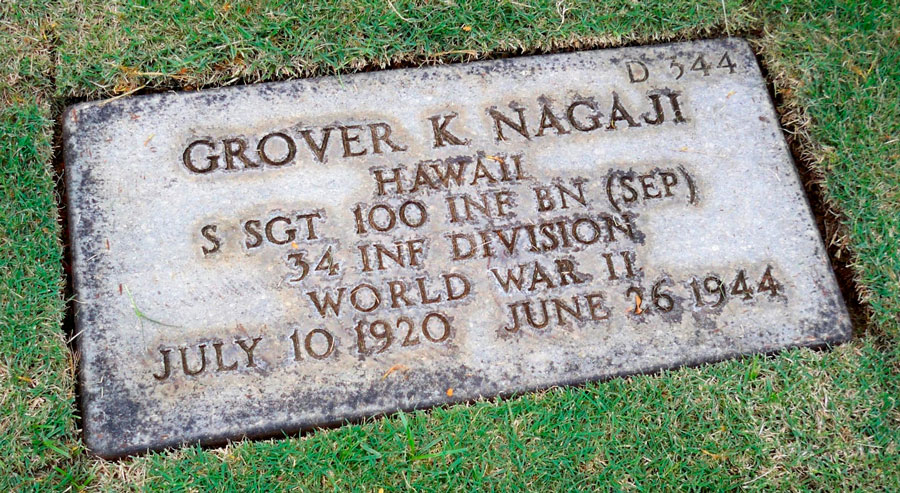
Sgt. Nagaji’s headstone at the National Memorial Cemetery of the Pacific in Honolulu, Hawaiʻi. Photo credit: Jeff Hall.
World War II brought fear, destruction, and unimaginable suffering to millions around the world. Yet in humanity’s darkest hour, an entire generation answered the call to serve. They asked for no recognition or reward yet history will forever remember them as heroes. Among the brave souls who went off to war and made the ultimate sacrifice was U.S. Army Staff Sergeant Grover Kazutomi Nagaji.
Nagaji was born on July 10, 1920, in Waipahu, Hawaiʻi, the son of Kichijiro and Shizuyo Nagaji, both Japanese immigrants who built their lives in the islands. He grew up in a close-knit family alongside his two brothers and sister. Raised with strong values of integrity, responsibility, and perseverance, he would go on to embody these principles throughout his life.
He was educated at Waipahu Elementary before attending McKinley High School where he graduated in 1939. A brilliant student, he then continued his studies at the University of Hawaiʻi. However, as the world moved closer to global conflict, Nagaji chose a different path. He left the university to serve with the Hawaiʻi Territorial Guard and later joined the Varsity Victory Volunteers where he distinguished himself through his skill in carpentry and dedication to service. In a moment meant to be, Nagaji fell in love with Betty Katano of Waipahu. They became engaged and dreamed of a future that the war would ultimately deny them.
Following the lifting of restrictions on Japanese American service in combat units and determined to play his part in the struggle for freedom, Nagaji joined the U.S. Army on March 25, 1943. He became a proud member of the 100th Infantry Battalion (Separate), 34th Infantry Division, and trained at Camp Shelby in Mississippi. His determination carried him through the intensity of his instruction, preparing him for the harsh realities of combat overseas.
In 1944, Nagaji was deployed to Europe, where he saw action in Italy as part of the allied campaign against German forces. Thousands of miles from home, he fought near Suvereto in Tuscany, Italy, and displayed remarkable bravery under fire. Sadly, on June 26, 1944, during an assault on an enemy tank, he was mortally wounded when it exploded. He was only 23 years old.
News of his death brought profound grief to his family and community in Hawaiʻi. His parents, siblings, friends, and fiancée were left devastated by the loss of a young man with so much life still ahead of him. His father, Kichijiro, passed away in 1963, followed by his mother, Shizuyo, in 1965. Both were later laid to rest at Mililani Memorial Park in Waipahu Hawai’i.
Today, Nagaji rests at the National Memorial Cemetery of the Pacific in Honolulu, Hawaiʻi, where he is honored among fellow service members who also gave their lives for a cause greater than themselves. The cemetery stands in quiet stillness, a place of remembrance and reflection.
When service called, Nagaji fulfilled his duty with pride and dignity. Now it is our responsibility to honor and preserve his legacy, ensuring his sacrifice is never forgotten. His story exemplifies those of countless Japanese American heroes who fought for peace and liberty. At a time when their loyalty was questioned, they answered with unwavering courage, proving their devotion through their actions on distant battlefields. Their determination and sacrifice remain forever woven into the proud history of Japanese American military service.
Author John Dekhane is based in France and writes articles dedicated to fallen World War II heroes. “I do this work voluntarily with the sole goal of keeping these often-forgotten stories alive.”