
By Karl Kaoru Matsushita
NAP Contributor
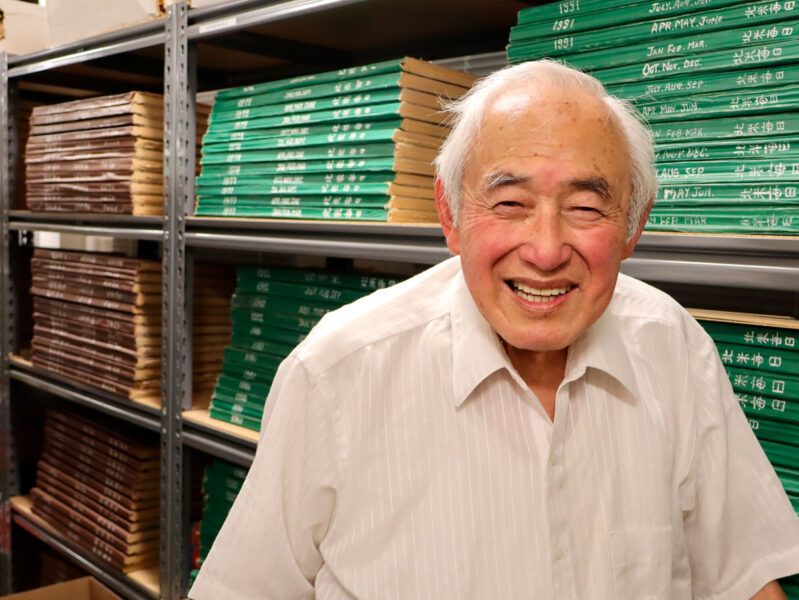
Karl Kaoru Matsushita in front of bound copies of the Hokubei Mainichi. Photo credit: Rita Takahashi.
The following is an excerpt from Karl Kaoru Matsushita’s statement in accepting JARF Housing, Inc. Award presented at Nihonmachi Terrace’s 50th Anniversary Celebration in June:
It is my distinct honor to accept this Pioneer and Preserving Leadership Award from the Japanese American Religious Federation (JARF) Housing, Inc. They have been the Japanese American National Library’s (JANL) foundation for many of its 57 years existence (since 1969).
The idea for establishing this community-based library stemmed from the San Francisco State College (now University) 1968-1969 strike [in California]. I fully supported and participated in the movement that fought for inclusion of relevant ethnic and cultural content in the curricula. The success of this strike made this happen. Once we got what was demanded, we had to get to work to plan and provide what was needed for the newly established Ethnic Studies. A group of us, called the Center for Japanese American Studies, met frequently to address Japanese American books and historical materials needed for courses and historical preservation.
From these early beginnings, I became even more deeply committed to developing a wide base of Japanese American materials. I focused on acquiring as much as possible to enrich what was available to expand knowledge and information about Japanese American history, values, cultures, and experiences. While acquiring and assembling a treasure trove of Japanese American materials, the idea of establishing a library emerged. We needed more resources to develop courses. Other ethnic and cultural groups attempted to do the same but with lack of funding, most stopped operation after a short period.
I held on and further solidified my commitments to build a substantial Japanese American library. With meager resources, the only way to keep the library viable was to use my own money for the most part. I hung on for 57 years because I was bound and determined to make it work to build and maintain the ethnic and cultural institution that will survive the test of time. I kept going despite financial challenges. Once I started something very valuable that preserves Japanese American history, values, and cultures, I would not give up. I could not risk leaving and having such a valuable collection unattended or obliterated.
Initiation and Early Phase
When it started, the community-based ethnic library was called the Japanese American Library but on 28 March 1991, the board [of directors] submitted legal papers to the California secretary of state to change the name by adding one word: “National.” This change more accurately reflects the broad scope of its holdings, mission, purposes, and services. Renamed, it became the Japanese American National Library (JANL).
Initially, the library’s newly acquired materials were housed in my apartment and in the hallway of the house where I lived in San Francisco. JANL’s first organizational facility space materialized because of Yukio Sekino, who was in the 1970s the treasurer of JARF and president of Hokka Nichi Bei Kai. He offered the rent-free use of a room in the Hokka Nichi Bei Kai building located at 1759 Sutter Street, San Francisco.
After the Nihonmachi Terrace was built, Sekino suggested that the JANL move from the one small room in Hokka Nichi Bei Kai to the garden-level, large room in Hinode Tower in the Nihonmachi Terrace complex. He said this was necessary because JANL had acquired so much in those early years that it was already splitting out at the seams. Sekino clearly said that he wanted a means to honor and preserve the rich Issei [(Japanese immigrants)] legacies for over 100 years. He firmly believed that the community needed and wanted a library that would serve as a resource center, be located in and readily accessible to the Japanese American communities and be firmly grounded with diverse Japanese American cultural and historical information. Sekino, who was actively engaged on the JARF as the board treasurer, helped negotiate low rental rates for the JANL. Until his death, Sekino also remained on the JANL board and committed to its purpose and mission. Because low rent was maintained through the years, JANL has been able to sustain itself in San Francisco’s Japantown. JANL has been pleased to have nice facility space in a prime Japantown location.
Development and Growth Phase
Through the years until around 2021, I was busy around the clock each day collecting, preserving, and maintaining probably the richest collection of Japanese American materials anywhere. I systematically acquired as many publications as I could via purchases and donations. I contacted authors and asked for a donated book of their new publications, and/or I looked online for archival, rare, and current materials. I attended events to acquire programs, information documents, and to meet possible donors. JANL also created and delivered a range of Japanese American ethnic, cultural and historical programs.
Maturation and Perpetuation Phase
I extend gratitude to JARF Housing, Inc., JANL board of directors, and to the community for their ongoing support, which allowed JANL to grow, mature, and survive over its 57-year history. JANL is grateful for the many volunteers who provided services and for the donors (from institutions, organizations, groups, families, and individuals) who helped build and enrich the JANL collections.
Support was also felt when the community came to JANL’s sponsored, open, public programs and participated as speakers and/or engaged as the audience. Our work and the JANL collections were validated, valued, and utilized. I have always wished JANL could do more if there were more resources to sufficiently staff JANL and to organize the holdings in one facility rather than in storage lockers.
I have had the honor and privilege of serving as director of JANL for 57 years. I am confident that JANL will exist in perpetuity doing what its Articles of Incorporation says and what JANL has been doing, to “. . . function as a resource center to acquire, catalog, and preserve books and other materials pertaining to the cultural and historical heritage of Japanese Americans; to promote the educational needs of the community through lectures, research, publications, and other media; to act as a communication and information link between the Japanese American ethnic community and the general public; and to promote a better understanding of Japan, the ancestral country.”