
By Lewis Miesen
NAP Contributor
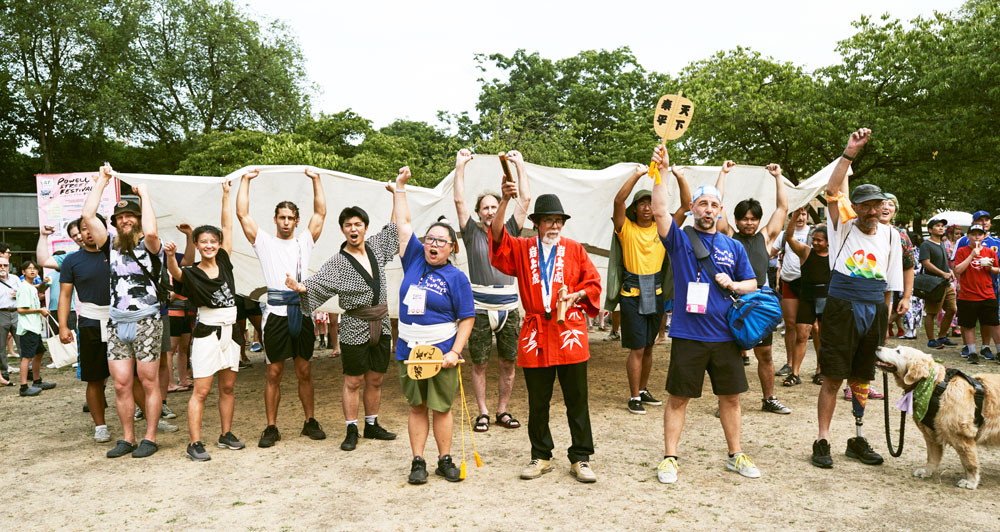
Sumo Sundays participants at the Powell Street Festival in Vancouver’s historic Japanese Canadian neighborhood in Downtown Eastside. Photo credit: Kayla Isomura.
Revitalized as an inclusive martial art, sumo has made a comeback through grassroots clubs, like Sumo Sundays, reflecting a rich history of resilience and community.
Arriving with the first immigrants and nearly extinguished in the internment camps during the Second World War, sumo was the favorite sport of Vancouver’s Japanese Canadian community. Today, nearly 80 years after the war’s end, sumo has made a comeback in Vancouver, displaying the community’s resilience and forward-thinking nature.
Since 1877, laborers from Japan moved to Canada, working in the fishing, forestry, shipping, and railroad industries. They carried sumo with them to isolated logging camps, ports, and factories. It was a common pastime, rivaling baseball. Among Japanese manual laborers, sumo rings (dohyō, 土俵), were established in several Japanese cultural institutions around British Columbia. Japanese communities along the West Coast, as well as in Hawai’i and Alaska, celebrated New Year’s with sumo tournaments. It united the community across generational and social lines. Throughout the year, tournaments were frequent and well-attended, generating interest beyond the Japanese community. As early as 1905, The Vancouver Daily Province reported on a sumo tournament held at City Hall Auditorium:
“The battle consists in keeping feet on the mat, the opponents lean heavily on each other and toward the centre. This brings many feints and sidesteps into play that are unknown in American wrestling, for very often a man is defeated by the force of his own weight carrying him outside the line … The opponent was so heavy that nothing short of an earthquake or his own weight could budge him. So the nimbler man encouraged him to push hard, till the muscles of his fat sides stood out in rolls. Then something happened. The Nimble One jumped in the air while the heavy fellow fell like a log between his opponent’s feet. And how those Japanese did howl and yell ‘Banzai’ to the lucky boy who used his head.“
The somewhat amused tone of this observer reflects how sumo has generally been regarded in the West — as a slightly comical cultural curiosity. However, at the same time, the reporter manages to grasp the essential spirit of the sport: the importance of brains over brawn.
Under the bleak and primitive conditions of the World War II Japanese incarceration camps, sumo was practiced as a way to pass the time. Japanese Canadians’ properties were liquidated, destroying the wealth that the community had worked generations to build. After the war, they were not allowed to return to the Pacific Coast until 1949. Due to this extreme disruption and shattering of their community, businesses, and lives, it is estimated that approximately 25% of the Japanese Canadian pre-war population returned to British Columbia. Sumo went on a long hiatus.
Community Revival
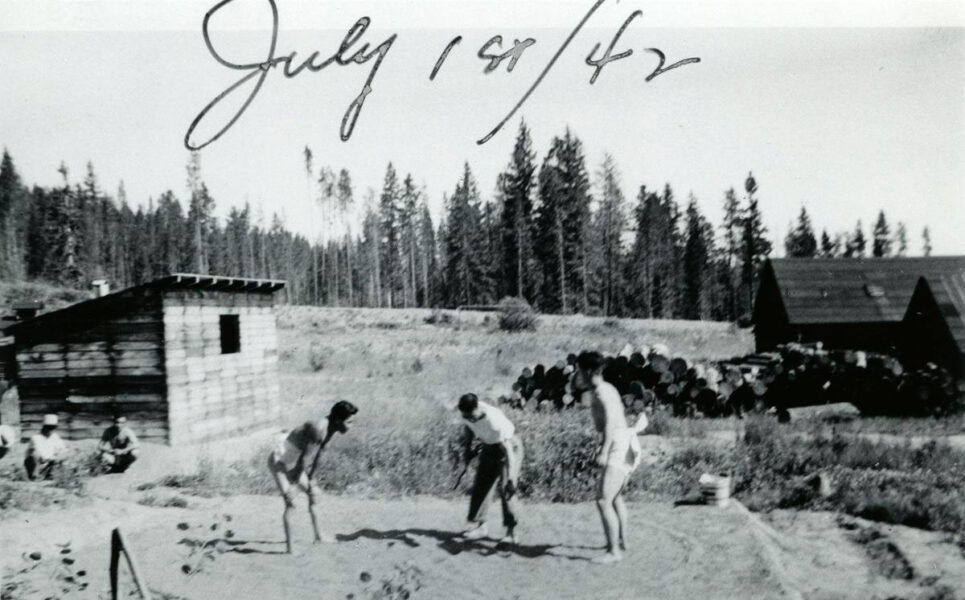
Sumo wrestling at an internment camp on the Hope-Princeton Highway Project. Photograph taken in the Summer of 1942. Photo credit: University of British Columbia Library.
In 1977, the Japanese Canadian community association Tonari Gumi founded the Powell Street Festival to celebrate the spirit of Vancouver’s historic Japanese Canadian neighborhood (Paueru-gai, パウエル街), in the Downtown Eastside. This marked the beginning of the movement of Japanese Canadians to reclaim their cultural identity after decades of cultural assimilation and displacement. The festival was a means of reconnecting with Japanese arts and traditions as well as an opportunity to teach the next generation and the wider society. The festival also dovetailed with the redress movement which was gaining momentum with Japanese Canadians. It demanded a formal apology and compensation from the Canadian government for their internment, loss of property, and the violation of their rights as citizens. The movement led to the government officially apologizing and offering modest compensation in 1988. Held in the heart of what was formerly home to 8,000 Japanese Canadians, the Powell Street Festival has become a platform to celebrate Japanese Canadian culture and political activism.
Since the earliest days of the festival, one of the main events has been a friendly sumo competition organized by the Sumo Fun Club to challengers of all backgrounds and body sizes. Because of the community’s history and the festival’s presence in the current Downtown Eastside (one of the most economically marginalized neighborhoods in Vancouver), inclusivity has been an important theme of the festival. It reflects the values of the Japanese Canadian community. The Sumo Fun Club organized the sumo exhibition at the Powell Street Festival for more than 40 years before passing the torch in 2017 to organizers Shane Pecknold and Lydia Luk. Though the event had originally followed a traditional, exclusionary attitude towards women, within the last eight years it has gradually evolved to include women and non-binary competitors.
To offer a consistent space to practice sumo, Pecknold and Luk also went on to co-found the Sumo Sundays club in 2022 with Kayla Isomura, a regular participant of the sumo competition. Pecknold lived for several years in Japan where he developed a passion for sumo. Upon his return to Canada, he sought to reinvigorate Vancouver’s sumo tradition and “normalize sumo as just another wrestling style that anyone can play, regardless of size.” What makes Sumo Sundays unique and successful is its rigorous emphasis on openness and inclusivity. The club attracts a wide range of participants from all walks of life, not only Nikkei (Japanese Canadians) but also martial arts enthusiasts, members of the queer community, and many others. Newcomers are encouraged to practice techniques and breakfalls without feeling pressure to face an opponent, keeping injuries to a minimum, and allowing members of all skill levels to participate.
While the Powell Street Festival is held only once a year, Sumo Sundays take place regularly in a dohyō on the top floor of the historic Japanese Language School & Hall, (487 Alexander Street on the corner of Jackson Avenue and Alexander Street). It overlooks the Port of Vancouver, which was once bustling with Japanese workers. Established in 1906 but closed from 1941 to 1952, the school was the only property restored for the Japanese Canadian community after the war. It is now a powerful symbol of the community’s resilience.
Sumo Sundays’ website (https://sumosundays.ca) also acknowledges that training takes place within the former 100-mile exclusion zone that Japanese Canadians were forbidden to enter during the war as well as “on the unceded traditional territories of the Musqueam, Squamish, and Tsleil-Waututh nations.”
Sumo is inherently body positive. Sumo wrestlers need a combination of strength, agility, and flexibility which does not guarantee that one body type will always prevail. Indeed, smaller players who can skillfully use their opponents’ power against them are often victorious (as noted in the 1905 article from the Daily Province).
At Sumo Sundays, opponents are matched by weight irrespective of gender. In traditional sumo, women are considered to be “unclean” (kegare, 穢れ) and not allowed to enter the sacred dohyō. When the Mayor of Maizuru in the Kyoto Prefecture collapsed due to a medical emergency at a 2018 sumo event, female medical personnel in the audience rushed into the dohyō to perform CPR but were repeatedly asked by a referee to leave. Salt was then thrown around the ring to “purify” it after the female medics stepped out. The Japan Sumo Association later apologized for putting the mayor’s life at risk. In 2000, the female governor of Osaka Prefecture, Fusae Ota, was forced to present the Governor’s Trophy outside the sumo ring. As its popularity has grown, Sumo Sundays’ all-gender sumo tournaments have been subject to an online backlash. Some traditionalists claim that women fighting men offends the spirit of sumo, while others maintain that women are incapable of beating men although this is a frequent occurrence!
Women’s participation in sumo, however, is not a new phenomenon. The Nihon Shoki (Japan’s second-oldest book from the year 720) describes a match between two court ladies. From the Edo period (1603) until the 1950s, women’s sumo (onnazumo, 女相撲) was a popular event at shrines and temples. It was also folklore in many rural regions of Japan noting women’s sumo was a way to pray for rain. It seems that the cultural prohibition against women entering the dohyō began only in the Meiji era (1868–1912). Despite the historical evidence, only amateur sumo events are open to women today in Japan. Little Miss Sumo (2018), a Netflix documentary about a young woman fighting for women’s rights (both inside and outside the dohyō), has inspired interest in women’s sumo around the world.
The atmosphere of Sumo Sundays contrasts markedly with the machismo of many martial arts clubs. Partially because sumo is not an established martial art in Canada, it offers an unparalleled opportunity for crossover training. Practitioners of various grappling martial arts—Greco-Roman wrestling, judo, football, and Brazilian jiu-jitsu—can apply their knowledge and cross-pollinate with sumo techniques. Some people are even drawn to sumo specifically to test their skills against bigger and stronger opponents.
Shane Pecknold’s enthusiasm has led to a revitalization of Sumo Canada—a previously defunct sporting body. In September 2024, he represented the Canadian team at the Sumo World Championships in Poland along with two other participants of Sumo Sundays—Ryan Kimoto and Bryan Chan. Ironically, the Japanese women’s team earned more medals than the men’s.
Though sumo is Japan’s oldest sport, it is the most recent Japanese martial art to take root overseas. Today, sumo is increasing in popularity and being adapted into new forms, such as a beach sumo club.
The beauty of sumo is that physical size or strength does not always ensure victory. A determined, crafty player can succeed against a dominant, larger opponent. That is the story of Vancouver Sumo. Against the odds, a progressive sumo club is re-establishing traditions. It is forging a new martial arts culture in the heart of Pauerugai.
(This article was originally published in https://kyotojournal.org/asian-encounters/sumo-revival-in-vancouvers-historic-japanese-canadian-neighborhood.)