
By Michael and Kimiko Johnston
NAP Contributors
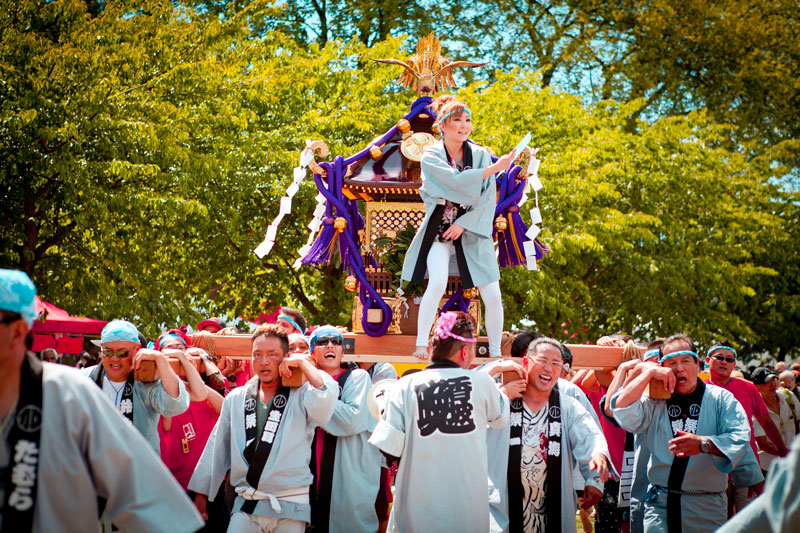
A mikoshi (portable, mini shrine housing a god to ward off misfortune) was paraded around the park during the 50th annual Powell Street Festival. Photo credit: David Yamaguchi.
David and Roger Yamaguchi led a group of 12 travelers, mainly Japanese American, on an enjoyable multi-day visit from Seattle to the Vancouver area to meet the Japanese Canadian community and learn about its history.
The group started with a guided tour of the breathtakingly beautiful Nikkei National Museum and Cultural Center in Burnaby, led by the museum’s educational coordinator, Kimiko Yoshino (a Nikkei).
The museum contained an abundance of displays about the rich history of Canada’s Nikkei community including the earliest immigrants, the prejudice they faced in the early years, their harsh treatment during the Second World War and struggle for citizenship and redress, and their many contributions to Canada’s economy and culture. There was a great deal of information on the sad chapter of Canadian history—the internment of Japanese Canadians. It was interesting that the Canadians prefer to use the term “internment,” distinguishing their experience from the Japanese American “incarceration.” For example, the Canadian camps were not fenced and had no guard towers.
The group spent much of the next day visiting the historic village of Steveston, a community where Canadian Nikkei were heavily involved in fishing, boatbuilding, and cannery operations. The village included numerous preserved and restored historical buildings including the Brittania Shipyards Historic Site and the Gulf of Georgia Cannery National Historic Site.
Vancouver residents, Aki Takeda and James Min led the group to various landmarks in downtown Vancouver including the city’s Japantown and Chinatown. An enjoyable highlight of the visit was time spent at the 50th annual Powell Street Festival, a joyous celebration of Japanese arts and culture. There were numerous food and craft vendors, music, dance, and martial arts performances, and a mikoshi (portable, mini shrine housing a god to ward off misfortune) was paraded around the park. Unfortunately, the group’s busy schedule did not allow time to watch or participate in the festival’s sumo tournament. A historic Buddhist temple was located next to the festival site. Nearby, the group enjoyed an informative, guided tour of the historic and beautifully preserved Vancouver Japanese Language School and Japanese Hall, led by Debbie Saimoto.
Afterward, the group visited the impressive Chinese Canadian Museum, which recounts the rich and varied history of Canada’s Chinese communities; and the Chinatown Storytelling Centre, a separate museum that takes visitors on a journey deep into the history of Vancouver’s Chinatown.
Later, the group visited Stanley Park to view the solemn and impressive Japanese Canadian War Memorial. It was paid for by the Nikkei community and dedicated in 1920 to memorialize Nikkei Canadians who served and gave their lives in “the Great War.” Names of Japanese Canadians who made the ultimate sacrifice in subsequent wars have been added to the monument.
The final stop of the tour was the Museum of Anthropology at University of British Columbia. Additionally, a few members of the group ventured out one evening to enjoy the popular Richmond Night Market, an international, outdoor food festival that sadly, will be discontinued after this year.
All in all, it was a meaningful and informative adventure. The strong sense of community among Vancouver’s Nikkei community was particularly impressive.