
A Quiet Pioneer Behind Japan’s IT Foundations
By Ryoko Kato
NAP Contributor

Matsumoto wearing a happi coat and handing out samples at the Hachinohe Aomori Japan booth in Hachinohe. Undated. Photo credit:Yasuki Matsumoto.
Surrounded by figures who would become legends of the IT (Information Technology) world, Yasuki Matsumoto joined Microsoft headquarters as its first Japanese employee and played a key role in establishing the company’s Japanese subsidiary. For decades, he helped bring American software companies into the Japanese market through strategic investment and business development. Today, the same frontier spirit is guiding him toward a new mission: introducing outstanding Japanese products to the world. This feature looks back on a career spent building companies, mentoring startups and interns, and continuing to open new paths across borders.
Yasuki Matsumoto was born in 1953 in Mie Prefecture in Japan. He graduated from the Department of Mechanical Engineering at Kansai University (Japan) and earned a master’s degree in mathematics from Portland State University (Oregon). In 1982, he joined Microsoft Corporation in the United States as a COBOL (Common Business-Oriented Language) systems engineer and later worked on the establishment of Microsoft’s Japanese subsidiary. Matsumoto also supported the launch of the company’s Korean and Taiwanese subsidiaries and served as a product development manager for the Far East region. He founded DBC Technology in 1991, EnCompass Group in 1995, and Encompass Japan Inc. in 2021. In addition to managing the businesses he founded, he currently serves as a special advisor to transcosmos Inc.
Roots Shaped by His Hometown and His Parents’ Example
Matsumoto grew up freely in the nature-rich city of Tsu, Mie Prefecture. As a child, he spent countless hours fishing in rivers and catching insects with his older brother who was four years his senior. His family ran Matsumoto Shoten, a wholesaler that mainly supplied soybeans to tofu shops. Because of the family business, their dining table was often filled with tofu and aburaage (deep-fried tofu) received from customers.
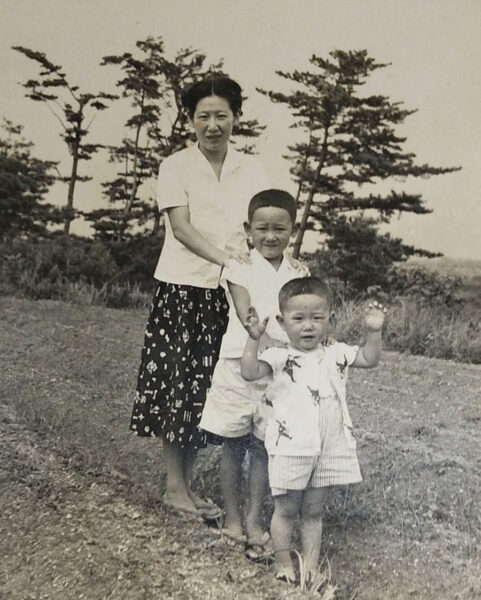
Matsumoto with his mother, Yoshiko, and his older brother, Hideki. Location and date unknown. Photo credit: Yasuki Matsumoto.
During summer vacations, Matsumoto rose early to help with deliveries, traveling across Mie Prefecture in a two-ton truck known as a Kurogane. Some routes covered roughly 180 kilometers (120 miles) round trip between Tsu and Owase. Watching his parents work from morning to night, carrying burlap sacks filled with soybeans that weighed as much as 60 kilograms (132 lbs.), gave him an early, firsthand understanding of how demanding work could be.
After graduating from high school, Matsumoto followed his father’s advice and entered Kansai University to study mechanical engineering. His older brother studied electrical engineering at the same university. Their father apparently hoped that one day, his two sons would help mechanize tofu production and expand the family business. Matsumoto himself had little interest in that path but during his university years he encountered something that would change the course of his life.
As a sophomore, he traveled to the United States through a program run by the International Youth Exchange Association. While staying in Boston, he lived with a professor who taught computer science at Tufts University in Medford, Massachusetts. That experience sparked his interest in the field. After learning that the West Coast was at the forefront of computer science, Matsumoto persuaded his parents to let him study at Portland State University’s graduate school. Studying abroad was expensive at the time with the exchange rate 360 yen to the dollar. He covered his tuition by teaching at a Japanese school and working as a university teaching assistant. He completed his master’s program with strong academic results, an experience that gave him lasting confidence.
The First Japanese Programmer at Microsoft Headquarters
In 1979, Matsumoto joined a major Japanese electronics manufacturer as a software development engineer. Even then, his mind was occupied by developments in American computing. After learning about Microsoft in a specialized industry magazine, his desire to work in the United States as a programmer grew stronger. After roughly two years, he left the company, used up his savings, received support from his parents, and returned to Portland as an international student to look for work.
Soon after arriving in the United States, Matsumoto visited Microsoft headquarters with a resume in hand. He was unable to meet with anyone that day but a week later he received an invitation for an interview and advanced to a decisive second round. The people who appeared before him were industry figures who would later become legendary: Charles Simonyi, Paul Allen, and Steve Ballmer. Allen gave him a programming problem, which Matsumoto was able to solve thanks to his practical experience. He was later hired at an annual salary of $22,000. Although it meant taking a pay cut, he was filled with hope as the first Japanese employee hired at Microsoft headquarters. Looking back, Matsumoto modestly says he was fortunate.
At the time, Microsoft headquarters had only about 100 employees and was filled with the energy of a student dormitory. Matsumoto remembers occasions when the company rented out a movie theater so the entire staff could watch a film together. Everyone was highly motivated and spent their days absorbed in program development from morning to night. It was an environment where employees could speak openly to their supervisors, try new things, and take risks without fear of failure. Gates, too, was a leader who did not act superior but remained open and willing to debate with employees. Matsumoto threw himself into development every day determined not to fall behind the other programmers.
The Little-Known Story Behind the Founding of Microsoft Japan
Three years after Matsumoto joined Microsoft in December 1985, he was entrusted with the task of establishing Microsoft’s Japanese subsidiary. The mission was daunting with only three months from launch to incorporation. Matsumoto had found satisfaction in program development but he also wanted to seek work that only he could do. As one of three people tasked with leading the creation of the Japan office, he accepted the challenge.
From the mid-1980s into the 1990s, Japan’s personal computer industry was still developing with major electronics manufacturers selling their own proprietary hardware. At the time, Japan was one of Microsoft’s most important overseas markets second only to Germany. The sales channel was handled by ASCII Corporation, a publisher known for introducing and selling overseas software in Japan.
Because Microsoft’s products were often supplied through OEM (Original Equipment Manufacturer), arrangements under other companies’ brands, the Microsoft name was not yet widely recognized in Japan. Matsumoto and the team struggled to open an account at a major Tokyo bank to secure office space, eventually beginning operations from an office in Sanbancho district in Chiyoda-ku, Tokyo. One of the greatest challenges was recruiting talent. Matsumoto had been entrusted with creating a development division inside the Japan office, an unusual policy for a foreign company at the time. It reflected Bill Gates’ high regard for Japan’s technical capabilities. In the middle of Japan’s economic boom, however, attracting talented people to a relatively unknown foreign company was extremely difficult. In the end, the team approached 18 employees from ASCII which had been working closely with Microsoft and they agreed to join. Matsumoto remembers feeling deeply grateful that they were willing to step into the unknown challenge of launching Microsoft Japan together.
Matsumoto began by visiting customers every day and listening directly to what was happening in the field. Leading a young team, he often found himself moving between banks and manufacturers as a manager dispatched from headquarters. In the early days, Japan’s share of Microsoft’s overall sales was still small but with the arrival of Windows 95 the subsidiary entered a period of rapid growth. It eventually became the company’s second-largest market after the United States.
Matsumoto later helped establish Microsoft’s Korean and Taiwanese subsidiaries and contributed to the company’s expansion in Asia as a product development manager. Around the same time, Microsoft headquarters completed its IPO (Initial Public Offering) in the United States and began to emerge as a corporate giant.
By 1991, Microsoft had grown to more than 8,000 employees. As the company became larger, it was harder for Matsumoto to see the full picture and to pursue the work he most wanted to do. He even began to feel that he might not be able to compete with local talent in English or programming alone. Instead, Matsumoto wanted to build a company that would specialize in software localization into Japanese and use his strengths as a Japanese professional. It was not an easy decision because he felt indebted to Gates and the company that had helped him obtain permanent residency. Still, he chose to trust himself and became an entrepreneur.
When asked whether he felt anxious about leaving Microsoft, Matsumoto answered immediately, “No.” Confident in his ability to read the future of the industry, he began a new career as an investor and businessman.
A Key Figure in the Spree of Personal Computers in Japan
After leaving Microsoft, Matsumoto founded DBC Technology in Seattle with the goal of translating and selling American software for the Japanese market. His first major project was supporting Compaq, later acquired by Hewlett-Packard, as it brought IBM-compatible personal computers (PC) to Japan.
At the time, Japanese PC manufacturers sold software based on their own proprietary standards. To make products compatible, users often needed specialized knowledge and programming language skills which limited the reach of PCs. The arrival of IBM’s DOS/V operating system and compatible machines made it possible for software to work across PCs from different manufacturers. Compaq was the leading U.S. manufacturer in that field.
Matsumoto spent six months in Houston, where Compaq was headquartered, supporting the company’s entry into the Japanese market. The result was a sharp drop in PC prices across Japanese manufacturers and a surge of opportunities for a wide range of software developers. This development, known as the “Compaq Shock” sent tremors through Japan’s IT industry and helped lay the foundation for widespread PC adoption.
An Investor’s Career Dedicated to a New Business Model
DBC Technology sought to expand but financial constraints eventually led Matsumoto to consider mergers and acquisitions. Around that time, transcosmos, a major Japanese company in business process outsourcing, IT outsourcing, and help desk services approached him with a proposal. They wanted Matsumoto to establish an investment company as a joint venture with an affiliate of Nikko Securities. In July 1995, he founded EnCompass Group and began strategic investments in the U.S. IT companies, venture capital work, and business expansion into Asia. He later served as president of transcosmos USA, now transcosmos Investments & Business Development Inc., and as a vice president of transcosmos before moving more fully into the investment business as a special advisor.
Matsumoto’s venture capital (VC) model differed from the conventional approach which typically prioritizes investment returns above all else. His focus was on helping U.S. startups grow in the Japanese market. He provided end-to-end support including market entry, research, strategy, localization, product development, and partner development. This distinctive business-development-oriented investment model made collaboration with competing VC firms easier. His strong track record in Japan was highly valued, leading to many investment opportunities.
This was the Web 1.0 era, when technologies such as HTML (Hypertext Markup Language) lowered the barrier to creating websites. Netscape went public, Amazon was founded in 1995, and Google was established in 1998, marking the dawn of the digital revolution. As development costs fell, it became possible to create convenient new digital services quickly which also increased the possibility of acquisition by major companies. Active investment in the IT industry created opportunities for short-term returns but the low barrier to entry also made competition intense.
Understanding these characteristics, Matsumoto says that the survival path for IT startups is generally either acquisition by a major company or going public. In the past, many companies aimed to go public and become central players in their industry. With the remarkable growth of giant IT companies; however, acquisition by larger firms has become increasingly common. Because acquisition can allow investors and founders to recover capital faster than an IPO, business strategies built around selling the company from the outset have become more mainstream.
Through VC investing, Matsumoto came to understand the importance of a strategy that matches market needs, strong product development, and speed. He also experienced the difficulty of exit strategies but there were successes as well. One was investing in a company that was acquired by a major IT firm for $200 million.
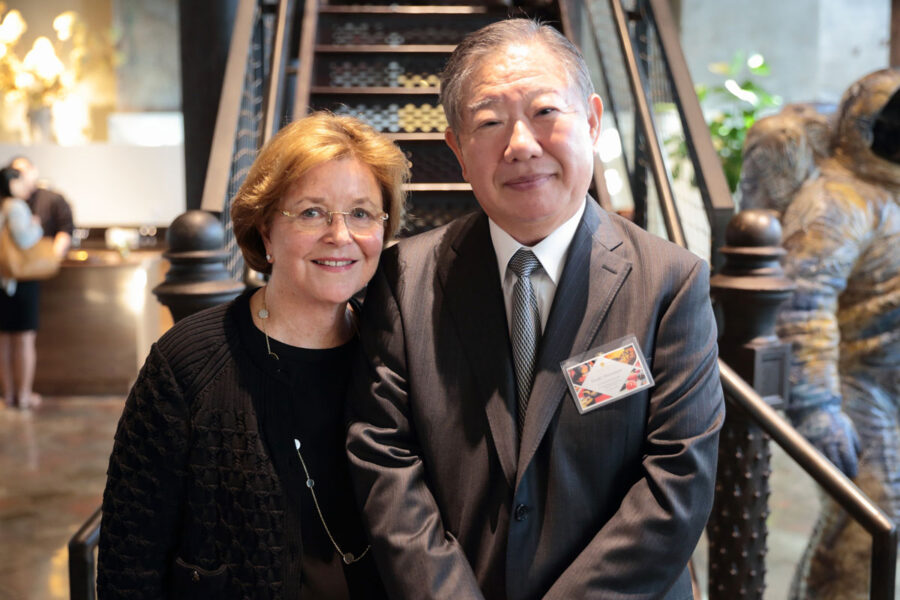
Fran’s Chocolates founder Fran Bigelow with Matsumoto at the Fran’s Chocolates’ Georgetown store in 2015. It is the company’s current headquarters, main production, and retail location in Seattle. Matsumoto held a lacquerware experience event there with Bigelow and a lacquerware artisan from Japan. Photo credit: Yasuki Matsumoto.
Helping Japanese Products Find Their Way into the U.S. Market
After many years of helping American software companies enter Japan, Matsumoto is now applying that experience in the opposite direction. His current mission extends beyond IT by introducing Japanese foods and traditional crafts to the American market. Since founding Encompass Japan, Inc. in 2021, he has supported market development for products such as kumiko woodwork from Aomori and yoga mats made with tatami from Kumamoto, creating unique proposals that combine Japanese tradition with contemporary design.
At a food event held in collaboration with Aomori Prefecture, Matsumoto wore a happi coat printed with “Aomori Prefecture” and handed out samples himself as part of a Hachinohe anko (dessert) project he was developing with student interns. With its strong interest in Japanese culture and residents who are willing to spend on dining, Seattle is an ideal place for test marketing. Despite a distinguished career as an industry pioneer, Matsumoto has never forgotten the importance of standing at the front line with customers. That, more than anything, reflects his business philosophy.
Matsumoto is currently focusing on a project to introduce lacquerware to the United States in partnership with Yamada Heiando, a lacquerware company that serves the Imperial Household Agency. The project struggled to gain traction for more than five years. Through repeated trips around the United States and ongoing negotiations with manufacturers, its sales channels have steadily expanded. The lacquerware is now being used for lipstick containers by a cosmetics manufacturer in New York and is carried by the popular gallery shop KOBO in Seattle. When lacquerware was adopted by Seattle-based luxury chocolatier Fran’s Chocolates, Matsumoto says he was encouraged by the deep understanding and sympathy for Japanese craftsmanship shown by the company’s founder, Fran Bigelow. These experiences taught him that lacquerware may be more readily accepted in the United States not simply as a stand-alone object but as a vessel that enhances what it holds.
Serving as a Bridge to the Next Generation
One distinctive aspect of Matsumoto’s company is its active effort to provide interns with practical business experience. Behind this is his hope that young Japanese people and engineers will gain greater market value and social recognition, and that they will be willing to take the leap into the U.S. market. In the lacquerware project, interns once raised $30,000 through crowdfunding and helped publish an English-language book introducing the history and craftsmanship of urushi (tree sap for making lacquer).
Matsumoto says he wants young people to keep trying until they succeed even if they fail many times along the way. During Japan’s high-growth era and the early days of IT everything was trial and error, and failure was considered part of the process. In today’s mature economy, however young people face a different kind of pressure. Success is treated almost as the minimum requirement. Failure is often seen as unacceptable whether remaining inside a company or taking risks to start something new. They may appear fortunate but their choices can be limited. That is why when students tell him they are glad they had the chance to take on a challenge, Matsumoto feels compelled to create more opportunities for them.
He also expresses deep gratitude to ICC, the Japanese student organization, as well as the University of Washington and Bellevue College, for providing opportunities to support these students.
Matsumoto holds one quote especially close: Eleanor Roosevelt’s words, “The future belongs to those who believe in the beauty of their dreams.” As if embodying that idea, he has continued to take on challenge after challenge with a resilient spirit that bends but does not break. Matsumoto’s story of investment, opportunity, and support for the next generation is still unfolding. That pioneering spirit will no doubt continue to connect with the innovations of the future.