
Free Families Pilgrimage:
From Remembrance to Resistance
By Barbara Mizoguchi
NAP Editor-in-Chief

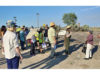
Co-organizer Stan Shikuma speaking (with a microphone) and pilgrimage walkers standing behind him at the King County International Airport. Photo credit: Barbara Mizoguchi.
In the early morning of October 7, approximately 20 people gathered in Hing Hay Park in the Chinatown-International District of Seattle for a four-day pilgrimage around the Puget Sound area. They consisted of survivors of the World War II incarceration camps, descendants of the camps, and faith leaders. Immigrant rights advocates who organized the pilgrimage included Tsuru for Solidarity, La Resistencia, and Free Families: The National Coalition to End Family and Child Detention. The group gathered for a 48-mile walk to critical locations demanding an end to the lock up, family separation, and deportation, as seen across the U.S. and locally today. They are demanding a future where families and communities are together and safe.
It was just like World War II in 1942 after Japan bombed U.S. ships at their naval base in Pearl Harbor, Hawai’i. Suddenly, U.S. citizens became extremely racist, prejudiced, and discriminatory against those of Japanese descent. The hysteria led to the U.S. Executive Order 9066 that removed all people of Japanese descent living on the West Coast. Within days Japanese and Japanese Americans (J&JAs) were forced to leave their homes, farms, and businesses for incarceration camps when they did nothing wrong. Some families were even separated and did not know if they would see each other again.
Yet it is happening again, and the local news keeps us up to date on the latest incidences across the U.S. That is the point of the pilgrimage. It is an outcry against what is happening to individuals and families just like in 1942. People are being arrested in the U.S. while attempting to get to and from work. Individuals are inadvertently getting killed due to profiling. Children are separated from their parents and locked up with other children, not knowing if they will see their families again. It is even occurring locally.
The pilgrimage started at Hing Hay Park then continued walking with their signage down Sixth Avenue South toward the INScape Arts building (former U.S. Immigration and Naturalization Service building). The walk connected sites of past and present injustices. Relatives of Japanese immigrants shared their family’s experiences in the INS building. Then the group continued walking down Airport Way South. Along the way, a van was available for elderly walkers to ride in. There was also a team with walkie talkies handling logistics, security, and health.
Another team was waiting for the group’s arrival at the King County International Airport (KCIA). They brought a banner, strings of multi-colored, origami cranes, signage, and a speaker box with a microphone for a media program as the group arrived. Reverend Karen Yokota Love from Blaine Memorial United Methodist Church began with a poignant prayer. She acknowledged the courage of the walkers to speak out about how ICE (U.S. Immigration & Customs Enforcement) must be abolished, how those unjustly imprisoned are being flown from the airport not knowing where they are going, and how they all must be freed. People gathered together as a community.

Left to right: Satsuki Ina, age 82; Rev. Kenji Akahoshi, age 84; and Chizu Omori, age 96 all from California. They are participating in the pilgrimage and listening to speakers at the King County International Airport. Photo credit: Barbara Mizoguchi.
Stan Shikuma from Tsuru for Solidarity mentioned how his family from Shelton were incarcerated but no one in the community cared. No legal entity said, “No.” La Resistencia has been watching KCIA and noticed shackled individuals boarding planes three to four times per week. They do not know where they are going. It is morally unjust and constitutionally wrong. As the Bainbridge Island Japanese American Memorial Associations says, “for the sake of the children” (Nidoto Nai Yoni.)
Josefina Mora-Cheung of La Resistencia, noted that in 2024, approximately 5,000 individuals and 122 flights departed. Last year, 124 flights departed in 10 months, and this year so far, 4,283 individuals departed. John Parrott, KCIA Executive Director, is familiar with the U.S. executive order which suggests the flights but does not enforce it. However, he is allowing the flights to be enforced. Examples include: Mr. Stevenson, a Tukwila resident who was bussed to Georgia when he was trying to get married. A 29-year-old Florida man was shipped to the Tacoma detention center and has been there over a year now. The flights do not necessarily take them to their hometown but to areas where the cartels prey on them.
Satsuki Ina, co-founder of Tsuru for Solidarity, came up from California to participate in the pilgrimage. She is the author of “The Poet and the Silk Girl” book. Ina was a child when her family was incarcerated at the Tanforan Assembly Center in San Bruno, California and Tule Lake Incarceration Camp in California. Her parents protested the incarceration and answered “no” on the loyalty form which was handed out to all those in the camps. Her father often gave speeches to fight but he was then sent to Bismarck, North Dakota on allegations of sedition. Today, as Ina meets children in detention centers, they are crying from the brutality. The children remind Ina of herself during her own incarceration. She also witnessed a mother and baby in shackles being sent to south Texas. Many decades later at 82 years old, Ina knows what freedom is and has lost faith in the U.S. government. It must stop. Instead, it needs to be replaced with humanity and love.
Mike Ishii, co-founder of Tsuru for Solidarity, said this pilgrimage is about freeing families in detention centers. These walks are timely due to the upcoming U.S. mid-term elections on November 3. They will determine if the U.S. House of Representatives will be under Democratic or Republican control. That is why these pilgrimages have been occurring since June in Atlanta, Georgia; Portland, Oregon; and Crystal City, Texas.
Recently, the concern has been at the Dilley Immigration Processing Center in South Texas. Both the U.S. Democrats and Republicans agreed to close the center; however, it was re-opened in 2025 to increase border controls by the U.S. Republican president. Last month, Dilley was highlighted due to ICE arresting a five-year-old boy wearing a bunny hat and carrying a Spiderman backpack in Minneapolis, Minnesota. He and his father were sent to Dilley. The boy was separated from his father and placed in a cage with other children who had been there for months. Ten days later, a judge and the U.S. Congress were required to obtain their release. Today, there are more than 1,300 individuals at Dilley — many of them are children. The largest ICE facility is in Alexandria, Louisiana. It is not a detention center but a logistics hub which converts detentions into a deportation system. Instead of housing, there is a secret airport that transports detainees out of the U.S. This is one of five facilities with thousands deported per day.
If immigrants cannot get jobs then there is no healthcare or food for their families. American farms will not have anyone working their fields and crops will die leaving a severely reduced food supply for the country. Companies will not have service workers and will have to close businesses. As a result, the U.S. government is “shooting themselves in the foot,” says Ishii.
Chizu Omori is 96 years old. She came to Seattle from California to participate in the pilgrimage. She has been a political activist since college and said she “got with the lefties.” Omori was involved with civil rights marches and anti-war demonstrations in the 1960s and 1970s. By the 1980s, she was involved with the redress, demanding that the U.S. compensate J&JAs for their unjust government incarceration during World War II. Omori was also involved in the Hohri v. U.S. case that helped establish the Civil Liberties Act of 1988. Today, she is concerned about children being detained and separated from their families. Omori also feels more media needs to be involved. However, she is glad the Burn Order podcast hosted by Rachel Maddow has been interviewing people who were incarcerated during World War II. Also, MS NOW was at the Los Angeles Orpheum Theatre interviewing U.S. Congressman Mark Takano and the Nisei Progressives. Omori wrote for Nichi Bei News with a column reviewing books and film. She also helped her sister produce the “Rabbit in the Moon” film. Her own family was incarcerated at the Poston War Relocation Center in Arizona.
Lastly, Kristin Kumph, national coordinator for Free Families: National Coalition to End Family and Child Detention, came from Richmond, Virginia to participate in the pilgrimage. The organization is an advocacy group that has supported 10 pilgrimages so far. The Crystal City to Dilley, Texas pilgrimage was approximately 40 miles. “Deportations are costing U.S. taxpayers money so we must call for an end,” says Kumph. She, too, gave examples of the Alexandria facility. There is no due process or legal services available for the detainees. Also, there is no care or sponsorship for the families of the detainees. This causes dramatic trauma and stress for all.
The program ended by announcing individual names of those who died in the Puyallup Assembly Center. Pilgrims who stayed until the end of the media program received box lunches provided by the organizers.
After lunch, the group continued their walk to the Tukwila Community Center for the closing ceremony.
The next day, the pilgrimage began at the Tukwila Community Center with an opening ceremony. Then they walked to the ICE facility (USCIS Seattle Field Office) in Seattle. Another media program occurred with highlights describing the role of the field office, its use of digital detention, the holding of children and families, and the historical parallel of the J&JA incarceration. Kairos Center for Religion, Rights, and Social Justice also joined the group. The closing ceremony was at the White River Buddhist Temple in Auburn with other inter-faith leaders. They gathered with the pilgrimage group in solidarity and in a call to action to protect our communities. Stories of resistance during the J&JA incarceration along with ICE concentration camps were shared, interspersed with song and bon odori dancing.
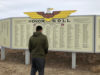
On Friday, the group began at the White River Buddhist Temple with an opening ceremony. Then they walked to the Remembrance Gallery located inside the Washington State Fairgrounds in Puyallup. There was an end-of-day healing ceremony with a ritual song. Afterwards, the names from the Book of Peace were read. The book holds the names of J&JA people who were incarcerated at the Puyallup Assembly Center during World War II.
On the last day, the group began at the Remembrance Gallery with an opening ceremony followed by a walk to the Northwest Detention Center (NWDC) in Tacoma. They then participated in the Solidarity Day rally led by La Resistencia and Urban Grace Church. Participants listened to faith leaders, survivors of the World War II incarceration camps, and NWDC detainees who spoke about their experiences. La Resistencia demanded the shut down of NWDC and an end to all family detentions. Taiko drumming and song were interspersed throughout the rally.
As Ishii said, the point of these pilgrimages is to have the community join them in the declaration. Everyone learns from the public media what is happening. This is a way to actively protest detention centers, deportation flights, and families in illegal holding cells. It is history repeating itself like during WWII. These detentions cause long-lasting trauma which can have inter-generational trauma.
Across the country, groups are uniting to resist the detention and deportation which is escalating and expanding. It includes cruel tactics of coercion, babies forced to represent themselves in immigration court, and ICE detaining children on their way to school or soccer practice. This leads to life-long emotional and mental health issues. Worms and mold in food have been found at Dilley Detention Center. Families are constantly sick and have trouble sleeping. Many have thoughts of self-harm or suicide. The U.S. government is even planning on re-opening the La Salle Alexandria Airport Family and Child Detention facility in Louisiana. Chemicals in the drinking water is 575,000 times higher than the federal limit.
There is a connection between what is happening in these detention centers and what happened in the incarceration camps of Japanese and Japanese Americans. As Tsuru for Solidarity says, “Stop Repeating History.”
For more information about the organizers and how to get
involved, see:
Tsuru for Solidarity
- tsuruforsolidarity.org
La Resistencia
- laresistencianw.org
Free Families: National Coalition to End Family and Child Detention – freefamilies.net