Emerging Radiance Artists’ Talk
By Barbara Mizoguchi
NAP Editor
You might recall NAP’s April 11, 2025 issue on page 7 about the Day of Remembrance activities. One of them was about the opening of Emerging Radiance at the Bellevue Public Library in Washington, an artwork created by local artist Michelle Kumata and Seattle-born, Los Angeles-based creative director Tani Ikeda. It is an interactive farmhouse honoring Bellevue’s rich history of Japanese American (JA) farmers in the area before World War II. Even the library resides on the former land of Eizo Masuyama, an Issei (first generation JA) farmer from 1919.
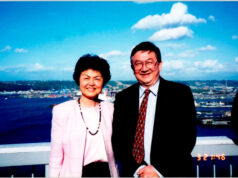
Last month, Kumata and Ikeda provided an artists’ talk describing the background, research, and technology of their artwork. Kumata naturally began with her own family history, showing a 1922 photograph of a large group of Nikkei (JAs) at a Hiroshima Kenjinkai picnic in Chico, Washington. Her paternal great grandfather, Kikujiro Kumata, an Issei who owned a tailor shop in Seattle’s Nihonmachi (Japan district), is shown with his family. Her grandfather in the photograph was a Nisei (second generation JA) who later became a mechanic and his wife, a garment worker.

Four sides of the farmhouse by Michelle Kumata and Tani Ikeda, 2025. Photo courtesy: Michelle Kumata.
In 1941, during World War II, Pearl Harbor in Hawaii was bombed. This created hysteria about JAs on the U.S. mainland being potential spies. The U.S. Executive Order 9066 then authorized the forced removal and incarceration of all people of Japanese ancestry on the West Coast. Kumata’s grandparents on both sides of her family were sent to an assembly center at the Puyallup (Washington) fairgrounds and lived in horse stalls. Later, they moved further inland from the coastline to a permanent incarceration camp called Minidoka in Idaho where her parents were born. After the war in 1945, the U.S. government circulated propaganda to encourage former incarcerees to move inland since they were still perceived as a threat. Her paternal grandparents moved to Cleveland, Ohio and later returned to Seattle.
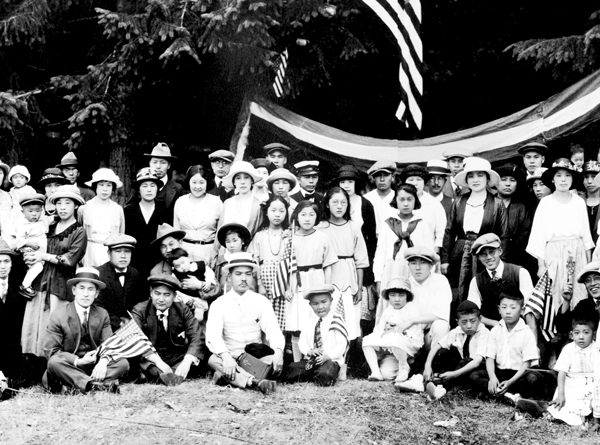
Hiroshima Kenjinkai picnic in Chico, WA, 1922. Photo courtesy: Michelle Kumata.
Kumata’s maternal grandparents, Kametaro and Kinue Kawaguchi, emigrated from Japan to Seattle where they managed hotels and other businesses before the war. After the war and their incarceration, they returned to Seattle and managed the Standard Hotel located south of the famed Smith Tower in Pioneer Square.
When she was a young girl, Kumata heard derogatory remarks aimed at herself, her mother and grandmother but they never talked about it. It was typical of Japanese culture where questioning authority, rebellion or risk-taking were not encouraged. As a result, the trauma of World War II has been silently carried throughout the generations.
Kumata, who was an only child, quiet and shy, did not feel she fit in with her classmates at a small private school until she joined a taiko (Japanese drumming) group. There, she found community support and pride.
Kumata’s father was an architect who was also an artist and influenced his daughter’s interest in art. Kumata then studied graphic design at the University of Washington and illustration at the School of Visual Arts in New York. She returned to Seattle and worked on the Wing Luke Museum’s first community-based exhibit titled, “Executive Order 9066: 50 Years Before and 50 Years After.” After working at The Seattle Times as a graphic artist, Kumata returned to the Wing and learned the importance of diverse representation and the influence of artists.
Meta (formerly Facebook) began Open Arts Program where Kumata was to create a mural in their new Bellevue Kumata wanted to create a mural to help the employees understand the “hidden history of the land where they worked”. After researching JAs in the Bellevue area, Kumata chose to paint larger-than-life portraits of farmers from various generations including quotes from them. She also used yellow and gold colors to make the skin glow and enhance their presence.
Kumata then recruited Tani Ikeda to “bring a dynamic dimension to the painted mural”. Ikeda is an award-winning documentary film director, Augmented Reality artist, and daughter of Tom Ikeda (founding and former Densho Executive Director.) After scanning the QR codes, Ikeda developed an activation of Augmented Reality using AR Spark. She also used Densho’s oral histories and selected individuals who were comfortable in front of a camera. She proceeded to study their mannerisms and emotions, then sketched them into puppet-like, two-dimensional animations with animators. Those who worked with Augmented Reality did all the mixing online. Now, the actual voices of the farmers can be heard while they move, and descendants can re-imagine their family members.
The research also included what produce the farmers grew. Working with Kitazawa Seed Company, the team was able to obtain seed packets, like those from the past, for visitors to take home and plant to make sure the stories continue.
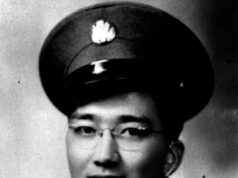
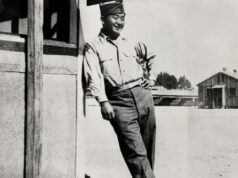
One of the portraits on the farmhouse is of Kimitomo Muromoto. He served in the famed 442nd Regimental Combat Team, a segregated JA unit which was the most decorated in U.S. military history. The 442nd fought for the U.S. during World War II while their families were incarcerated. When the mural was completed, Muromoto visited it with his son, Kim Jr. who pushed for the mural to be more accessible to the public.
That is when the mural developed into a farmhouse and was on display at Bellevue Arts Museum in 2022. Kimitomo got to see the farmhouse but passed away in 2024 at age 101. The farmhouse was purchased by the City of Bellevue then moved to the Bellevue Public Library. It will be on display there until February 2027.
111 – 110th Avenue Northeast
Bellevue, Washington 425-450-1765
Monday-Thursday 9 a.m. – 9 p.m., Friday-Saturday 10 a.m. – 6 p.m.,
Sunday 12 – 8 p.m.
https://kcls.org/locations/bellevue
Formerly known as Facebook – a social media company. Open Arts was an internal arts program that commissioned art for Meta’s global offices. Emerging Radiance began as an office mural project in the Spring District offices in downtown Bellevue. It then expanded into a public facing interactive art installation and awarded the Tribeca X Award for Best Immersive Project in 2022.
Also known as mixed reality. It is a technology that overlays real-time, three-dimensional-rendered computer graphics onto a portion of the real world through a display, such as a handheld device or head-mounted display. This experience is seamlessly interwoven with the physical world such that it is perceived as an immersive aspect of the real environment.
It documents testimonies of Japanese Americans who were unjustly incarcerated during World War II in the 1940s before their memories are extinguished. There are irreplaceable first-hand accounts, coupled with historical images and teaching resources, to explore the principles of democracy and promote equal justice for all.