By Masahiro Nakashima
NAP Contributor
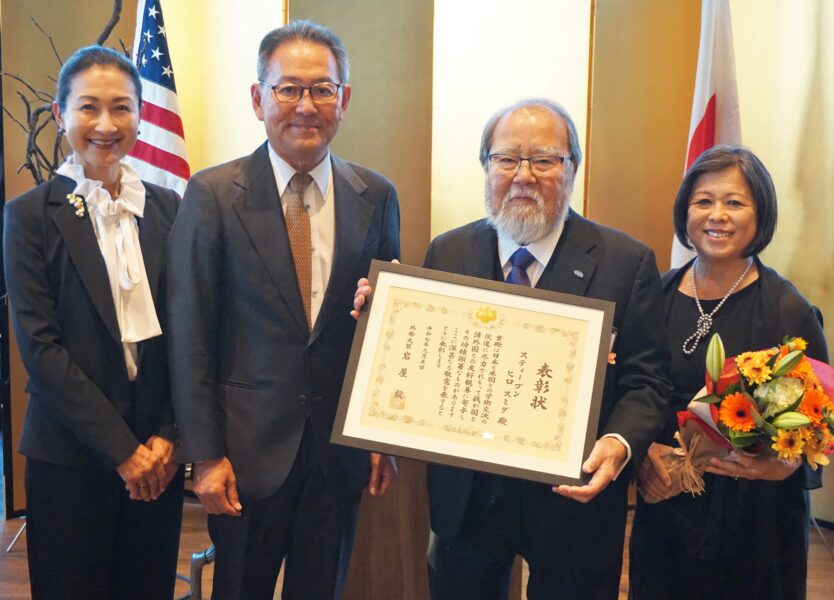
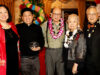
Left to right: Yuko Iyori, Con. Gen. Makoto Iyori, Steve Sumida holding his commendation, and Gail Nomura holding flowers. Photo credit: Consulate-General of Japan in Seattle.
Dr. Stephen Hiro Sumida, Professor Emeritus in the Department of American Ethnic Studies at the University of Washington (UW), has been awarded the Foreign Minister’s Commendation by the Japanese government. The prestigious honor recognizes individuals for outstanding achievements in promoting friendship and mutual understanding between Japan and other nations.
Dr. Sumida’s recognition specifically highlights his decades of dedication to promoting academic exchange between the U.S. and Japan. Beginning in 1989, he championed and chaired a crucial academic exchange program between the U.S.-based American Studies Association and the Japanese Association for American Studies. His unwavering commitment and leadership in this effort deepened scholarly ties and significantly contributed to the development of American Studies in Japan.
A Pioneer’s Poetic Acceptance
At the acceptance ceremony, Dr. Sumida delivered a moving speech, shifting away from a formal address to what he called his “talk stories” or “rakugo” (a form of Japanese comic storytelling). He began by noting with a knowing smile that the number of participants present was the same as the legendary 47 Rōnin (Chūshingura) [samurai who will die untimely for their lord], immediately bridging Japanese culture with the gravity of the occasion.
Acknowledging his wife, UW Professor Emerita Gail Nomura as his closest partner in their work as pioneers in Asian American studies, Sumida moved on to recount stories of his life as an American sansei (third-generation Japanese American) in Japan. He shared humorous episodes, like freezing at a Tokyo market unable to recall the Japanese word for chicken wings. A more startling moment was when he was repeatedly mistaken for a yakuza boss (oyabun) in Shibuya.
Crucially, Sumida addressed the cultural friction in Japan experienced by many Nikkei-jin (people of Japanese descent living outside of Japan). When a young American Embassy staffer condescendingly joked that he spoke Japanese better than the professor, Dr. Sumida delivered a pointed, on-the-spot retort, calling out the casual lack of understanding regarding the complexity of Asian American identity.
From Seattle Theater to the Temple of Heike Monogatari
Sumida, a key figure in establishing Asian American literary studies and an esteemed UW faculty member who also chaired the American Studies Association, concluded his speech with a profoundly personal anecdote that intertwined his academic and artistic life in Seattle.
He recounted the cancellation of an American adaptation of The Tale of the Heike for Seattle’s ACT (A Contemporary Theatre), where he was cast as the ruthless Taira no Kiyomori. This personal failure led him and his wife to visit Kyoto’s Jakko-in Temple, where Kiyomori’s daughter, Kenreimon-in, lived as a nun after the clan’s defeat. There, by the pond where the former empress met her old nemesis, a small, iridescent blue butterfly landed on Sumida’s shoe. He felt certain it was Kenreimon-in, coming to pay respect to all people and all tragedies. He concluded by reflecting on the epic’s core theme — that all things must pass (shogyō mujō) — a truth he now finds comforting.
Sumida’s honor celebrates a career that has not only defined a field of study but has consistently built vital cultural and intellectual bridges between the U.S. and Japan.