
Renewed Ishigaki Wall & Accessible Pathway
By Barbara Mizoguchi
NAP Editor-in-Chief
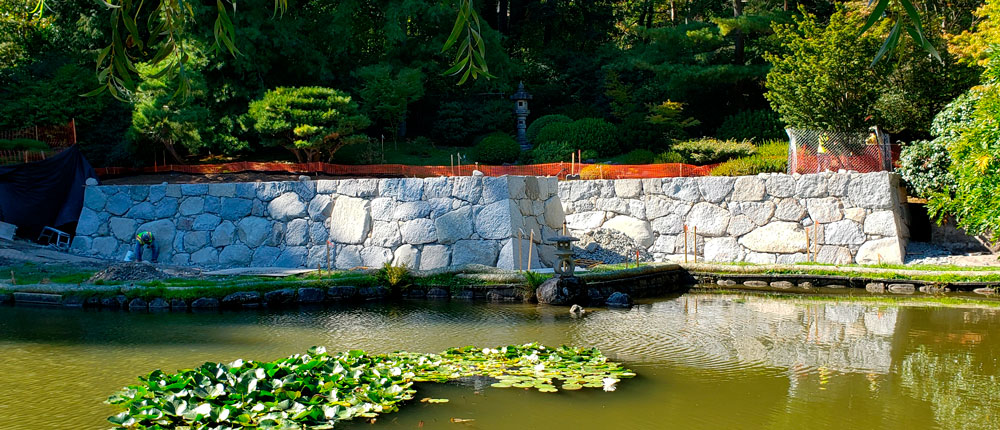
View of the new Ishigaki wall being built at the Seattle Japanese Garden. Photo credit: Barbara Mizoguchi.
This summer, the Seattle Japanese Garden (SJG) had a rare opportunity to work with the 15th generation Anōshū guild member Suminori Awata from Shiga, Japan. He was asked to lend his invaluable guidance in rebuilding the garden’s original basalt retaining wall, which was deteriorating. This vital project will also incorporate an accessible walkway allowing visitors with strollers and wheelchairs to stroll through the garden.
The garden was originally designed in 1959 by landscape architect Juki Iida and Kiyoshi Inoshita of Japan. Today, Hoshide Wanzer Architects and Berger Partnership developed a new schematic design for the entire section of the garden. Along with the new wall, it will incorporate future plans for a pavilion and surrounding landscape.
The garden’s decades-old wall will be replaced with granite stones carefully selected from the greater Cascadia region of the Northwest. Awata is collaborating with Green Man Builders, a Californian stone masonry company that has worked with him on several projects, including Kubota Garden and the Portland Japanese Garden. Over the years, they have developed similar craftsmanship, trust, and artistry.
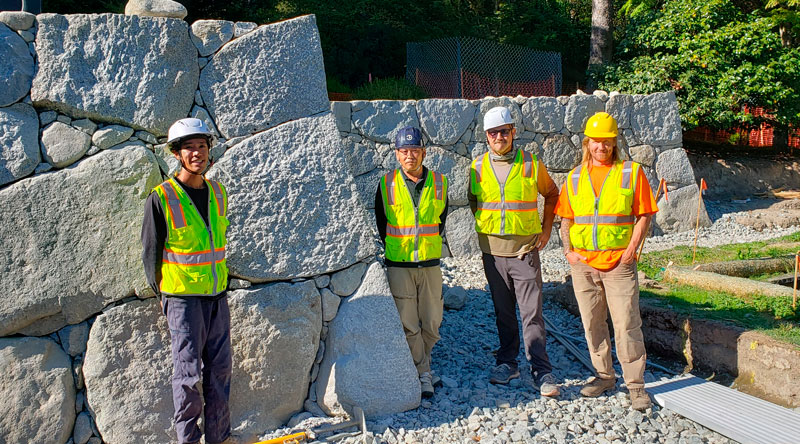
Some of the Green Man Builders helping Awata-san (second from the left) build the new Ishigaki wall at the Seattle Japanese Garden. Photo credit: Barbara Mizoguchi.
Awata works in the Anōshū style, featuring stacked, dry stones without using mortar. Instead, large split boulders and small, leftover stones are used. However, this practice goes beyond just the stonework. It involves centuries of practice, orally handed down through the family lineage. As Awata says, it is listening to the stone. A distinctive sound rings out when the stone is split with various tools. Then it is placed where it is meant to be. It takes patience, skill, and understanding of the stones.
Awata’s family has built approximately 80 percent of the stone walls seen in Japan. These include castle and temple walls that are centuries old. After junior high school, Awata began training with his grandfather Makizo Awata. At age 20, he became the head of the Anōshū tradition. He is now the president/representative director of the Awata Construction Company. His career has largely focused on repairing or maintaining existing walls built by his ancestors.
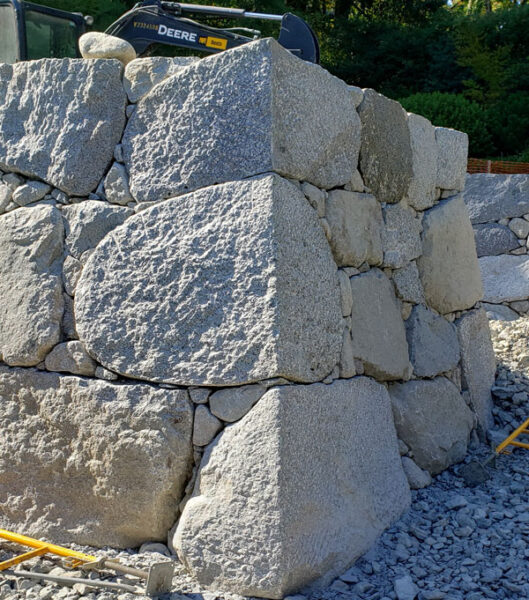
Right corner of the new, front, Ishigaki wall at the Seattle Japanese Garden. Photo credit: Barbara Mizoguchi.
The roots of Anōshū stone stacking can be traced back to the sixth century in Anou (present day Sakamoto, Otsu City in Shiga prefecture.) The Anōshū stonework can still be seen at the Enryaku temple and around the Satobo district of Sakamoto. By the 16th century, daimyō Oda Nobunaga desired the Anōshū method at his new castle because it prevented walls from falling. As a result, the Anōshū method became popular with other daimyōs wanting to build castles. However, by the 19th century, castle building and Anōshū walls diminished due to a new edict by the country to demolish them, believing they represented “old Japan”. By the 20th century, Anōshū skills were revitalized due to the long-term preservation. They are even being used in modern architecture today.
“Awata’s work is not about creating something novel or noticeably different at each location. He follows the fundamental principles and methods of the Anōshū while responding to [SJG’s] pond, terrain, and each individual stone. Through that process, a stone wall that belongs naturally … [begins to] emerge,” says Avram Dalton of Dalton Landscape. Awata first looks at the stones, decides where they will be placed, then determines the type of wall to build. He can envision what the wall will look like decades and even centuries later. Awata listens, observes, and thinks. Then he visualizes the face and the vertical and horizontal sides of the wall. He said, “When I first saw the (SJG) site, I wanted to create something that would become a symbol of this garden. I selected stones that suited that vision.” He also said, “For generations, our ancestors have taught us that a stone wall is like human society. There are large people and small people. Some have gentle, rounded personalities while others are sharp and angular. Some stones have beautiful faces, while others have rough and uneven surfaces. Yet each one has its own role, and not even one is without purpose. Both a stone wall and human society are formed when many different individuals support one another.”
Awata continued with, “Dandori begins with selecting the stones. Once I have chosen stones that fit the image of the wall I have envisioned in my mind, 80 percent of the work is already complete.” He usually studies the stones for about a day or two. If it is a large stone wall, then it might take a week. He added, “The pond is a defining feature of the Seattle Japanese Garden so I carefully considered how the stone wall would appear when reflected in the water.” Even the way the stones are chosen reflects a mason’s personality. Looking at his grandfather and father’s walls, Awata sees the difference in style. But one cannot have an ego doing this kind of work. Anōshū walls are built by and for the community to take care of in the future. Awata believes, ” … first communicate the appeal of stone walls to the younger generation and nurture the people who will continue the work. I hope that projects overseas such as this one will provide an opportunity for people not only in Japan but also around the world to discover and appreciate this tradition.”
During the construction of SJG’s wall, the public was still able to visit the garden and even view the work being done. As the large stones were hung by wires, a backhoe slowly and carefully moved them to where Awata wanted them to be. Then the team removed the wires and shifted the stones into perfect position with their gloved hands. The result is two parallel walls with a stairwell in between and the accessible pathway below.
When the wall is completed, visitors will find a safer and more accessible garden experience that includes a continuous looped and ADA (Americans with Disabilities Act) pathway. The century-old black pine donated by Seattle-born Nisei (second generation Japanese American) Richard “Dick” Yamasaki will be carefully re-incorporated with the new walls. The black pine will represent the vision, labor, and sacrifices of the Nisei. He was a World War II survivor of the forced removal of Japanese and Japanese Americans. He also guided the original SJG design intent and provided instructions used by the staff today.
Awata poignantly says, “I believe the Seattle Japanese Garden is a place where people can experience Japanese culture. By seeing this stone wall, which represents one of Japan’s traditional crafts, I hope that even those who have never visited Japan will be able to experience something of Japan here.”
Seattle Japanese Garden is operated under a cooperative agreement between Seattle Parks and Recreation, and the Seattle Botanic Gardens.
Seattle Parks and Recreation
Seattle Parks and Recreation promote healthy people, thriving environment, and vibrant community. The Seattle Japanese Garden is one of four specialty gardens among a 6,200-acre park system of 400+ parks and natural areas.
Seattle Botanic Gardens
In January 2016, the Arboretum Foundation became the primary support organization to Seattle Parks and Recreation in the operations of Seattle Japanese Garden. In 2026, the Arboretum Foundation evolved its 91-year partnership with the University of Washington to become Seattle Botanic Gardens, also a nonprofit organization. Seattle Botanic Gardens will continue to support the programming, community outreach, and fundraising of the Seattle Japanese Garden.
For more information, see: www.seattlejapanesegarden.org.