
Hiroshima/Nagasaki Atomic Bomb Victims’
Interfaith Memorial Service
By Barbara Mizoguchi
NAP Editor-in-Chief
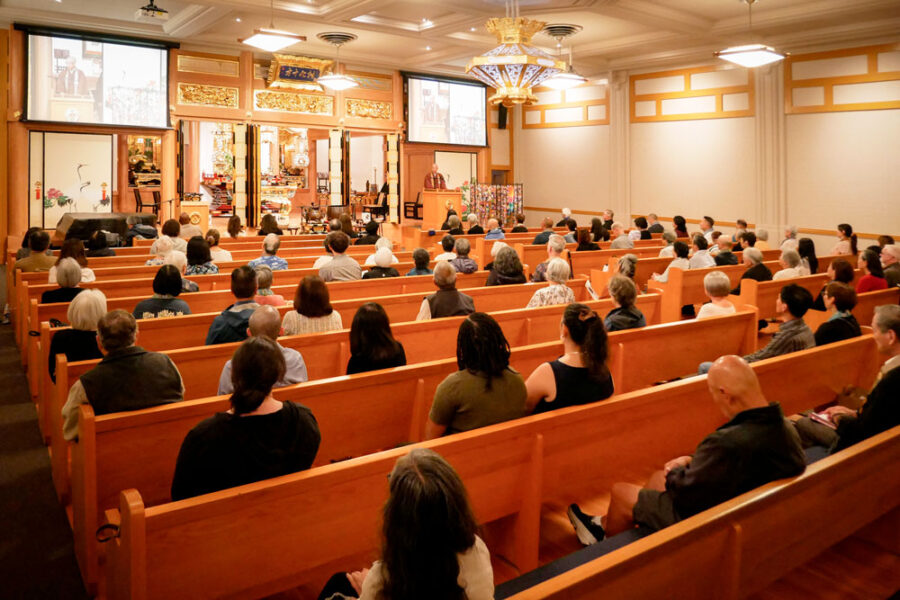
Sangha (congregation) in the hondo (sanctuary) of the Seattle Betsuin Buddhist Temple during the interfaith memorial service. Photo credit: Bruce Fleming.
Many of us learned about or survived the U.S. aerial, atomic bombings of Hiroshima and Nagasaki, Japan, on August 6 and 9, 1945, respectively. The devastating destruction of the two cities took the lives of 150,000 to 246,000 people who were mostly civilians. Many Nikkei (Japanese Americans) had friends and relatives living in those areas. Eighty-one years later, the victims are still honored and remembered, thanks to the Seattle Hiroshima Club and the Seattle Betsuin Buddhist Temple.
The two organizations have held a memorial service since 1975. Although it was initially attended by survivors and their families, today it also includes descendants and friends. In the second interfaith service which was held August 2, several local churches with messages of peace were invited to attend at the Seattle Betsuin Buddhist Temple: Blaine Memorial United Methodist Church, Konko Church of Seattle, Nichiren Buddhist Church, St. Peter’s Episcopal Parish, Wat Khemarak Pothiram Temple, and Seattle Koyasan Shingon Buddhist Temple. The theme was “Reflection on Peace.”
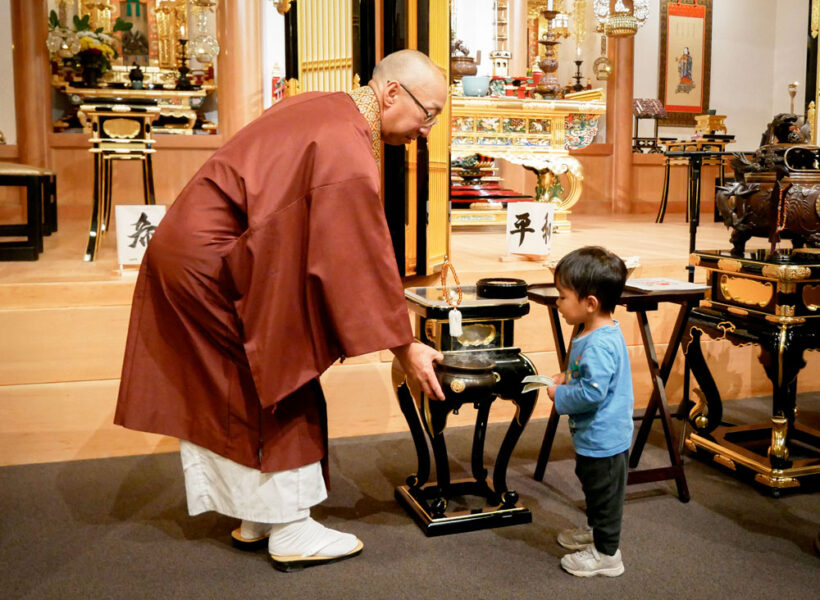
Rimban Kusunoki lowering the incense bowl for the boy to reach. Photo credit: Bruce Fleming.
As the bonsho (large bronze bell) rang from across the street, the sangha (congregation) gathered in the temple’s hondo (sanctuary). When entering, monto-shikisho (sashes) were available to wear, representing honor and respect of Buddha and the readiness to hear the Buddhist teachings. Onenju (Japanese mindfulness) beads were also available to use during gassho (joined palms). The many visitors were allowed to walk around before the service to learn about the incense burning, the beautiful new altar (refurbished after the fire), and even the area where only the Buddhist ministers can walk. The raised, gold altar at the front of the hondo represents the pure land. The inner area (exclusively for Buddhist ministers) is the naijin consisting of a large, gold butsudan with a gold Amida Buddha statue in the center. A hanging scroll on each side represents the founders and masters of Buddhism. On each side of the naijin are a few rows of elegant chairs where the ministers sit. When there is no temple service, the shoji screens are closed, covering the naijin.
Service began with kansho (bell ringing) and a moment of silence meant to calm the mind and to be present in the temple. The opening chanting was performed by Venerable So Anh Em of the Wat Khemarak Pothiram Temple. The sutra chanting “Juseige” was led by Rimban Katsuya Kusunoki of the Seattle Betsuin Buddhist Temple. Each church/organization representative then walked to the front center of the hondo, offering incense in the large, elaborate, bronze vessel which symbolizes the removal of impure thoughts and transiency of all existence.
Rev. Karen Yokota Love read an impactful prayer/poem written especially for the event. The congregation sang “Sadako and the Thousand Paper Cranes” composed by Michiko Pumpian. Afterwards, a message from Hiroshima governor Mika Yokota was read in Japanese by Dr. Tsukasa Namekata from the Seattle Hiroshima Club. Sharon Kosai from the same club read the message in English. Yokota mentioned how there is still not an international law of nuclear weapon disarmament. More research needs to be done on nuclear policies. In the meantime, we all must promote peace around the world.
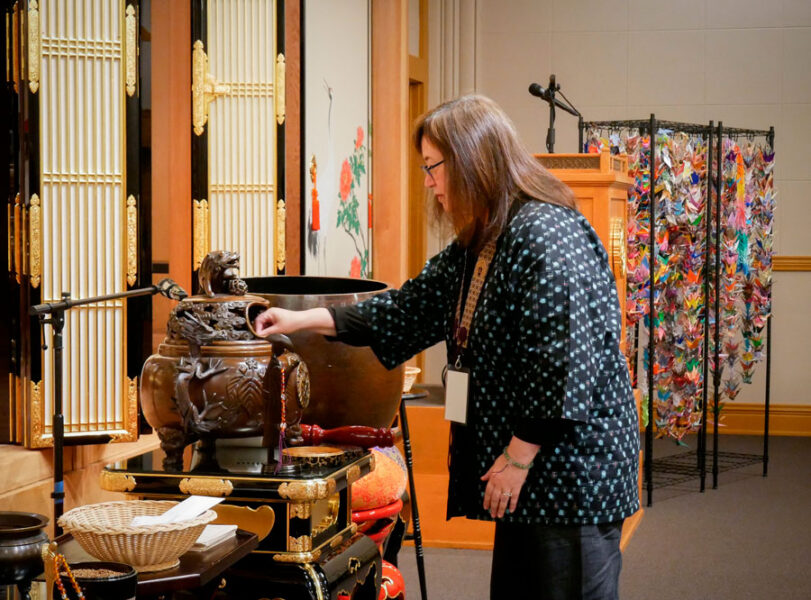
Karyn Kubo Fleming, representative of St. Peter’s Episcopal Parish, offering incense during service at the front of the hondo (sanctuary) of the Seattle Betsuin Buddhist Temple. Photo credit: Bruce Fleming.
Rev. Kusunoki delivered a poignant message, comparing dharma (the way of the Buddha teachings) with peace. 140,000 lives were lost in Hiroshima and 70,000 in Nagasaki when Kusunoki’s father (then six years old) was living in Nagasaki. He climbed a tree to watch the cicadas when someone yelled that a bomb was exploding. He ran alone to a shelter area, terrified and crying.
In 2005 and 2015, Kusunoki’s temple members in Nagasaki wrote their memories, now published in books. The Seattle Hiroshima Club videotaped its survivor testimonies which can be viewed at: https://seahiro.org/interviews.
In 2010, Kusunoki came to the U.S. for his first assignment as a minister at the Buddhist Church of Lodi in California and to further study English. In 2017, he arrived at the Seattle Betsuin Buddhist Temple. He was asked to write for the temple newsletter every month. That was when he made a personal commitment to write about the bombings. Some hibakusha (bomb survivor) memories include his father’s which were translated into English.
Kusunoki also mentioned Gene Fujita who passed away at 81 years old, wondering how many more wars there must be. He wanted the world to be at peace but the wars continued. The hopes and wishes of hibakushas have not been answered. Kusunoki was thinking about what he could do. Historically, religion can cause conflict and contribute to wars. Hiroshima has a peace park and Nagasaki has an interfaith friendship. Division can cause conflict but religion can promote peace. He encouraged the sangha to continue joining in the memory of Hiroshima and Nagasaki. We must kindle peace and shine in our community.
The closing prayer was by Rev. Robert Giulietti of the Konko Church of Seattle. Temple announcements were made by various individuals. The folded cranes displayed in front of the hondo were made by the community.. A thousand were folded by Blaine members. After the service, a display of the bombings and a video recording of hibakushas were shown downstairs of the temple. The hope is that more faiths will join the Seattle Hiroshima Club and the Buddhist temple in the future.
The Blaine congregation was treated to a tour of the temple. A fire had occurred on December 31, 2023, which reignited on January 2, 2024. There was no alarm. Smoke went up one of the crawl spaces from the basement to the hondo. All the library books were lost plus many articles. Items also started to mold from the ash and moisture. Densho along with over 125 volunteers helped with the archive recovery.
The new naijin was officially opened during the 2026 summer obon (Japanese Buddhist festival). After the fire, the hondo was full of smoke with soot covering every surface. A cleaning company came in but the naijin was ruined. It had to be disassembled and sent to Japan for repairs. In Japan, there are only two major companies that could do this type of restoration. It took two workers plus a dozen volunteers to dismantle it. A 40-foot truck was needed to move it and it took over a month to ship. Since there are no nails in the naijin, the pieces fit together like a puzzle causing a need for a spreadsheet listing each piece for re-assembling.
The electrical system was the old knob and tube wiring that had to be completely replaced and upgraded. This also provided an opportunity to install air conditioning. Since the original locked doors down the hallway were broken by firefighters (who needed to enter and ensure that no one else was in the building), new doors and electronic locks were installed. The lack of a sprinkler system was grandfathered in when the temple was built in 1941.
The next phase of the restoration will be to install an ADA (American Disabilty Act) elevator by removing one of the rooms. However, fundraising is needed. See Seattle Betsuin Arson Restoration & Building Fund at: https://seattlebetsuin.org/fire. For more information, contact: ArsonRestoration@SeattleBetsuin.org.
Established in 1901
Our temple has served as an important place of listening and sharing the message of the Buddha for over 100 years.
Services
Join us for Sunday service at 10:00 a.m. in-person or online via YouTube!
Visit
1427 South Main Street Seattle, WA 98144
206-329-0800, office@seattlebetsuin.org
Office Hours: Mon, Tue, Thu & Fri 9:00 a.m. – 3:00 p.m.
The Seattle Hiroshima Club aims to engage with the greater Seattle area about our proud Hiroshima heritage, educating future generations of the devastation of the atomic bomb, and the promotion of peace. We promote the general welfare of the Japanese American community and encourage the relationship with the Hiroshima Prefecture in Japan. We invite you to join us in our efforts!
Contact Us: info@seahiro.org or see: seahiro.org.