By Pamela Okano
NAP Contributor
In 2024, the Nakata family celebrated 100 years of the farm ownership with a big family reunion. This article will tell the story of the family and the farm. Initially, the farm was used primarily to grow strawberries with help from members of the Membrere family, a Filipino family on the island. By the 1930s, Bainbridge Island was known as the strawberry capital of the Pacific Northwest.
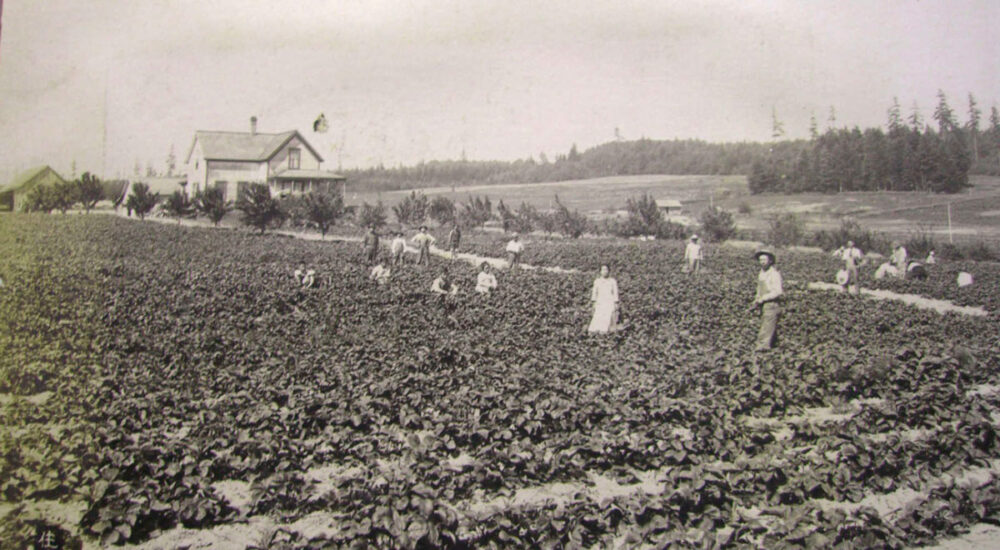
Middlefield Farm, 1930s. Location unknown. Photo courtesy: Pamela Okano.
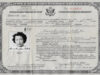
One hundred and three years ago, Issei (first generation Japanese immigrants) Jitsuzo Nakata purchased the 15-acre Sumiyoshi strawberry farm on Bainbridge Island in Washington. Well, he did not really buy it. Under the alien land law, he could not because he was not a citizen. Moreover, the law prevented him from becoming a citizen. He also could not put the property in the name of his American-born oldest son Masaaki because he was not old enough. So, the property was put in the name of a Nisei (second generation Japanese American) neighbor, Ione Nakao, until Masaaki was old enough to be the landowner.
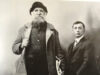
Nakata first came to Bainbridge Island from Agenosho, Yamaguchi Prefecture, Japan in 1892. Initially, he worked at a mill in Port Blakely. Two years later, he was called back to Japan for military service in the Sino-Japanese War in 1894. At the end of that war, he returned to Bainbridge but was again called back to Japan, this time to serve in the Russo-Japanese War of 1904. By 1906, the war was over and Nakata married a girl from his hometown named Shima Akimoto. He returned to Bainbridge Island with his new wife where they lived and operated a barbershop and laundry in Winslow, a small town on the island.
In 1909, Sumiyoshi had constructed a large two-story farmhouse on the farm that included space for preserving strawberries. Subsequently, demand for canned strawberries increased so much that it became impractical to can the berries in the farmhouse so the berries were shipped to Seattle, Washington. By the early 1920s, however, a cannery was constructed just a few blocks away from the farm and by the 1930’s, Bainbridge Island was known as the strawberry capital of the Pacific Northwest.
The family had a large circle of Japanese friends on the island. Nakata and three of his younger sons also struck up a friendship with the Loveriches, an immigrant Croatian family. The Loveriches purchased a grocery store in 1921 delivering ice to Nakata who used it to keep meat fresh. The Loverich-Nakata friendship would later prove to be a pivotal one for both families.
In 1931, facing declining revenues from the barber-laundry business, Nakata suggested that his oldest son might want to inquire about a job at the Eagle Harbor Market, a local meat market. The owner, Charley Bremer, a German immigrant, could not pronounce “Masaaki.” Consequently, he named him “John.” John learned the butcher trade there. His younger brothers Momoichi “Mo” and Gerald (“Jerry”) did odd jobs and learned how to butcher.
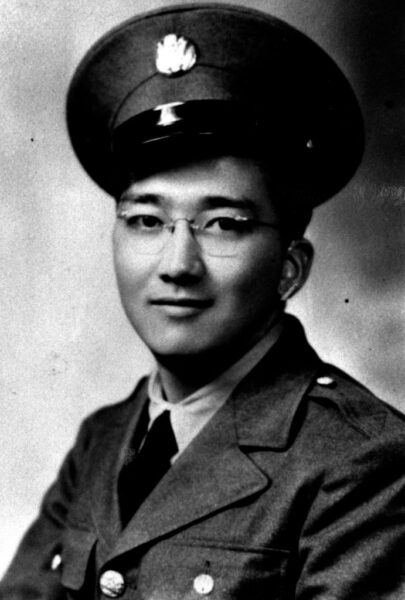
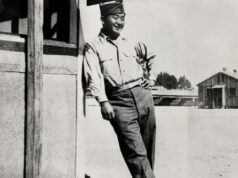
Momoichi “Mo” Nakata in the U.S. Army 442nd Regimental Combat Team. 1943-1946. Photo credit: Densho.
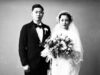
The Nakatas had seven children who lived to adulthood. In 1933, the two eldest, John and Shigeko (Jean), married a sister (Yukiye Pauline) and a brother (Joseph) from the Kawamoto family in a double wedding on the Nakata farm (8/31/23 NAP https://napost.com/2023/voices-0825). After their double honeymoon, John and Pauline began living in the farmhouse, where their first son, Donald Tadashi, was born. John bought Eagle Harbor Market in the 1930s and his family moved into the shop’s living quarters.
By the 1940s, the strawberry market was declining. John tore down the old family barber-laundry house and built a new grocery store. His wife, children, and the rest of the family all moved into the old farmhouse, where they grew vegetables to supply the grocery store.
Then came the bombing of Pearl Harbor U.S. Naval Station in Hawaii during World War II. On March 24, 1942, soldiers posted notices around the island that “all Japanese persons, alien or non-alien” would be “evacuated” just six days later. This would be the first time the U.S. Army had moved whole families of Japanese descent. John and his wife now had three small children, Donald Tadashi (7), Robert Kenji (6) and Wayne Yoshiaki (2). All were American citizens by birth. Apparently, the U.S. government preferred the word “non-alien” to calling them what, by birthright, they really were — American citizens.
John was forced to sell the grocery store in less than a week. When a Bainbridge Review newspaper reporter came to talk with him, he brushed off the difficulties, instead saying, “I want you to write a little piece in the paper about how I appreciate all the island has done for me … Tell them I thank them for their many kindnesses and offers to help …” He could not finish. Later, he wrote a letter that was published in the review: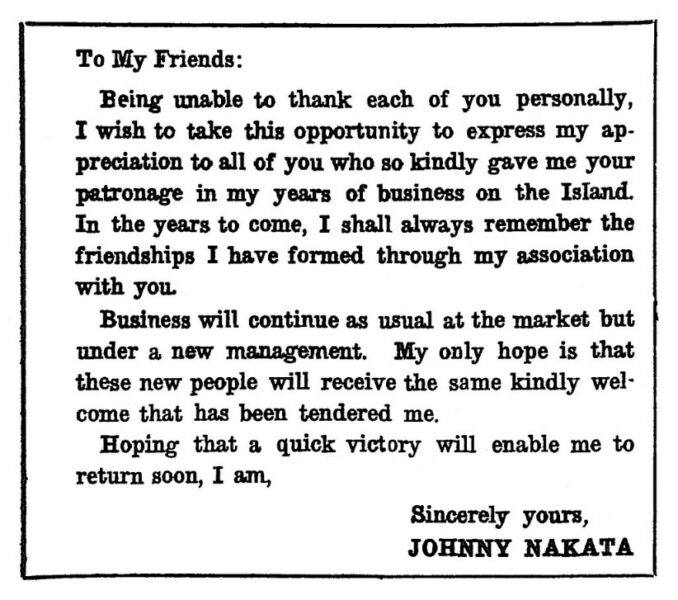 The Loveriches gave John Nakata’s family a private place in which to store their belongings including Jitsuzo Nakata’s truck. During the war, the farmhouse was rented to a Filipino family, the Vadalions, who took care of the farm.
On March 30, all 11 members of the Nakata family, together with 265 people of Japanese descent, boarded a ferry to Seattle. They would catch a train to go to who knew where?
The train went to Manzanar Incarceration Camp. Cultural tensions in Manzanar grew between the California city folk and the Bainbridge Island farmers. Eventually, many Bainbridge incarcerees decided to move to Minidoka Incarceration Camp in Idaho. The Nakatas stayed in Manzanar.
While in the camp, the Nakatas’ U.S. Naval Station second son, Momoichi “Mo”, joined the U.S. Army 442nd Regimental Combat Team as a radioman and helped rescue the “Lost Battalion” in France. He was wounded by shrapnel, which required a month-long hospital stay in England. He was awarded a Bronze Star and Purple Heart. The Bronze Star was because, despite his wounds, Mo refused evacuation and dragged himself along, so that he could continue broadcasting to help his comrades.
The family returned to Bainbridge Island in 1945 but did not resume farming. In 1946, Mo Nakata married Sachiko Koura. Yet, neither he nor his brothers John and Jerry could get jobs. So, they ended up wrapping line guides onto bamboo fishing poles to be sold in Canada.
It was Mo who came up with the idea of starting a grocery store. His friend, Ed Loverich (who had been an All-American basketball star at the University of Washington), decided to go in with him in the now vacant Bainbridge Gardens grocery store. John Nakata declined, because he believed that the store would be too small for three owners. Mo and Loverich opened their store in 1947. Mo cut meat while his brother Ken helped out. Loverich managed the grocery department.
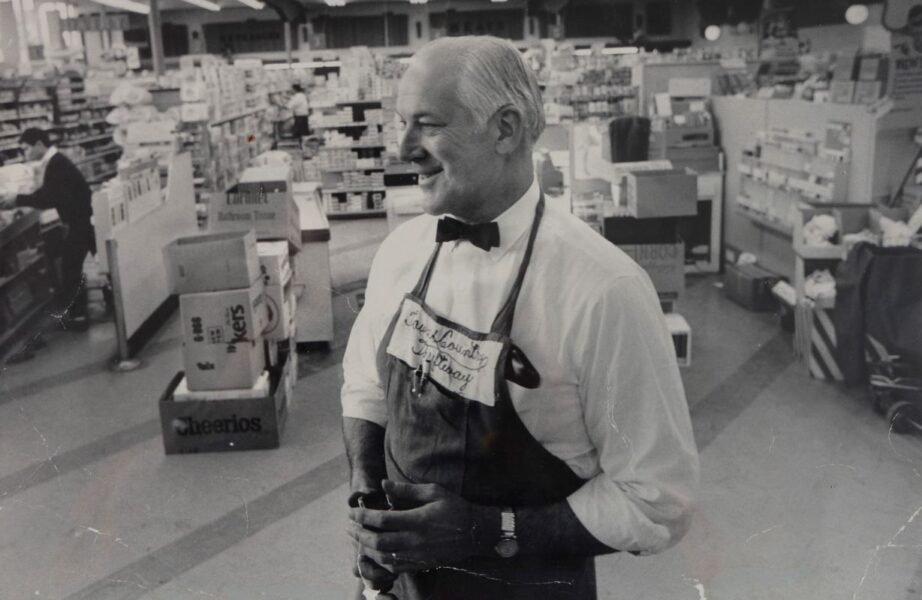
Edward Loverich, one of three partners of Town & Country Market, Bainbridge Island, WA. Date unknown. Photo courtesy: Susan Nakata Allen.
In the meantime, John and Jerry Nakata leased a grocery store on Capitol Hill in Seattle. John was able to save enough cash to buy back the Eagle Harbor Market. Jerry then took over the Capitol Hill grocery.
Shima Nakata passed away in 1949. Jitsuzo Nakata followed her in 1955. Although John had succeeded in paying off the mortgage on the farm several years earlier, the elder Nakatas did not live to see their family’s greatest successes.
John Nakata’s grocery store, as well as Mo Nakata’s and Loverich’s, were quite profitable. However, neighborhood grocery stores were coming to an end. A group of Bainbridge Island residents and businessmen formed Bainbridge Investors, Inc. It was decided that they needed a supermarket with plenty of off-street parking to anchor the business district in Winslow. They approached Mo and Ed Loverich.
One problem was that the site the investors group had chosen for the new business was just a block or two away from John’s market. Ed and Mo said that John had to be part of the enterprise. When John agreed to participate, the three of them were able to capitalize on the island’s first supermarket, Town and Country (T&C) Thriftway.
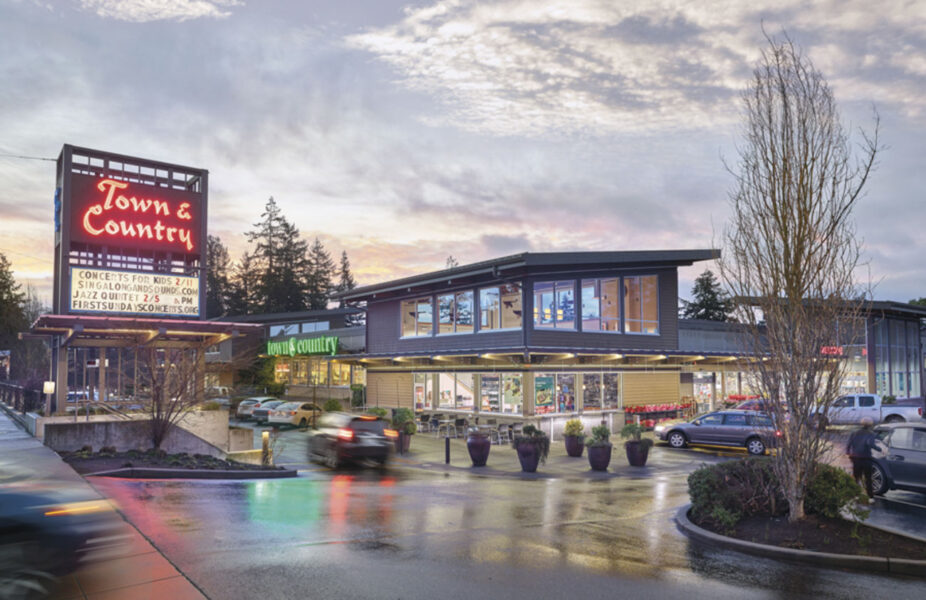
Town & Country Market, 43 Winslow Way E., Bainbridge Island, WA. Photo credit: Town & Country Market.
John’s oldest son, Don, had graduated from Seattle University with a degree in business administration, the first Nakata college graduate. He helped his father, his uncle, and Ed develop the store.
The grand opening was on August 29, 1957. Bainbridge Island was a very different place then—much more rural, significantly less populous, and less wealthy. Almost everyone knew everybody else. The adults were excited because many people had never seen a supermarket before. Not only that but the great Joe Louis “the Brown Bomber” (world heavyweight boxing champion 1937-1949) and his erstwhile opponent, Max Baer, would be there. Children were excited because Stan Boreson, a local children’s entertainer, was coming. Plus, the store was handing out free ice cream cones! Sadly, Don could not attend the grand opening. At the time, there was a mandatory draft system in place, and he was serving in the Army.
Wonder of wonders! At the new store’s entrance, there were automatic sliding doors, which no one had ever seen before. The 10,416 sq. foot market was the largest in North Kitsap County. Inside, Mo and John were at the open meat counter, assisted by Sam Nakao, whose older brother had helped Jitsuzo buy the farm so many years before. Ed was again in charge of groceries. Ken Nakata, John and Mo’s youngest brother, oversaw the dairy department. Ed’s sister was the bookkeeper, and his father-in-law was the produce manager. Wayne Nakata, John’s second youngest son, was a box boy. Wayne’s mother, Pauline, would have likely been a checker. The previous year, she had given birth to the couple’s youngest son, Vernon. Meanwhile, Mo’s eldest son, Larry, and two of Ed’s brothers worked as “bottle boys” in charge of redeeming returned bottles.
T&C became what Starbucks is today — a place to meet your neighbors and friends. Everyone knew the number 1 and number 2 checkers, Kay Nakao, and Fujiko “Fudge” Sakuma. Out front was a 30-ft cedar sign board that originally advertised sales but since the 1970s, it has been used for community announcements. Since two of the owners were Japanese Americans, there was plenty of Japanese food—rice, shoyu (soy sauce), tofu, etc. It was the only place on the island, and most likely in Kitsap County, where you could ask for “sukiyaki meat” and not have to explain what it was. Interestingly enough, the store sponsored annual sukiyaki dinners at the local elementary school that were popular for years.
John retired in 1971. His son Don purchased his shares in the company. When Mo suffered a severe heart attack in 1971, Don’s responsibilities for the store increased significantly.
In the 1970s, inflation became a big concern for everyone. Accordingly, Don introduced a new discount grocery, Viking Mark-It Foods, in Poulsbo, a small town on the mainland of Kitsap County. His uncle, Jerry, managed the produce department; Don’s wife, Ellen, became the bookkeeper; and cousin Larry (Mo’s eldest son) worked in the grocery department.
Both stores specialized in customer service. When Mo heard that a customer had died, he would deliver ham to the grieving family. Ed would use his own money to buy products that customers requested and the stores would sell them to the customers at cost.
Kay Nakao made it her personal mission to win over a gentleman who had been part of a small but vocal, anti-Japanese American minority on the island, and she succeeded! At Mark-It, the deli would give first-time customers a free half pound of sliced meat and a free half pound of cheese.
With John retired, and Ed and Mo scaling back their involvement in the stores, Wayne Loverich, Ed’s nephew, began to assume a larger role. Wayne introduced specialty foods to the stores such as Bon Maman jams from France, free-range chickens, gourmet mustards, and specialty cheeses. As inflation became a lesser concern in the 1980s, these products became quite attractive to customers and remain so today. Mark-It Foods also evolved from its discount roots to become the Poulsbo Market Place, managed by Larry. One customer wrote, “I drive from Bremerton once a week [approximately 20 miles] to shop at Poulsbo Market Place, bypassing other grocery stores along the way. The journey is worth it. There are things that motivate me to shop at the market—organic produce, the best selection of bulk dried goods I’ve seen anywhere, and environmentally sound paper and cleaning products. Shopping, which is usually a chore, has been an hour of delightful discovery every week.” In 1994, the Poulsbo Chamber of Commerce named Larry its “Person of the Year.”
In the meantime, Don continued to explore avenues to expand. In 1986, he and a partner, Bill Weymer, opened the newly remodeled Ballard Market on the site of a previously failed grocery store. Ballard Market became famous for its “Singles Night” where single people could meet and mingle. The second “Singles Night” was so successful that the Seattle Fire Department had to shut it down because of the number of people who showed up. Ballard Market also sponsored a precision drill cart team—a group of employees that marched while pushing grocery carts. This was an idea borrowed from the Bainbridge and Poulsbo stores where teams marched in local celebrations.
By the late 1980s, John and Ed had retired, and Mo had passed away. Don was now completely in charge. He and Mr. Weymer then opened another store in Bellevue, Overlake Market.
By 1988, Don’s accomplishments began to be recognized. Food Dealer magazine named him “Grocer of the Year” in 1988. In 1989, the four T&C stores were included on Progressive Grocer magazine’s Honor Roll of “Outstanding Independent Grocers.”
Nevertheless, back home on Bainbridge Island, a threat was looming — Safeway was coming to town. On the day in 1990 that Safeway opened on the island, the T&C store was undergoing a major remodel that would take months to complete. When the renovations were done, customers discovered many new features to help make their lives easier. There was a full-scale deli with food that had been cooked in-house in consultation with a New York restaurateur, a salad bar, an organic produce section (the first in the state!), a large wine cellar, a housewares shop, and a natural and bulk food department. If that did not cement the emotional bond islanders had with the store, The Great Blizzard of 1990 did.
(Story continues in the next NAP issue.)