
Japanese Judo Olympian Shares His Special Skills
By Hana Hiraoka and Calvin Terada
NAP Contributors

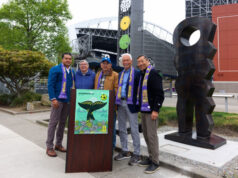
Terada family – all judo practitioners with Hiraoka sensei. Left to right: Calvin Terada (6 Dan); Nathan Terada (Calvin’s son, 1 Dan); Hiroaki Hiraoka, sensei; Mitsuko Terada (Calvin’s mother, 4 Dan); AlvinTerada (Calvin’s father, 7 Dan); and Marvin Terada (Calvin’s brother, 4 Dan).
Olympic Games medalist Hiroaki Hiraoka from Hiroshima, Japan spent a day in March inspiring 122 judoka (judo practitioners) to reach their highest potential. They were from all over the Pacific Northwest in the U.S. The event was held at Kentridge High School in Kent, Washington.
The day was divided into two sessions starting with the youth, from six to 16 years old, learning from one of Japan’s most accomplished judo practitioners and medalists. The afternoon was later filled with adults from beginners to (black belt ranking) instructors, all wanting to learn techniques that made Hiraoka an Olympic medalist.
Hiraoka-sensei (teacher) had everyone bow in, which is an important Japanese tradition that helps make judo different from any other Olympic competition. Youth from different judo dojos (clubs), wearing all colors of obi (belts) which indicate rank and experience, warmed up together. Hiraoka-sensei’s 13 year-old daughter, Hana, participated in this session and said, “I really liked the warm-up because I got a chance to practice with people I have never met before.”
Hiraoka-sensei then started with the basics of how to grip one’s opponent, a key secret to his success which was built over 34 years of learning, practicing, and competing in judo. He explained how gripping is important to throw, and to defend. Hiraoka-sensei followed-up by having all the students participate in an exercise using their own belt to build the muscles to grip and control their opponents. He carefully watched all the young students pull each other across the mat. Then he asked all the other instructors to help so that each judoka learned how to properly pull each other across the mat.
With the students fully warmed-up, Hiraoka-sensei then demonstrated one of his favorite throws. Judo competition is like free-style wrestling with standing takedowns or throws to the back with speed, force, control, and impact. Judoka can achieve a full point with a throw or beat their opponent using mat work through a pin or submission. With the care of a true master, Hiraoka-sensei started by teaching “seoi nage”, which is one of the most famous throws known in judo. He taught the hand and leg movement, and then asked everyone to grab a partner and try it. “Sensei’s favorite techniques like seoi nage, is great to understand how he teaches. The level of detail and precision is so high, it really helps make everyone’s technique better, even though it’s hard to absorb it all” said Pepper Uno-sensei, from Seattle Dojo.
After a short rest, Hiraoka-sensei spent the next two and a half hours teaching advanced judoka a unique throw called the reverse seoi nage or Korean seoi nage which was developed in Korea. Marvin Terada-sensei from Budokan Dojo, who also helped to sponsor the clinic, said “These judokas are in for a treat because Hiraoka-sensei was the first judoka in Japan to make this throw famous!”
“The clinic was fantastic because Hiraoka-sensei carefully walked us step-by-step through how to throw using his favorite techniques. For example, I have never learned the reverse throw and his experience made the explanation easier to understand. The attention to details was very helpful,” says Jayne Loo, a student from the Budokan Dojo.
“Today was a special day!” said” Yuko Mera–sensei from the University of Washington Judo Club. She continued by sharing, “I think everyone learned a lot from him. We had different levels of judoka here today, and I think everybody can go home with something they could work on.” After bowing out, Hiraoka-sensei expressed words of appreciation to end the wonderful clinic.