From Shikoku to Seattle The Tsuyoshi and Yayoi Inouye Family History Part.2
By Geraldine Shu
NAP Contributor
This is a continuation of the NAP article from the October 2025 issue.
EVACUATION AND INCARCERATION
Howard (the fifth child) had four older sisters. He often said he was bossed around by them. He was very interested in baseball like his father. They would follow the games on the radio with Leo Lassen (Seattle baseball announcer). In 1940, Lloyd (the sixth child) was born ten years after Howard when Yayoi Inouye was 40 years old. When the evacuation orders came for all Japanese and Japanese Americans on the West Coast of the U.S. in 1942, Lloyd was only a year old and ill with amastoid ear infection and pneumonia. Curfew for the Japanese was at 8 p.m. When the doctor came to the house, he decided that Lloyd needed to be taken to the hospital. He took him to Providence Hospital himself and arranged for the toddler’s care. The next day, the family was able to visit. Frances recalled going to the hospital for a direct blood transfusion for Lloyd since they shared the same blood type. She remembered being nervous because of the resentment against the Japanese.
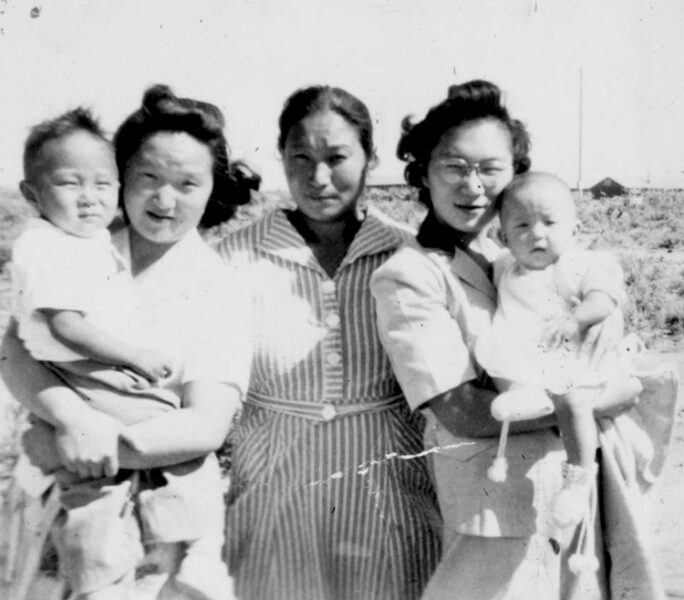
Left to right: Lloyd, Fran, Grandma, Bessie, and Di in Minidoka, Idaho, 1942-1945. Photo courtesy: Geraldine Shu.
When Japan bombed Pearl Harbor, Hawai’i, in December 1941, no one talked about it. Many in the Japanese community were shocked that Japan would have the nerve to attack America. The Inouye family was not harassed although the shipyard customers initially quit coming. They eventually returned because they still needed to eat.
U.S. Executive Order 9066 was issued in February 1942. More than 7,000 Seattle Japanese were given two months to evacuate, forcing them to leave businesses and property behind, causing many of them to lose their acquired wealth.
To prepare for evacuation, Tsuyoshi Inouye and one of his daughters placed a sign on the door of the restaurant thanking customers for over 20 years of patronage. A padlock was snapped in place because there was no time to sell the business prior to departure. Before the evacuation, the restaurant property was under lease from Charles Clise. Each year prior to renewing the lease, Tsuyoshi Inouye would worry. However, when the restaurant had to be closed due to the evacuation, the owner refused to release him from the lease; even while in internment camp, he continued to charge $100/month rent. Later, with the help of a lawyer, the furniture (tables, chairs, mahogany counters, and heavy mirrors) in the restaurant was used as partial payment of the debt in addition to a monetary settlement. In the meantime, the restaurant equipment, such as dishes, pots, and pans, was stored in the basement of the family home with their other household items. Some friends asked to store their possessions, so part of the basement was “fenced off.”
Howard helped his mother reinforce straw kouri (packing boxes), stuff duffle bags with clothing, and store countless belongings in the basement of the house. The children were released early from school. In the spring of 1942, under escort of military guards, the Inouye family and numerous other Japanese families boarded outdated Greyhound buses which were lined up along 11th Avenue in Seattle. They did not know where the buses were taking them. When they reached the Puyallup fairgrounds in Washington, they were given the last of a series of typhoid shots and had to stuff their own mattresses with straw.
While in Puyallup at “Camp Harmony”, Bessie received her University of Washington (UW) diploma at a graduation ceremony held at the horse racing stadium. To keep from getting separated during the evacuation, she and Roy Okada were married in April 1942 by Reverend Emery Andrews who performed many quick marriages for the Nisei (second generation Japanese Americans). She and Roy went to Camp A in Puyallup while the rest of the family went to Camp D. Seattle Japanese families stayed in “Camp Harmony” for three months until their permanent incarceration site at Minidoka, Idaho, was completed.
Since Ruby was a junior at the UW, her withdrawal from school in April 1942 left her education, and that of 440 other Japanese American UW students, unfinished. Plans were being made by concerned educators (including UW President Lee Paul Sieg) to find schools that would allow more than 2,500 Japanese Nisei students to continue their education. Ruby wanted to change her major from home economics to pre-med. She approached her father, who asked her why. He told her that girls were expected to marry and raise a family. Ruby’s reply was that she did well in school, graduating as salutatorian of her high school class, that she was healthy, hardly missing any school days, and that she wanted to do something for humanity. Tsuyoshi Inouye thought about this for several days before he gave her his reply to “go ahead with your ambition.” He also told her that when she became a doctor, she was to take care of the family. While the family was interned, there was never any question about Ruby spending the family savings to continue her schooling.
She was eventually accepted at the University of Texas. Upon arriving in Texas at the train station, Ruby went in search of the restroom. She was confused by the “white” and “colored” signs for separate facilities and was unsure which she should use. Necessity made her choose one. She realized that the people in Texas were not as concerned about Japanese as they were about Black people. She started school February 1, 1943, living with a Quaker family. Ruby did minor household chores and babysittng in exchange for room and board. In June 1944, she graduated with honors and was accepted to the Women’s Medical College of Pennsylvania in Philadelphia. All this time, her family was interned at Minidoka, Idaho.
Frances left camp in early 1943 to work in Jerome, Idaho, and Salt Lake City, Utah, doing chores as a live-in maid for a family. Lillian believed that being put in incarceration camp was the best thing that happened to her because it was there that she became a Catholic and met John Matsudaira, her future husband. She left camp in 1944 with her friend, Nobie, and moved to Philadelphia where they both found jobs. They rented an apartment, which they shared with Ruby during her first year of medical school. Lillian found a job at an insurance company. She and Ruby lived on the $10 – $20 per week that she earned.
Howard recalled camp being more of an adventure rather than one of anxiety and sacrifice. As a teenager, he played cards and baseball often since very little homework was required of the students. Lloyd was just a baby, so Yayoi Inouye was busy caring for him during the incarceration years. She also served as a waitress for Block 15 dining hall. Tsuyoshi Inouye worked in the hospital kitchen stockroom, ordering and keeping track of supplies with Yayoi Inouye’s cousin, Mr. K. Yamamoto. He earned $12/ per month. The family was in camp from August 1942 until June 1945. In early 1945, as the war was winding down, the word was that those interned would be permitted to leave and return to the coastal regions.
In fact, everyone was ordered to leave. Where would they go? How would they survive? While playing on the floor of 15-3-B, their camp location, Howard overheard a conversation between his mother and father. Tsuyoshi Inouye was telling Yayoi Inouye that living in a camp had taken away their means of a livelihood. Now, having aged much more than his 57 years, he worried about how he would provide for the family. He said to her, “Now that I am old, I worry about whether I will be able to start all over and make it outside.” Then he blurted out, “I worry so much, I haven’t been able to sleep at all for the last several nights!”
THE POST-WAR YEARS
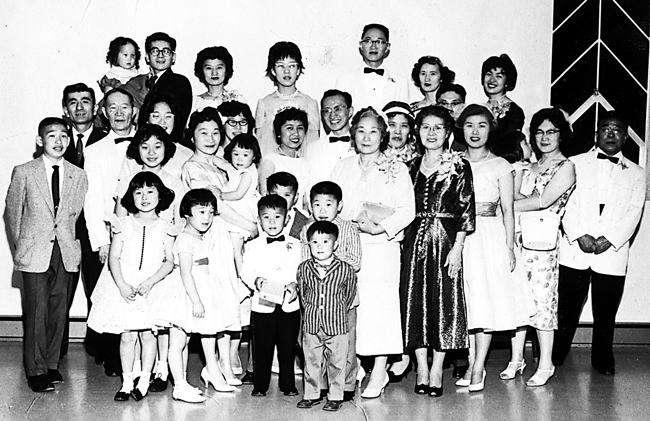
Inouye family, 1960. Photo credit: Geraldine Shu.
After the war, many Seattle Japanese returned to the International District having to essentially start over economically as well as face open hostility in the Northwest. Tsuyoshi and Yayoi Inouye returned to their Spruce Street home in June of 1945. Unfortunately, while they were away, most of their stored possessions had been ransacked by renters. An agent was responsible for renting out the house at $25 per month but with frequent changes in tenants, the house itself was not well-cared for. Some of the mattresses even had bedbugs. Furthermore, the large beautiful Japanese cherry tree on the front lawn was cut down to an ugly five-foot stump. In 1947, Tsuyoshi Inouye began operating an apartment building, eventually selling and moving the family out of their Spruce Street home. Yayoi Inouye worked as a seamstress in the garment industry. Seven or eight years later, Tsuyoshi Inouye bought another apartment building. They labored so that all their children could attend and finish school, recognizing that education was the key to success in America. Tsuyoshi and Yayoi Inouye finally retired in 1963, selling both apartment buildings and purchasing a home in Seattle’s Rainier Beach neighborhood. Yayoi Inouye stayed busy gardening, teaching ikebana (Japanese flower arrangement), and attending the Japanese Baptist Church.
Bessie and Roy Okada were expecting their second child when they returned from camp in 1945. When Bessie visited a doctor, the doctor declined to take on her care, stating that his other patients might get upset. They operated a grocery store, and both worked at Boeing in different capacities.
Ruby started her own medical practice in Seattle’s International District and married Dr. Evan Shu in 1951. They eventually built their own medical office building where they spent most of their careers. From Salt Lake City, Frances then moved to Cleveland, Ohio, and married Ben Ogino. Lillian married John Matsudaira after he returned from Europe with the U.S. Army’s 442nd regiment at the end of World War II. Howard graduated from the UW with a degree in mechanical engineering and worked for a while at Boeing. He eventually changed his career to focus on religious work and married a girl from Hawai’i. Lloyd left camp with his parents and returned to Seattle when he was 5 five years old. He attended the Seattle Public Schools then graduated from the UW with a mathematics degree.
In the 1980s, after Tsuyoshi Inouye passed away, Howard sat talking to his mother at the kitchen table about the past. He thought about how she had come to America in 1918 as an 18-year-old picture bride, not ever having seen her husband before, to a strange land. He asked her, “Mom, what would you say was the most difficult experience of your whole life?” After a short pause to collect her thoughts, she replied, “When we had to go to camp and ended up losing all that we had worked so hard for and then to start all over.” However, she stated this without any sense of bitterness. In fact, she seemed to have been made stronger by it.
The Inouye family continues to thrive with 77+ members as of this writing. Family gatherings are held at least twice a year, usually with games which originated with Yayoi Inouye and continued by Howard until his passing. Many family members have visited the small villages in Shikoku, Japan, where Yayoi and Tsuyoshi Inouye originated and have connected with the Japanese relatives living there. Even though the American and Japanese relatives speak different languages, the energy is the same. Their strength, resilience, and perseverance live on in each family member as do the family values that Yayoi and Tsuyoshi Inouye so treasured.