INTERVIEW:
Yu Ugawa, Coordinator at Kimono Art
By Hitomi Kato
NAP Contributor
Translated by Bruce Rutledge
NAP General Manager
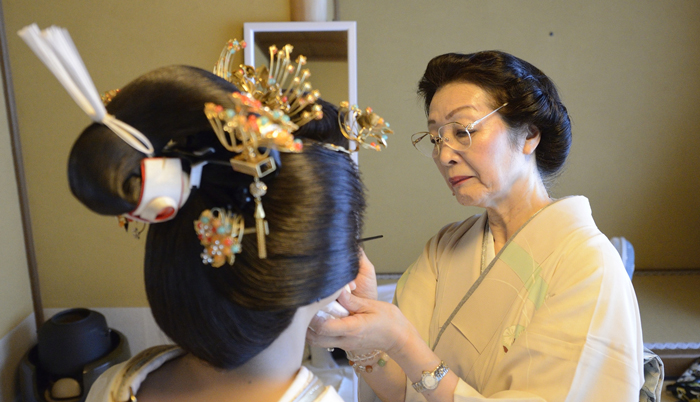
Yu Ugawa finishing the make-up on her model prior to a kimono show. Photo credit: Kimono Art.
Yukiko “Yu” Ugawa was born in Ashiya City, Hyogo Prefecture in Japan. She married into a long-established kimono shop in Kobe, Japan, called Kaneshou and aspired to become a professional kimono stylist.
In 1985, she established the Kaneshou Kimono Styling Academy. Five years later, she founded the Kinki Kimono Styling Association. In 1993, she expanded it into the You & Yu Kimono Styling Academy, introducing a new era of kimono coordination. The following year, she launched Bridal Group You & Yu, expanding into the bridal industry. Following the Great Hanshin Awaji Earthquake of 1995, she proposed Wayu-gi®︎, a style of wearing kimono freely like Western clothing. In 2010, she established the NPO (Non-Profit Organization) Ai Love Kimono Kōkai to promote kimono culture. Nine years later, she founded the general incorporated association Kimono Art. In Seattle, Washington, she provides kimonos for the annual Coming-of-Age Ceremony USA and hosts shows at various events such as Japan Fair.
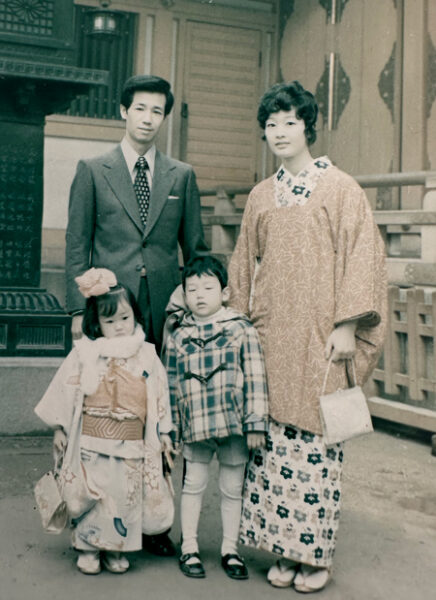
In this family portrait, bottom left Mariko is wearing a kimono that was generously raised at the shoulders and waist. “The obi was heavy, and she looks tired in the photo, as if she were carrying a school bag,” Ugawa says with a laugh. Photo credit: Kimono Art.
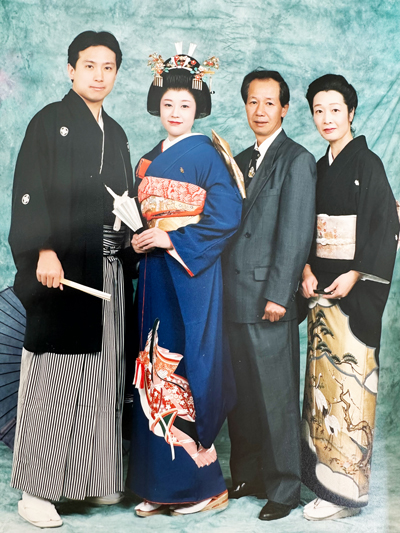
The furisode kimono that Ugawa tailored for her daughter, Mariko, is now worn as a color-coordinated kimono. Photo credit: Kimono Art.
From“Young Lady” to “Proprietress”
Ugawa tirelessly promotes traditional kimono culture around the world these days, but her deepest ties are to Seattle and Kobe. She grew up in a family that embraced Western culture. Her father was a pianist. Her mother was also a musician. As a daughter of two classically trained musicians, Ugawa’s formative years were in an atmosphere about as opposite to kimono culture as one could imagine. It seemed that her fate was already decided. “If I had been a boy, I would have become a pianist,” she says. “But since I was a girl, I was expected to marry and become a normal housewife.”
In 1965, at the age of 19, she married a friend of her cousin, Motohide Ugawa. He was the heir to a long-established kimono shop in Kobe called Kaneshou. This marriage drastically changed her life. “I didn’t think at all about what it would be like to marry into a kimono shop. The very next day after returning from our honeymoon, I was already standing at the counter involved in sales,” she recalls. “I had no knowledge of kimonos and didn’t even know what was needed for them. Plus, I was also doing household chores, so every day was a struggle.”
Today, wearing a kimono is a major event for Japanese people. But during her early years of marriage, kimonos were part of everyday life. When a woman got married, the family placed an order and gave the bride custom-made kimonos of the formal and informal variety for special occasions, as well as shorter haori coats (traditional Japanese jacket worn over a kimono). It was typical form for others to wear an informal kimono with a black haori for school entrance and graduation ceremonies back then. But cultural norms changed quickly as Japan’s post-war economy grew and grew. “Gradually, people shifted from kimono to Western clothing, ” Ugawa recalls. “The chance to wear kimonos in daily life decreased. The majority of people didn’t even know how to wear a kimono. Well, ‘can’t wear’ and ‘won’t wear’ are essentially the same thing. A kimono only has value if you wear it. Otherwise, it just collects dust in your closet. This trend is what spurred me to start a kimono-wearing class. I wanted to increase the opportunities to put on a kimono.”
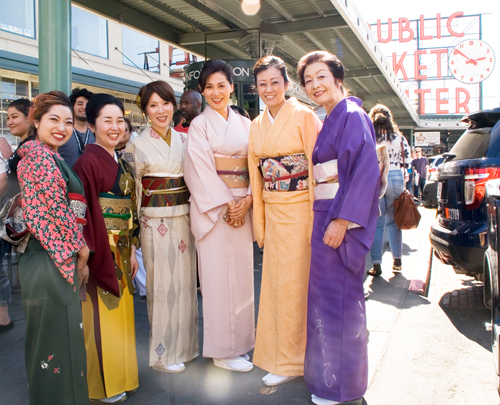
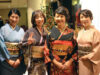
Ugawa (far right end) with her models at Pike Place Market in Seattle, Washington. Photo credit: Kimono Art.
The Birthof Wayu-Gi®
In January 1995, Kobe was struck by a devastating earthquake. The Great Hanshin Awaji Earthquake destroyed much of Kobe, including her beloved Kaneshou kimono shop.
“The store was destroyed, the house was destroyed, and we had to start from scratch,” she recalls. “When I thought about what I could do, I kept coming back to the kimono.That was the beginning.”
Immediately after the disaster, a luxury cruise ship called Hotel Ship Symphony was offered free of charge to disaster victims. At one point, Ugawa asked if she could put on a yukata (cotton summer kimono) fashion show to get people smiling again. “I proposed the idea of doing something that would have the same effect on people as when they just finish a bath. I wanted them to relax,” she says. “Just showing off yukata wouldn’t be interesting. Let’s wear them short like miniskirts. Let’s turn them into dresses. Let’s pair them with sneakers. Let’s roll up the sleeves to the shoulders like Western clothing and wear fishnet tights. Let’s try wearing the kimono backwards… Wow! That’s a surprise, right?” The event was a hit and soon people were talking about this fun-filled fashion show. “That experience taught me that kimonos are not just for wearing correctly or looking beautiful,” Ugawa recalls. “We can enjoy wearing them more.”
Ugawa’s Wayu-Gi® style was modern and innovative. At times, her approach clashed with her husband’s more conservative ideas. However, at the core of Wayu-Gi® is a deep respect for the origins of kimono culture. Ugawa is careful to keep the traditional aspects of kimono-wearing at the front of her mind as she innovates and adapts the clothing for more modern uses. “My motto is to preserve tradition while adapting it to the modern era,” she says firmly.
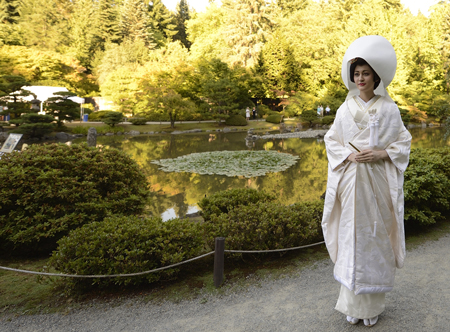
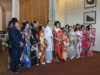
Bridal kimono being modeled at the Seattle Japanese Garden.Photo credit: Kimono Art.
Kimonos follow Japanese people throughout their lives, from the early 7-5-3 (year-old) celebrations to the coming-of-age ceremonies, weddings and funerals. Ugawa has mastered all these uses, which is why she can offer innovative situations that suit our modern sensibilities.
Ugawa is also dedicated to constant learning. After obtaining a first-class kimono styling certificate, she obtained a beauty license at age 50. She also is certified in bridal kimonos. “I’ve obtained all the certifications,” Ugawa says, “and that means I’m not afraid of anything.”
Once the family re-opened its store after the earthquake, the nature of the business changed. The shop became less of a storefront and more of a personal consultancy. “We take customers to an exhibition space and assist them with their shopping,” Ugawa explains. “When proposing how to wear a kimono, it’s not just about matching the fabric with a sash. It’s about supporting the overall coordination, starting with the undergarment, then adding the collar, the obi knot and sash.” The business is no longer about just selling kimonos. They handle dyes, alterations and offer maintenance and preservation services. They connect their customers with artists. One example she points to is their collaboration with Azumi Hosoda, a kimono and textile artist who specializes in roketsu dyeing (traditional Japanese dyeing technique using a wax-resist method to create intricate patterns on fabric). “Her technique is remarkable, but her ideas are also incredible,” Ugawa raves. “She comes up with unique designs like octopuses and crocodiles. It’s true kimono art!”
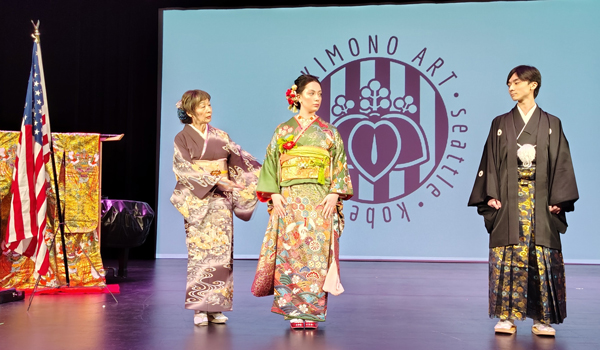
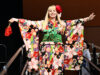
Yu Ugawa (left) describing the dressing of both models on stage during a Kimono Art show. Photo credit: Kimono Art.
Ugawa says she wants to be known as the Picasso (acclaimed Spanish painter and sculptor) of kimono. Her best friend once told her,“You wear kimonos backwards and turn them into dresses. You’re like Picasso!” That became her mantra, and Kimono Art was born. “A kimono made from a single 12-meter (39.37 feet) piece of fabric and an obi knot – now that is truly a work of art,” she says.
Ugawa’s daughter, Mariko, was the one who encouraged her mother. Mariko had moved to Seattle when her husband’s job got transferred. Ugawa would frequently visit Seattle to see her grandchildren. After the Great East Japan Earthquake of 2011, the Eastside Nihon Matsuri Association invited her to hold a yukata fashion show in Seattle with the theme of “bonds.” Five kimono instructors, including Ugawa, came from Kobe and worked with 30 models. The show was a hit, and Ugawa was invited back the following year. She performed a fashion show at a teahouse run by Hokubei Hochi Foundation in Seattle.
To fund these activities, Mariko opened a studio in Seattle to help with Shichi-Go-San (coming of age ceremonies). This evolved into Kimono Art of Seattle. Mariko, who previously managed a store of high-end brands in Tokyo’s ritzy Omote-Sando neighborhood, assists her mother behind the scenes.
This year’s Coming of Age Ceremony USA held in Bellevue, Washington was a huge success. Kimono Art provided the furisode kimono (kimono with long hanging sleeves) worn by Sofia Nayuko Palermo, who gave the keynote speech. They also provided rentals, photograph opportunities and helped people wear their grandmother’s hand-me-down kimonos.
“At Kimono Art, we constantly add new items to our collection and always have a large selection of carefully selected kimonos available,” Mariko says. “Centered on classic pieces that transcend time, we offer a diverse selection ranging from traditional crafts from across Japan, rare vintage pieces, to kimonos made of synthetic fibers that are easy to wear. This allows us to cater to the individuality and cultural backgrounds of customers from around the world, which is a key feature of our store.”
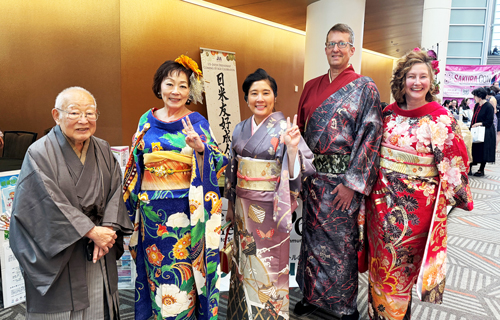
Left to right: Tomio Moriguchi, Elaine Ikoma Ko, Denise Moriguchi, Bruce Rutledge, and Karen Zaugg Black ready for their modeling in the Kimono Fashion Show at Japan Fair in Bellevue, Washington, July, 2025. Photo credit: Kimono Art.
The kimono industry in Japan has taken a similar path, using more modern patterns and colors. But Ugawa says there is something extra special about the traditional kimonos, especially the ones passed down from generation to generation. “Mama Furisode” is a trend where women wear their mother’s kimonos but change the accessories and coordinate them in a more modern way. “The other day, I saw someone wearing their grandmother’s kimono and obi, and it was really beautiful,” Ugawa says. “Traditional kimonos have a strong contrast, don’t they?”
The Kimono Art salon in Seattle needed time to help their customers understand what they were doing. Japanese Americans are used to passing down family kimonos, but these specialized services Kimono Art was offering were brand new to the American market.
“We started by fostering an interest in the kimono,” Mariko says. “As their understanding of the kimono deepens, we receive requests such as wanting to have the fabric tailored to their size or having faded kimonos dyed again. To keep costs down, we propose that customers perform the process of unstitching kimonos themselves and removing the lining to make them single-layered.”
Kimono Art has adapted its services to meet the unique needs of its customers. “If someone wants to dispose of their parents’ or grandparents’ kimonos, we visit their home to organize their wardrobe,” Mariko says. “We coordinate kimonos and obi that are stored separately to deepen their interest and advise them on what to keep and what to let go of.”
Today, Ugawa revels in the chance to work in the kimono business as a mother-daughter team with Mariko. When asked what wearing a kimono means to her, Ugawa replies, “To me, they are a wonderful garment that embodies the warmth of my mother, the joy of seeing my children grow up, and the spirit of Japan. They are unique garments that allow you to choose a kimono suited to the occasion, pair it with an obi knot, and enjoy your own style of fashion. I am committed to continuing and preserving the tradition of kimono.”
Website: Kimonoart.org
E-Mail: contact@kimonoart.org
Telephone: 425-785-5853