Passion with an Eye Towards the Future — Sam Takahashi
By Elaine Ikoma Ko
NAP Contributor
“My passion for life comes from the curiosity to find what kind of scenery is waiting for me when I turn the next corner.” These words perfectly capture the spirit of Sam Takahashi at 84 years old — a man whose journey has been defined by perseverance and boundless curiosity. Sam does not just wonder what lies ahead, he goes out and finds it. His story is a testament to chasing the unknown, fueled by resilience and the thrill of discovery.
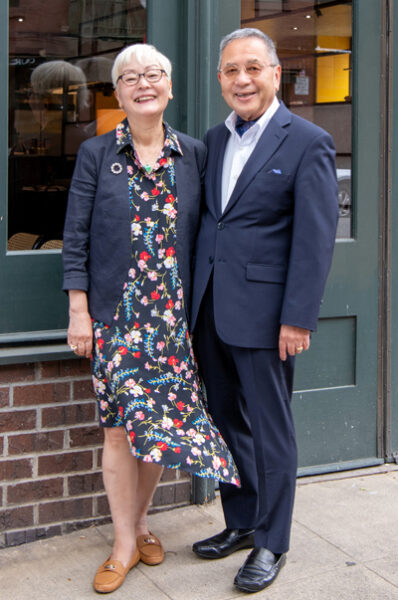
Katsuko and Sam Takahashi in front of their 84 Yesler restaurant in Seattle, 2019. Photo courtesy: Sam Takahashi.
Q: What brought you here from Japan? How did you survive leaving your homeland at a young age?
I was born in Nara, Japan, in 1941, grew up in Kyoto, Japan, and graduated from college there in 1964. I majored in American and English literature, which sparked a deep curiosity and passion to learn more about the American way of life and to pursue the American dream for myself.
I was just 28 years old in 1969 when I first arrived in Seattle, then a blue-collar town dominated by Boeing and Weyerhaeuser. I returned briefly to Japan but came back to Seattle in 1970 on a work visa. I stayed at the Cambridge Apartments at 903 Union Street while working for a Japanese antique store owned by a friend from Kyoto.
I met my wife, Katsuko,when she worked at British Overseas Airways Corporation (now called British Airways) at the Osaka Airport in Japan. We had a wedding in the summer of 1973 in the backyard of my dentist friend Don and Gloria Gardiner in West Seattle. Gloria picked out the bride’s wedding gown at Southcenter Nordstrom, prepared a reception in their home, and we invited about 50 guests. It was Seafair weekend with the Blue Angels and hydro (plane) races. Our families couldn’t come so we had an informal reception in the fall of the same year in Kyoto.
Looking back, I ask myself: how does a young immigrant survive in America? The truth is, I received the generous support of the Issei (first generation Japanese Americans) and Nisei (second generation Japanese Americans) community and without them, I would not be where I am today.”
The owners of the Cambridge Apartments, Jean and Toshi Nishimura, took care of me. Many others reached out including Toru Sakahara, Min Tsubota, James Matsuoka, Takemitsu Kubota, Tom Tsutagawa, and Art Harano.
Later, when I opened a Japanese restaurant in Bellevue, Washington, friends like Kaz Ishimitsu and Tom Kubota supported me every step of the way. I remember them all well and many have since passed. But to this day, my friendship with Tomio Moriguchi remains strong and has lasted through the decades.
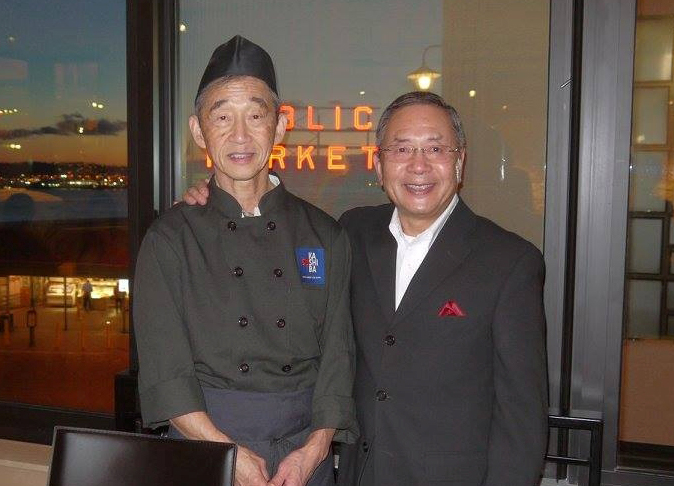
Shiro Kashiba and Sam Takahashi at the grand opening of Sushi Kashiba restaurant in Seattle, Washington, 2015. Photo courtesy: Sam Takahashi.
Q: When did your passion for food and restaurants begin, and what are the many restaurants that you started?
My passion for food and the restaurant business began after I married Katsuko. Her sister and brother-in-law were successful restaurateurs, owning over 80 restaurants and numerous resorts across Japan and Asia. Seeing great potential in the U.S.market, my brother-in-law encouraged me to come to America and start a restaurant venture with him.
In 1979, I bought the Vince’s Italian Restaurant building at 156th and Bel-Red Road in Bellevue, and with architect Tom Kubota, I completely remodeled it into Japanese Sukiya-style (type of residential architecture with tea house aesthetics).
In 1982, I opened Kamon of Kobe, a fine-dining Japanese restaurant that brought something new to the area. It featured a Teppanyaki room (cooking food on a hibachi [flatmetal grill] in front of guests) similar to a Benihana restaurant. There was also a sushi bar, main dining area called the Yao Room — named after Bellevue’s sister city in Japan, and a full bar, which was a novel concept at the time.
Two years later, I opened Bento Box in Bellevue. It was a popular, more casual dining and take-out spot in the Overlake shopping mall. Later, I opened a second one in the Renton shopping mall. It was the first time offering ramen in the Seattle area, and CNN (Cable News Network) media gave it national coverage. I sold the restaurants after 10 years.
Another important mentor in my restaurant journey was John Schwartz of Schwartz Brothers Restaurants. Together, we opened Chandler’s Crab House in Yokohama and Tokyo Bay in Japan during the 1990s. It was around the same time Starbucks and Tully’s Coffee were expanding into Japan.
Alongside my restaurant ventures, I also entered the financial services industry. I worked closely with another mentor, Robert E. Lee, a prominent, world-class businessman. I traveled with him for 14 years, helping to develop the Japanese market in financial services.
In 2008, at the age of 68, I retired from finance during the global market downturn. But retirement did not last long. I joined the legendary chef Shiro Kashiba and several partners to open Sushi Kashiba at Pike Place Market in Seattle — a project that brought my lifelong passion for food.
Q: Tell us about your newest restaurant concept and business in the urban downtown neighborhood?
To bring my restaurant journey full circle, I set out to open an American restaurant, one I would build entirely at my own financial risk with the dream of eventually passing it on to the next generation.
In 2020, at the age of 78, that dream came about with 84 Yesler, a Pacific Northwest seafood restaurant in Pioneer Square of Seattle. I chose (the street) Yesler Way for its historical roots. The building, constructed in 1913, once housed the Travelers Hotel, operated by a Japanese family until the late 1970s.
This area, once known as Japantown, was where many Issei immigrants first arrived from Yokohama aboard NYK (Nippon Yusen Kabushiki Kaisha) steam ships in the late 1890s. They built a vibrant community of hotels, restaurants, barbershops, public baths, bookstores and trading houses.
This was the original heart of Japanese America and I felt a deep calling to return to this neighborhood, a century later.
With 84 Yesler, I wanted to bring a modern, high-level restaurant experience to the area offering “food without borders and service without walls.” Our concept blends Japanese hospitality with dashi-based flavors and Pacific Northwest ingredients. We are creating something uniquely refined yet welcoming and accessible to all.
Our chef, Christina Siegl, who trained for years in Michelin-starred restaurants in Germany, immediately connected with my vision. She has now been with us for six years leading the kitchen with creativity.
Her menu showcases dishes like sea bass (lotus root, ponzu, sake kasu) and smoked octopus (grilled asparagus, hollandaise, ikura, nasturtium). It is complemented by an elegant space that honors both heritage and modern design.
I believe Pioneer Square is on the path to becoming a vibrant, cosmopolitan hub again, much like Tokyo, Yokohama or Kobe with its rich history and timeless beauty.
Q: You have a unique vision and philosophy about passing on your legacy to the young restaurant leaders.
Yes, one of the main reasons I opened the restaurant was to connect with young people of all backgrounds and to help inspire them to discover their purpose in life. I want to encourage them to do what they love and love what they do. It is my way of giving back to Seattle. It is the city where my family embraced the American way of life and where my own “American dream” came true.
My vision is to one day pass the restaurant on to the next generation — not just as a business, but as a legacy rooted in strong relationships, true friendship, happiness and peace. Everything we did in the past was a rehearsal for our main stage show of the future.
There is a saying I live by: Jinsei itaru tokoro seizan ari, sumeba miyako. Wherever life takes you, there are green hills; wherever you live, it becomes the capital. In other words, find beauty and meaning wherever life leads you.
My hope is for people to go out and explore the world with kokorozashi — with intention, heart, and purpose. Every day, I am grateful for my health, for the chance to keep working in the restaurant, and for the love and support of my wife and family.
Domo arigato gozaimashita, thank you, Seattle.