By Pamela Okano
NAP Contributor
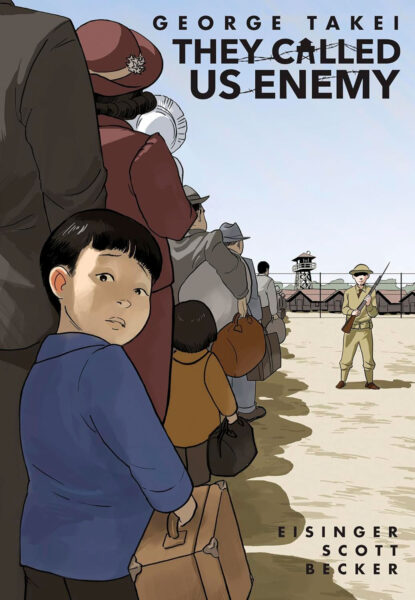
This graphic novel tells the story of George Takei and his family in the Rohwer, Arkansas and Tule Lake, California incarceration camps. George’s father, Takekuma Norman Takei, was born in Japan but was fluent in both Japanese and English. His mother, Fumiko Emily Nakamura, was born in California but was raised traditionally Japanese. George was the eldest, followed by younger brother Henry, and a baby girl named Nancy Reiko.Takekuma came to the United States as a teenager for his education and later opened a successful dry-cleaning establishment in Los Angeles, California.
The Japanese attack on U.S. Pearl Harbor Naval Station in Hawaii changed the Takei family’s lives. Earl Warren, a politically ambitious man who wanted to run for governor was then the California State Attorney General. He called for the federal government to “lock up the Japs.” For him, the absence of any evidence that Japanese Americans were disloyal simply meant that no one could possibly know what they were doing. The mayor of Los Angeles also testified that Japanese Americans were “non-assimilable.”
On February 19, 1942, U.S. President Franklin D. Roosevelt signed U.S. Executive Order 9066, thereby sealing the fate of all Japanese American people on the West Coast and Alaska. A curfew was imposed. Financial accounts were frozen.
Finally, it was the Takei family’s turn. First, they went to the Santa Anita Racetrack in California, where they were housed in horse stables still reeking of manure. George started school there, beneath the grandstand.
Eventually, wearing identifying tags, they were herded onto a train that would take them somewhere — they did not know where. Armed guards were stationed in the front and the back of every car driven by the families. They eventually arrived at Rohwer Relocation Center in Arkansas where it was beastly hot. George later said that he would never forget the hot blast of air that poured out of their assigned cabin when his father opened the door.
Fumiko had brought her sewing machine and started making curtains out of government surplus fabric. She also braided rags together for colorful floor mats. Meanwhile, the men in the camp including Takekuma, started building boardwalks so that people would not have to walk in the mud when it rained.
Takekuma was eventually elected block leader to represent their block in meetings with the U.S. government administration.
In the winter, it snowed. The boys had never seen snow before and had a grand time making a snowman and throwing snowballs.
At Christmas, who should arrive but a Japanese Santa Claus! George had seen the real Santa Claus once so he knew immediately that this was a fake Santa. But everyone was having such a good time, he decided to keep the secret to himself.
Then the infamous questionnaire arrived. Fumiko and Takekuma decided to answer questions 27 and 28 with a “no.” As a Japanese citizen who could not apply for U.S. citizenship, Takekuma would have been rendered stateless if he had answered “yes.” Fumiko had been born a U.S. citizen, but now her country was asking her to put her country first and her family second. That she could not do.
Soon, word came that the Takeis would be moved to Tule Lake because of the parents’ answers to questions 27 and 28. Tule Lake California turned into a hotbed of conflict between the radicals and the more moderate dissenters. It was not a pleasant time.
In the meantime, U.S. Congress had enacted a law that gave Japanese Americans who were U.S. citizens the right to give up their citizenship and be repatriated to Japan. Thousands of Japanese American citizens decided to take advantage of this law including Fumiko. Her ship was to depart on November 15, 1945.
Meanwhile, the U.S. Supreme Court had decided Mitsuo Endo’s case, ruling that loyal Nisei could not be held in the incarceration camps. The U.S. government, in a preemptive move, had already revoked U.S. Executive Order 9066. All those in the camps could return home, assuming they had a home to return to.
Two days before Fumiko’s ship was to sail, Wayne Collins, with the help of his associate, Theodore Tamba, filed habeas corpus (review of the unlawful detention or imprisonment of an individual) suits representing 968 plaintiffs including Fumiko. Fumiko was not going to be deported. After many years of hard work by Collins and his team, her U.S. citizenship was reinstated.
I highly recommend this graphic novel. The illustrations are very evocative. The book is also balanced. Takei gives the U.S. Army 442nd Regimental Combat Team its due but notes that the “No-No Boys” were also brave in their own way. Perhaps most interesting, he notes that on the same day that U.S. Chief Justice John Roberts stated that United States v. Korematsu “has no place in law under the Constitution,” the US Supreme Court also upheld U.S. President Trump’s ban on immigration from Muslim countries.
Takei would go on to act in the 1960s science fiction television series, Star Trek. In an ironic twist of fate, he was invited to speak at the Franklin Delano Roosevelt Museum and Presidential Library in 2017. He became a leading advocate for social justice and LGBTQ (lesbian, gay, bi-sexual, transgender, queer) rights and marched with Martin Luther King, Jr., on the streets of Los Angeles. Emperor Akihito of Japan bestowed on him the Order of the Rising Sun and the Gold Rays with Rosette for his contribution to U.S.-Japan relations.