2025 Civil Liberties Symposium — The Coram Nobis Cases
By Bainbridge Island Japanese American Exclusion Memorial Association
NAP Contributor

Coram Nobis team, undated. Photo credit: Dean Wong.
The symposium will be held on Sunday, October 5, 2:00-5:00 p.m. on the waterfront of the Stan Pocock Legacy Rowing Center, just an eight-minute walk from the Bainbridge Island, Washington ferry terminal (281 Brien Drive SE). Doors open at 1:30 p.m. for the 2:00 p.m. program. Reserve your seat at: https://www.tickettailor.com/events/bainbridgeislandjapaneseamericanexclusionmemorialassn/1803518.
To enrich the experience, it is strongly recommended to view the one-hour documentary, Alternative Facts: The Lies of Executive Order 9066 prior to attending. A free community screening will be offered on Thursday, October 2 at 7:00 p.m. at the Bainbridge Public Library. All are welcome to attend. The film is also available for streaming on PBS.org for a limited time.
Lorraine Bannai, Kathryn Bannai, and Peggy Nagae are three attorneys who personally worked on the Coram Nobis cases of Fred Korematsu, Gordon Hirabayashi, and Minoru Yasui. Each will share reflections on their groundbreaking legal battles, followed by a moderated discussion connecting those cases to the constitutional challenges we face today.
The program will conclude with a community dialogue, inviting questions and conversation between the audience and the attorneys. Together, we can reflect not only on the lessons of history, but also on the responsibilities we share to defend civil liberties now and for the future.
Attendees will also have the opportunity to meet the presenters over appetizers and drinks afterward.
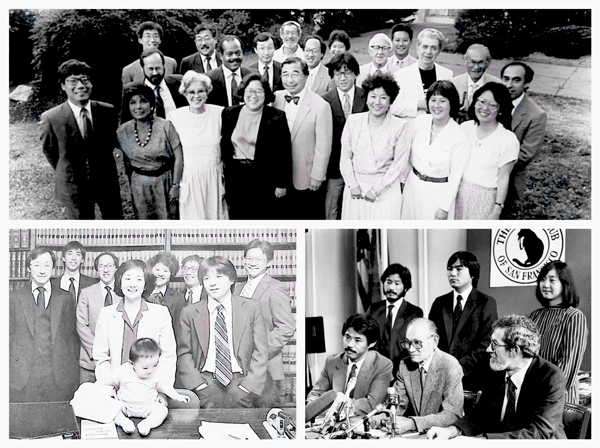
Bottom left: Hirabayashi team with lead attorney Kathryn Bannai, 1985. Photo credit: Stan Shikuma. Bottom right: Korematsu team with team member attorney Lorraine Bannai, 1983. Photo credit: Crystal Huie.
About the Symposium
The Coram Nobis cases of the 1980s — Hirabayashi v. United States, Korematsu v. United States, and Yasui v. United States — vacated the wartime convictions of Japanese Americans who resisted unjust government orders during World War II in 1942. In doing so, the cases effectively overturned earlier U.S. Supreme Court rulings that had upheld those convictions. These cases exposed government misconduct, including the suppression of key evidence, and demonstrated how fear and prejudice can override constitutional protections.
Their relevance today lies in the reminder that civil liberties are most vulnerable in times of perceived crisis. As new calls arise for surveillance, detention, and restrictions targeting immigrant or minority communities, the Coram Nobis victories highlight the importance of vigilance, accountability, and the rule of law. In short, constitutional rights do not enforce themselves — citizens, lawyers, and communities must fight to uphold them.
At the heart of this symposium is that spirit of research, persistence, resilience, and an unwavering commitment to justice. The Coram Nobis cases demonstrate how ordinary citizens, supported by dedicated attorneys and community advocates, uncovered suppressed evidence, challenged false narratives, and overturned historic wrongs — reminding us that safeguarding
civil liberties requires vigilance and courage in every generation.
Who Should Attend
This symposium is for anyone concerned about today’s civil liberties challenges and eager to learn how the historic Coram Nobis legal victories can inform our response to current events, including:
- Community members
- Civic leaders
- Legal professionals
- Educators
- Students
 Kathryn Bannai was lead counsel in Gordon Hirabayashi’s coram nobis case from 1982 to early 1985. Among other critical work, she successfully defeated the government’s effort to dismiss Hirabayashi’s case and persuaded the court to grant an evidentiary hearing. That hearing led to overturning Hirabayashi’s convictions for resisting the curfew and exclusion orders promulgated under U. S Executive Order 9066.
In addition to practicing law, she adjudicated cases for the British Columbia Human Rights Tribunal and Seattle’s Public Safety Civil Service Commission. She has served as president of the Seattle Chapter JACL (Japanese American Citizens League); president of the New York Chapter JACL; member of the Board of Trustees of Eastern Washington University; member of the Board of Directors of Little Tokyo Community Council in Los Angeles, California; and Advisory Council member of Kizuna (non-profit organization in Little Tokyo supporting future leaders.). She was also co-chair of the committee that nominated Mitsuye Endo Tsutsumi for recognition that led to her receiving posthumously the U.S. Presidential Citizens Medal.
Kathryn is a member of the Board of Trustees of the Japanese American National Museum . She received her law degree from University of California Law San Francisco (formerly University of California Hastings).

Lorraine K. Bannai is Professor Emerita and Director Emerita of the Fred T. Korematsu Center for Law and Equality at Seattle University School of Law. After earning her Juris Doctorate from the University of San Francisco School of Law in California, she joined what is now the San Francisco law firm of Minami Tamaki. While there, she served on the legal team that successfully challenged the infamous Korematsu v. United States decision, which had upheld the forced mass removal of Japanese Americans from the West Coast.
In her 25-year teaching career, Bannai wrote and spoke widely on the incarceration’s present-day relevance, the dangers of prejudice, and the importance of upholding the rule of law. She has testified before the U.S. Senate Judiciary Committee, and co-authored numerous amicus briefs in civil rights cases across the country, including Hedges v. Obama (challenging the NDAA [National Defense Authorization Act] detention provisions) and Trump v. Hawaii (challenging the Muslim travel ban).
Her books include Race, Rights, and National Security: Law and the Japanese American Incarceration and Enduring Conviction: Fred Korematsu and His Quest for Justice. She also served on numerous civil rights and community boards, including the Asian Bar Association of Washington, American Civil Liberties Union, the Japanese American Citizens League, and the Washington State Minority and Justice Commission.
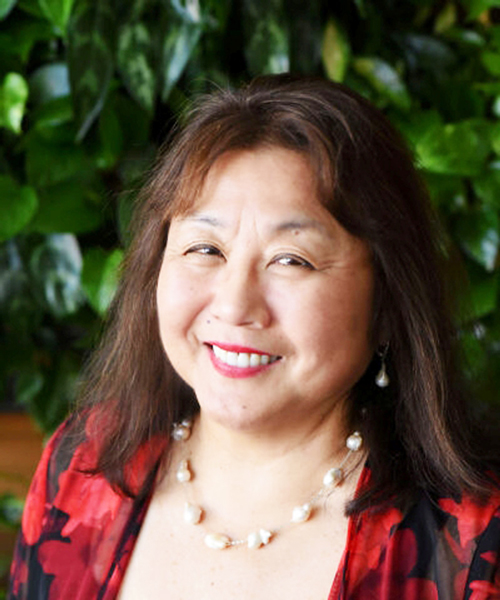
Peggy Nagae served as lead attorney in re-opening Minoru Yasui v. United States, one of the three coram nobis cases that successfully overturned the World War II (WWII) U.S. Supreme Court convictions of Japanese Americans who resisted exclusion in 1942. A Sansei (third generation Japanese American) whose family was incarcerated during WWII, Peggy has dedicated her career to advancing justice, equity, and inclusion.
She was the first woman president of the National Asian Pacific American Bar Association, served on the JACL National Redress Committee that helped secure passage of the Civil Liberties Act of 1988, and was appointed by U.S. President Clinton to the Civil Liberties Public Education Fund Board. More recently, she co-chaired the effort to honor Mitsuye Endo Tsutsumi with the U.S. Presidential Citizens Medal, awarded posthumously at the U.S. White House in 2025.
In addition to her legal work, Peggy has been a leader in numerous civil rights and community organizations, co-founded Asian American Pacific Islander Winning Together, and received the American Bar Association’s Spirit of Excellence Award. She continues to write, speak, and consult nationally on building a multiracial, inclusive democracy.

James Hattori is a veteran journalist whose career spanned local television news in San Diego and San Francisco, California; Spokane, and Seattle, Washington; and Houston, Texas. Later, he held correspondent posts for CBS News, CNN, and NBC News in Dallas, Texas; Tokyo, Japan; New York, New York; and Atlanta, Georgia.
Over the course of his career, Hattori covered a wide range of stories — from space launches and hurricanes to terrorism, tsunamis, technology, and the Iraq war. In the 60 Minutes television program, he profiled the Aum Shinrikyo cult behind the Tokyo subway gas attack. He was also nominated for an Emmy award (merits in the television industry) for live coverage of an Iraqi truck bombing in Baghdad. Hattori recalls some of his fondest moments at KING-TV in Seattle, especially covering Seafair and floatplanes from Lake Union. His mother and family were incarcerated at Tule Lake incarceration camp during World War II in 1942. Now retired, he lives in San Francisco.
Program Schedule
Doors Open at 1:30 p.m.
Pocock Rowing Center,Bainbridge Island.
Opening Remarks and Introductions
Presentation of the Coram Nobis Cases:
- Lorraine Bannai — Overview: pre-WWII, WWII cases, present-day relevance, and the
- Fred Korematsu coram nobis case.
- Peggy Nagae — The Minoru Yasui coram nobis case.
- Kathryn Bannai — The Gordon Hirabayashi coram nobis case.
Remarks on Mitsuye Endo Presidential Citizen’s Medal:
- Peggy Nagae
- Kathryn Bannai
Panel Discussion:
Moderated by James Hattori.
Audience Q & A
Closing Remarks
Reception:
- Meet and greet the speakers.
- Enjoy appetizers and refreshments.
For more information, see: https://bijaema.org/symposium/. Proceeds from ticket sales help cover event costs and support the Bainbridge Island Japanese American Exclusion Memorial Association (BIJAEMA), a nonprofit 501(c)(3) organization.