
Local Artists Examine Hiroshima 80 Years Later
By Lucy Capehart and Erin Schmith
NAP Contributors
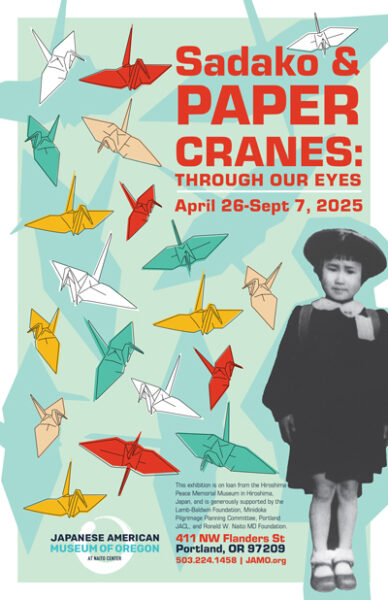
In observance of the 80 years since the atomic bombing of Hiroshima and Nagasaki in Japan, the Japanese American Museum of Oregon is featuring “Sadako & Paper Cranes: Through Our Eyes” on view through September 7. The exhibition pairs the story of Sadako Sasaki, a young girl who experienced the bombing and later died of leukemia due to her exposure, with artwork inspired by her life. Artists and students have been invited by the museum to create new works that contribute to ongoing discussions about peace and nuclear disarmament.
On August 6, 1945, Sadako Sasaki was just two years old when the U.S. dropped an atomic bomb on Hiroshima, where she lived with her family. Although she survived the blast, she developed the symptoms of leukemia nine years later and eventually died from her illness. While she was in the hospital, she folded over 1,000 origami paper cranes, a symbol of good luck that she believed would help bring her back to good health. After her death, Sadako’s classmates and family started a national movement to build the Children’s Peace Monument as a tribute to her and all the children who lost their lives to the atomic bombs. In the exhibition, the portions that tell Sadako’s story are on loan from the Peace Memorial Museum in Hiroshima. The accompanying works connect Sadako’s story to the Pacific Northwest.
Erin Shigaki, Lynn Yarne, Marie Okuma Johnston and Maya McDarragh are all Northwest artists of Japanese American heritage who work with themes of identity, multiculturalism, community and current events. Because the story of Sadako and her classmates speaks specifically to a youth experience of war, the museum also invited local student artists to participate. The students were selected from Unite People, a Japanese American youth organization associated with the Portland JACL (Japanese American Citizens League), and Grant High School. Combined, the works on display span generations, cultures and media.
“Many people in the U. S. know about Sadako Sasaki from several popular books that have been written about her,” said Hanako Wakatsuki-Chong, executive director of the Japanese American Museum of Oregon. “Young people today may be able to relate to her story and struggles.In this exhibition, we want to facilitate the connections between her story, Northwest Nikkei (Japanese American) artists and local young people to help foster a wider discussion of the difficult issues raised and the need for peace moving forward.”
About the Japanese American Museum of Oregon
The Japanese American Museum of Oregon preserves and honors the history and
culture of Japanese Americans in the Pacific Northwest. It educates the public about
the Japanese American experience during WWII and advocates for the protection of
civil rights for all Americans. Formerly the Oregon Nikkei Legacy Center, the museum is a venue for culture and research. It is also an invaluable resource for exploring
Nikkei experiences and their role in Oregon’s multicultural community. Location: 411 Northwest Flanders Street, Portland, OR 97232. For more info: telephone 503-224-1458 or visit jamo.org.