By Hiroko Kai
NAP Contributor
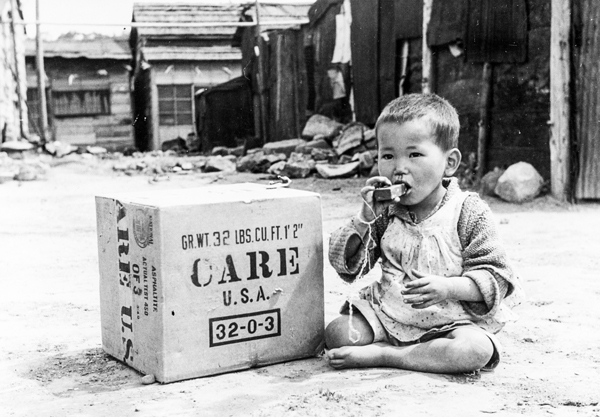
Child sitting and eating next to a CARE package from the USA in post-war Japan, 1945-48. Photo credit: CARE International Japan.
CARE International Japan, a member of the international cooperation NGO (non-governmental organization) CARE, operates in more than 100 countries around the world. They are looking for people who sent the CARE packages that triggered the foundation’s establishment, as this year marks 80 years since its founding.
The packages were first sent in 1945 by a U.S.-based citizens group called the Cooperative for American Remittances to Europe, which packed food and other supplies, then sent them to war-ravaged areas in Europe. August 15, 1948, the “End of War Day” (World War II) in Japan was also the start of CARE packages delivered to the Tokyo-Yokohama area. The relief packages contained 15 items, including rice, miso, soy sauce, and canned foods, such as corned beef.
The contents of the packages, were carefully selected with Japanese food culture in mind. It showed the deep involvement of Japanese immigrants in the selection of the items. A large percentage of the goods sent were estimated to be from those of North and South Americans Japanese descent.
In fact, on April 28, 1949, a proposal entitled “A Resolution of Appreciation for the Assistance to Japan from Hawaii, North and South American Residents, and Citizens of Japanese Descent” was introduced in the Japan House of Representatives by Representative Takizo Matsumoto (Hiroshima Prefecture) and 12 others. It was immediately passed. The text of the resolution reads as follows:
“We are truly grateful for the enormous amount of assistance given to us by our compatriots and citizens of Japanese descent in Hawaii, and North and South America since the end of the war in the form of Lara goods, CARE goods, relief packages, and other various forms. It is how much these kindnesses have been a source of comfort and encouragement to us.”
Initially, CARE packages consisted mainly of daily necessities such as food and clothing, but later, carpentry tools, agricultural seeds, and farming implements were also sent.
Those items enabled job training which helped victims become economically independent.
While the number of recipients in Japan estimated to be 10 million plus, no detailed records, such as lists, remain. As the war survivors are aging, the foundation is using this year as a final opportunity to unearth the memory of the CARE package.
In May 1987, what is now CARE International Japan was founded. It has been supporting developing countries with the hope of repaying the aid received from overseas after World War II. It is passing on the spirit of mutual support to the next generation. It is also compiling the memories of the aid received as part of the history of post-war re-construction to be used in future activities.
For information on people who sent CARE packages after World War II or if you know someone who did receive a package, please contact the foundation at: https://www.careintjp.org.
CARE (https://www.careintjp.org/about/index.html)
CARE is one of the world’s largest international cooperation NGOs that has been providing humanitarian assistance since 1945. In fiscal year 2024, 11,290 highly specialized staff members helped 53.4 million people in more than 121 countries to help them become self-reliant. In 2025, CARE celebrates its 80th anniversary.
CARE International Japan (https://www.careintjp.org/about/carejp.html)
CARE International Japan is a member of CARE operating in more than 100 countries The organization aims to create a poverty-free society through emergency and re-construction assistance at times of disasters, and by supporting the self-reliance of women and girls