By Pamela Okano
NAP Contributor
 This is not your usual story of a soldier from the 442nd Regimental Combat Team, U.S. Army. Most of the 442nd members came back to the West Coast, married Japanese American women, had a family, and tried to forget the horrors of the war and their families’ incarceration during that war. That is not exactly what Arthur Susumi did. This novel, based on true facts, is the story of Arthur and his French wife, Yvette.
Arthur and his family lived in West Seattle, Washington where they ran a florist’s shop. In March 1942, they went to “Camp Harmony” in Puyallup, Washington and three months later, to Minidoka incarceration camp in Idaho. While in Minidoka, Art decided to enlist in the 442nd. He was assigned to the Cannon Company as a radio operator. He would later be awarded a Purple Heart because of a shrapnel wound in his back and a Bronze Star for valor. Art was also a compassionate man. He suffered mightily when his friends were killed in combat. But unlike many, he also saw valor in what the “No-No Boys” had done.
After the war, Art signed up for the U.S. Air Force Reserves, thinking that it would be a part-time job on weekends. Instead, he was sent to France to help rebuild the country after the war. There, he met Yvette Gauvain, whose father, Maurice, had been part of the French Resistance. The Nazis murdered Maurice as the war was winding down. Art and Yvette married in France in 1952.
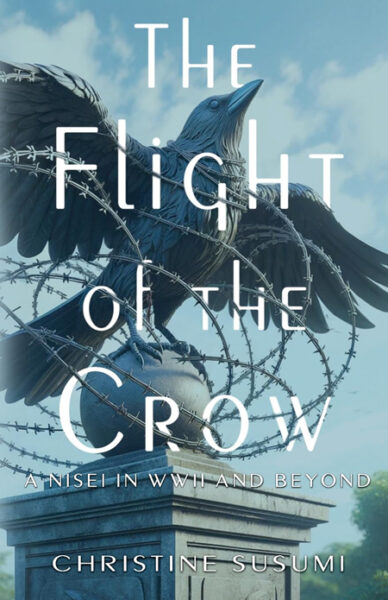
When she was a young girl, Yvette had taken in an injured crow, whom she named “Arthur.” She nursed it back to health and then set it free. When she married Art, her mother noted that with Art’s black hair, her crow, Arthur, had returned to her. That is the inspiration for the title of the book.
Art and Yvette returned to Seattle, where Art’s job as a funeral director at the Butterworth Funeral Home lasted for more than 50 years. He was, and remains today, the only funeral director in the Japanese American community, despite his death in 2005.
Their marriage was not always easy, principally due to forces beyond their control. Japanese Americans were slow to warm to Yvette. Caucasians often looked down on mixed marriages. For many years, they could not live in West Seattle due to restrictive covenants in real estate (selling homes to people of color in restrictive areas). But by the 1980s their lives improved. Yvette spent 20 years working in the food service at Asa Mercer Junior High, where she enjoyed serving children of all races. She also loved animals, a trait that was carried on in her daughter Christine, the book’s author, who is currently a veterinarian on Bainbridge Island, Washington.
The Flight of the Crow is a worthy addition to anyone’s Japanese American library. Beautifully written and meticulously researched, this book can be ordered from Amazon, Barnes & Noble, Elliott Bay Book Company in Seattle or at Eagle Harbor Books on Bainbridge Island. If you are a Washington State University graduate, you can also purchase it here: https://alumni.wsu.edu/s/1613/18/interior.aspx?sid=1613&gid=2&pgid=11164.