Sadako Statue Renewal
By Barbara Mizoguchi
NAP Editor
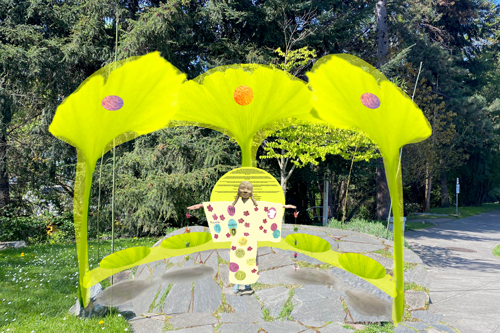
Concept for Sadako Reimagined. (Sadako’s face is from her photograph.) Photo credit: Saya Moriyasu.
You might recall the bronze “Sadako” statue that was located on the north end of the University bridge in the Seattle Peace Park in Washington state. You may also recall that the statue was cut off at the ankles and stolen last year. However, last month there was a ceremony about re-building and fundraising, thanks to a concerned community group consisting of Linda Ando, Jonathan Betz-Zall, Stan Shikuma, and Tara Tamaribuchi. The event began with a presentation by Seattle artist Saya Moriyasu.
Moriyasu was selected from artist applications and presented an overview of “Sadako Reimagined.” It is her concept of the new statue. She plans to keep the bronze feet, gently holding the new sculpture to represent transformation instead of destruction. The sculpture of Sadako will be wearing a kimono with long sleeves unfolding to suggest flight, joy, and resilience. Surrounding her will be an open pavilion of three large ginkgo leaves made of steel. It will not only represent resiliency and memory of the nuclear bombs in Japan but also the resiliency and memory of the Duwamish Coast Salish people whose land the statue will reside on (During that time, gingko trees grew in the area.)
Moriyasu plans to use cast aluminum to potentially prevent future theft. It will be coated with industrial paint that includes anti-graffiti properties. Dichroic vinyl (iridescent film) will be used on the ginkgo creating shifting rainbow colors representing the spirit of hope. An interpretive panel will describe the Coast Salish peoples’ significance of the site, Sadako Sasaki, the Peace Park, and Floyd Schmoe.
 Statue’s feet leftover from being vandalized. The bronze body of Sadako was cut at the angles and stolen. Photo credit: Saya Moriyasu.
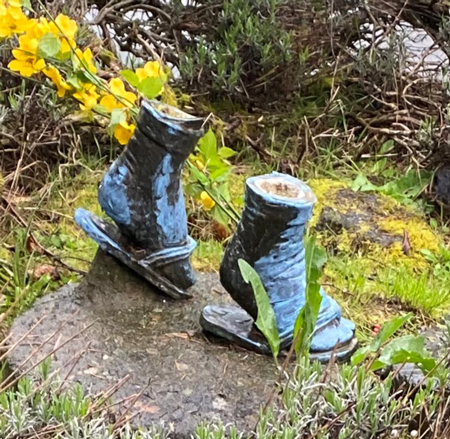 Statue’s feet leftover from being vandalized. The bronze body of Sadako was cut at the angles and stolen. Photo credit: Saya Moriyasu.
After the presentation, attendees walked across the street to the Seattle Peace Park. There, solemn Japanese drumbeats were performed by Shikuma as a healing process of the park, the vandalism, Sasaki, and in memorial of Schmoe.
Floyd Schmoe (1895-2001) was born on a farm in Kansas, U.S.A. He attended Seattle University in Seattle, Washington and spent most of his life in the area. He was also a sixth generation Religious Society of Friends (Quaker) and worshipped at the University Friends Meeting in Seattle.
Due to his interest in nature, Schmoe studied forestry until World War I broke out. Since he was a pacifist and abhorred all violence, Schmoe joined the American Friends Service Committee (AFSC). While in Europe, he helped build prefabricated homes for war refugees. After the war, Schmoe graduated from college and became a park ranger in nearby Mount Rainier. Later, he became a forestry instructor at the University of Washington while studying marine biology toward his master’s degree.

Former bronze statue of Sadako with strings of origami paper cranes draped over it. Photo credit: Geraldine Shu.
As World War II broke out, Schmoe organized demonstrations against the war. Through AFSC he helped Jewish refugees flee Nazi-occupied Europe. After the bombing of Pearl Harbor in Hawai’i, Schmoe left teaching and became the head of AFSC’s regional office. Initially, he helped Japanese American students from the University of Washington move east of the U.S. to continue their education safely. He then helped incarcerated Japanese Americans protect their property outside their incarceration camps despite being examined by the U.S. Federal Bureau of Investigation.
Since Schmoe detested the nuclear bombings, he attempted to build houses for the Japanese people in Hiroshima and Nagasaki who lost their homes during the war; but it was difficult to gain permission from Japan. Instead, he raised funds to bring building materials, food, and medical supplies to Hiroshima and Nagasaki “to show the feelings of many American people who regret that innocent Japanese people suffered due to the bombing.” With the help of volunteers, he was able to build 20 homes in Hiroshima and 12 in Nagasaki – housing almost 100 families. (Schmoe did the same during the Korean war).
Schmoe remained active through his 90s and became concerned about the small piece of land across the street fromhis church. It was a dumping ground infested with rats, overgrown brambles, and invasive weeds. With volunteers, he got it cleaned up and began planting native species plants. He then campaigned long and hard for the City of Seattle to turn it into a peace park. Then the difficult job of fundraising began. In the meantime, Schmoe received the Hiroshima Peace Center Kiyoshi Tanimoto Peace Award for his volunteer work in Japan. He then donated the award money toward the park. In addition to a grant, a bronze statue of Sadako Sasaki was created by sculptor Daryl Smith who also contributed his effort to it. The statue was approximately five feet tall with one arm extended holding a single paper crane. Throughout the years, strings of cranes have hung from her arm.
Sadako Sasaki was a two-year-old Japanese girl at the time of the nuclear bombing in Hiroshima. 10 years later she was stricken with leukemia from the nuclear radiation. While she was in the hospital, she folded 1,000+ origami paper cranes (according to her brother Masahiro Sasaki’s 2018 book) wishing health for herself, her family, and for peace. After Sasaki passed away, her classmates raised funds to build a memorial statue of Sasaki in Hiroshima. The story spread quickly making the paper crane a universal sign of peace.
Dedication of the Seattle statue was on August 6, 1990 – the anniversary of Hiroshima being bombed. Schmoe regularly visited the park and tended to the grounds. After he passed away at age 105, there was frequent vandalism which Daryl Smith restored each time.
The new sculpture will still be approachable, and visitors will still be able to leave origami cranes on or around it again –a symbol of resilience and healing.
Moriyasu’s artist statement says, “I believe peace is not stillness – it is something we walk, build, and carry together.” Moriyasu is part Nisei (second generation Japanese American) and part Caucasian. Her father came to the U.S. from Hiroshima to study and the rest of the family, including her grandmother, came later. Moriyasu’s grandmother and mother founded the Wakai (Peace Club) Tea School in Oregon. It is a daily practice of sharing the presence, listening, and healing. It is like Moriyasu’s approach to the new sculpture, “I want people to walk into the space, feel sheltered by the ginkgo forms, and experience presence and reflection.” Moriyasu also grew up with families rooted in Quaker values of service and shared life. “I learned that peace is not a concept. It is a way of living.”
With a clear concept of the new statue, fundraising has now begun. Even 10th grader Hinano Smith of Hiroshima is fundraising for it. She made her own custom postcards to sell and was featured on NHK – a Japanese broadcasting company. So far, Smith has raised $1,200. The fundraising goal is to raise $300,000 for the new statue and restoration of the park. Please contribute at:
1.https://www.ufmseattle.org/contributions
2. or write a check to the following and mail to:
Sadako Restoration Project University of Friends Meeting
4001 Ninth Avenue Northeast Seattle, Washington 98105
3. or go to: https://www.gofundme.com/f/restore-stolen-hiroshima-victim-statue-to-seattle-peace-park.