
By Karissa Braxton
NAP Contributors
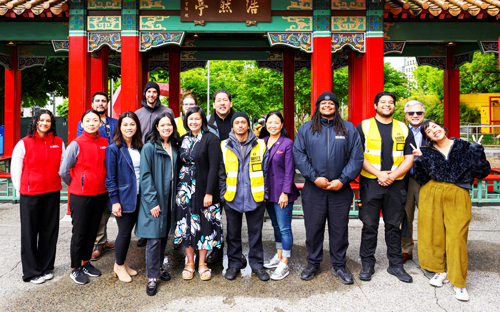
First CID ambassadors with Seattle Mayor Bruce Harrell and former U.S. Ambassador Gary Locke. Photo credit: City of Seattle.
In a shared effort to support safety, economic revitalization, and community well-being in some of Seattle’s most historic and culturally rich neighborhoods, the City of Seattle, Mayor Bruce Harrell, The Asian American Foundation (TAAF), Amazon, and the Chinatown-International District Business Improvement Area (CIDBIA) announced a $1 million combined investment in the Chinatown-International District (C-ID) Ambassadors Program, which launched in June.
Rooted in community care and cultural competency and modeled after other successful ambassador programs, such as the Downtown Seattle Association MID (Metropolitan Improvement District) Ambassadors, Ballard Alliance Ambassadors, and the city’s Downtown Activation Team, the C-ID Ambassadors Program will train neighborhood ambassadors to serve Japantown, Chinatown, and Little Sàigòn. These teams will work on the ground, block by block, to assist small businesses, welcome visitors, and foster safer, and more vibrant neighborhoods.
The program is made possible by a $1 million combined investment over two years from the city and TAAF, and represents a growing commitment to a deeper, place-based collaboration between public institutions, philanthropy, and community organizations.
“This program represents exactly the kind of public-private partnership we need to uplift and renew Seattle’s historic neighborhoods,” said Mayor Harrell. “With dedicated ambassadors on the ground, we are investing in safety, belonging, and visibility for one of our city’s most culturally significant communities. It’s about ensuring everyone in Chinatown, Japantown,and Little Saigon, business owners, workers, residents, elders, and visitors feels seen, supported, and safe.”
This announcement also marks the launch of TAAF’s new “TAAF Cities” initiative to spur historic, public and private investment in strengthening cities with large Asian American and Pacific Islander (AAPI) populations.Amazon is a founding partner of the initiative.
“TAAF Cities” will bring together local community, government, business, and nonprofit leaders to develop innovative, community-rooted solutions that promote economic opportunity, safety, and cultural pride. Seattle, a major cultural and economic hub with some of the nation’s oldest and most vibrant AAPI communities, was chosen to kickstart the effort.
“The Chinatown-International District is not just a neighborhood, it is a cornerstone of Asian American history and culture in Seattle,” said Norman Chen, Chief Executive Officer of TAAF. “TAAF is proud to partner with the City of Seattle, CIDBIA, Intentionalist (an online guide to intentionally spending at small businesses and diverse local communities), and local leaders such as the Chinese Information and Service Center (CISC) to invest in and build solutions that are community-led and people-centered. By funding this ambassador program and launching our TAAF Cities initiative, we are helping ensure the C-ID’s renewal is rooted in care, dignity, and long-term resilience. This program is made possible by the generous support of our partners like Amazon, who alongside TAAF will be making a series of co-investments in Seattle’s Chinatown-International District to advance safety, belonging, and prosperity.”
As part of TAAF Cities several partners are stepping up to further bolster the future of the historic C-ID:
Amazon has committed $250,000 to Friends of Little Sài Gòn to support economic development and public safety programs in the area. Amazon employees will also participate in community clean-ups across the district. In addition, Amazon has made a $250,000 commitment to bring the C-ID Night Market back to the district for three years.
As part of National Small Business month, the City of Seattle and TAAF are also supporting AMPLIFY: Chinatown-International District. It is an initiative led by Intentionalist, an online platform that encourages and incentivizes people to spend intentionally in support of brick-and-mortar small businesses. The AMPLIFY:Chinatown-International District campaign is engaging in a cross-sector coalition of partners to promote and support local businesses in Chinatown, Japantown, and Little Saigon throughout AAPI Heritage Month and beyond. The public were encouraged to come to the C-ID in May and use the free AMPLIFY: Chinatown-International District small business pass to explore and enjoy special promotional offers at 35 local businesses.
Together, these investments reflect a growing movement of coordinated action in Seattle, led not by any single entity, but by a shared commitment to preserving the cultural heritage, economic vitality, and community spirit of the C-ID.
ADVANCING SAFETY THROUGH THEC-ID AMBASSADORS PROGRAM
In the wake of the rise in anti-Asian hate during the pandemic, safety remains top of mind for many Seattleites. According to a 2024 TAAF survey of 1,000 AAPI adults residing in the Seattle metropolitan area, almost two in five (38 percent) respondents were victims of an anti-Asian incident in the previous 12 months, and nearly three out of four reported changes in their day-to-day behavior out of fear of being a target or victim of anti-Asian hate. In addition, 54 percent of respondents said that “public safety” was either a “major problem” or “somewhat of a problem” that needs to be addressed.
To promote safety and belonging, the CIDBIA will train teams of culturally competent ambassadors. This will improve the day-to-day experiences of all people residing, visiting, and working in the C-ID. Modeled after successful programs in other cities and neighborhoods, trained ambassadors will:
Walk and watch over neighborhood blocks to ensure they are safer, cleaner, and cared for. They will also provide a visible, welcoming presence by providing directions, assisting visitors, and reporting issues.
Assist the C-ID’s small businesses by deterring disruptive behavior, responding to quality-of-life concerns, and helping business owners and entrepreneurs access city services and support networks; and
Offer de-escalation and engagement services to individuals, responding with empathy and professionalism when residents or businesses encounter individuals in crisis. Rather than leaving businesses and residents to navigate these situations alone, ambassadors will act as trained “community-first” responders to help restore peace and dignity to public life in the C-ID.
WHAT PEOPLE ARE SAYING
“Thanks to the incredible partnership between TAAF and the City of Seattle, we are showing what it means to truly invest in the C-ID,” said Tuyen Than, Executive Director of CIDBIA. “This program goes beyond traditional approaches to community safety. It’s about creating a visible presence that makes our streets feel more connected and cared for. We’re proud to lead an effort that reflects the values of this neighborhood and responds to the daily needs of our community. Together, we’re strengthening the C-ID one block, one business, one life at a time.”
“Public safety isn’t just about enforcement—it’s about showing up,” said Yenvy Pham, James Beard Award nominee (highest accolade for chefs and restaurateurs in America) and owner of Hello Em and Pho Bac. “Sometimes a simple, respectful interaction can shift behavior and set the tone for our shared spaces. Safety Ambassadors help create that culture of everyday accountability, and as a small business, we see the difference it makes.”