The Life and Excitement of Tomoyuki Uehara
By Barbara Mizoguchi
NAP Editor
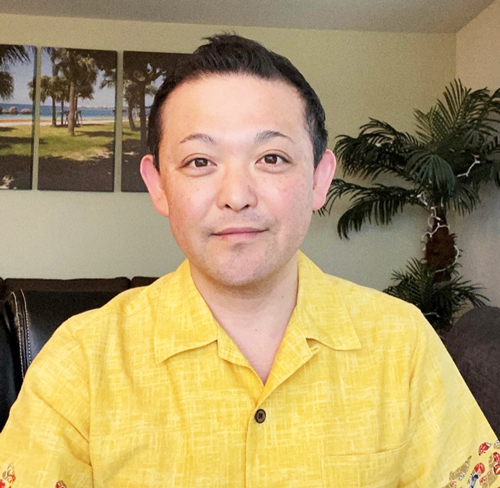
Self Portrait, 2024. Photo courtesy: Tomoyuki Uehara
A couple of years ago I met Tomoyuki Uehara at a kenjinkai (Japan prefecture association) event and had a great time chatting with him. He was so upbeat and willing to talk about his life that he even shared the difficult times. Then Uehara was suddenly in front of the room singing karaoke with a beautiful and confident voice. Surprisingly, I asked how he learned to sing and if he sang regularly. He humbly said, “here and there” but he is also in the Seattle Men’s Choir! Although Uehara was born in Japan, it is interesting how he adapted to American life and culture with such ease. It is a good time to share his story for the new year and reflect on our own lives. Positivity, determination, and inspiration are helpful for children, young adults, and adults to read. The following interview is with Uehara.
Where were you born and educated?
I was born in Naha City, the capital of Okinawa in 1978 and grew up in Ginowan City where my parents, siblings, and their families still live today.
I attended Futenma High School in Ginowan followed by Okinawa International University where I studied English Literature and Education. I studied TESOL (Teaching English to Speakers of Other Languages) at the University of Ulster in Coleraine, Northern Ireland earning a post-graduate degree.
Later, I moved to the U.S and attended Case Western Reserve University in Cleveland, Ohio. I received my Master of Business Administration (MBA) from the Weatherhead School of Management in 2012.
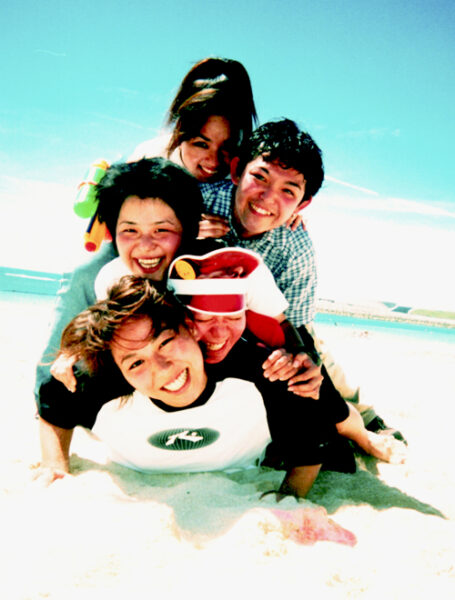
Typical college life in Okinawa, Japan. Going to the beach during lunch breaks, 2001. Photo courtesy: Tomoyuki Uehara
Tell us about your parents/family.
Both of my parents are Okinawan. My father was a high school chemistry teacher at a technical school and my mother worked in accounting for the U.S. Navy in Okinawa. They are now enjoying a well-deserved retirement.
My father is known for his incredible work ethic and endless curiosity especially when it comes to mechanical engineering. He can fix almost anything—from small household appliances to boat engines—so we rarely bought new items because he would simply repair them (laughs). He also loved building robots and machines. The students he coached won many robotics competitions at both
he Okinawa and national levels. He even built machines as gifts for local, small businesses that could not afford new equipment. In our neighborhood, he was the “go-to” person whenever something needed fixing.
My mother is equally hardworking and knew how to enjoy life while raising four boys and working full-time. She was always present for our activities especially when I was in the marching band traveling across Japan for national competitions. She supported my father throughout his career and was deeply engaged in community volunteering. She is warm, social, and has always been the heart of our family.
How did you learn English and so fluently without an accent?
Thank you so much for saying that—you are very kind.
I grew up in Okinawa where American culture is very present because of the U.S. military bases so English always felt somewhat familiar. What truly motivated me to learn English was my cousin who is half American. When we reunited at age 14, he no longer spoke Japanese and I could not speak English. We had to communicate through my aunt and that shock stayed with me. I thought, “I want to talk to him again without a translator.”
Th motivation led me to study in the U.S. for two years in high school. I was very lucky with my host family. They were incredibly patient with me especially given my very limited English at the time. Although my English was terrible at first, I studied hard every day for six to eight hours. I carried a small dictionary everywhere I went. I also played the trumpet and joined the brass band, marching band, and jazz band which helped me make friends and practice English naturally.
By my second year, I improved enough to leave ESL (English as a Second Language) and take regular classes. Later in university, I studied abroad again in Northern Ireland and stayed active in the community to use English as much as possible.
Those experiences—motivation, immersion, music, and supportive people—built the foundation for the English I speak today.
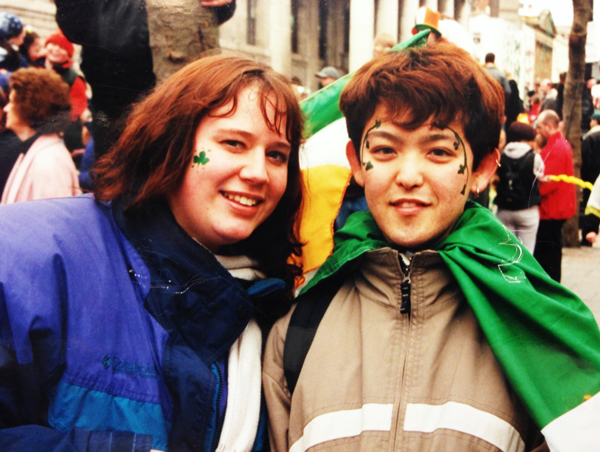
St. Patrick’s Day in Dublin, Ireland; 1999. Photo courtesy: Tomoyuki uehara
What brought you to the U.S./Seattle?
I spent two years of high school in Burien, Washington as an exchange student in the 1990s and had always wanted to return to the U.S. to build my career. However, finding a job in the U.S. while still living in Japan was extremely difficult. My degree was in English Literature and Education and my experience was mostly teaching and working in Japan. So, opportunities were very limited.
Still, I could not give up my dream. For two years, I submitted résumés to U.S. companies online every single day from Okinawa. I probably applied to more than 2,000 companies during that time. Most never replied and the few that did all said “no.” I even contacted many immigration lawyers, but many told me it would be nearly impossible for them to help me.
It was discouraging but I kept reminding myself, “No is not my answer. I just need one yes.” Finally, after thousands of rejections one company in Atlanta offered me an interview and I found a lawyer willing to take my case. That year, seven applicants applied for the H-1B visa (classification of non-immigrant visa) through the company, and I was the only one selected. After working in Atlanta for a year, I decided to pursue my MBA which eventually led me to Seattle.
Tell us about your work experience.
I originally started my career as a high school English teacher in Okinawa. While teaching, I quickly realized that many of my students asked me more about life than grammar—questions about careers, dreams, and their future paths. The only profession I truly understood was teaching. I could support them better if I gained broader “real-world” professional experience myself. My plan was to leave teaching for a few years then return but soon discovered that I could educate and train people in the corporate world as well.
I joined a staffing agency called On-Time Staffing, where I worked for five years before moving to the U.S. During that time, I spent two years in Germany managing the company’s newly opened office. I was only 24 years old and those years taught me invaluable lessons about both life and work.
After relocating to Seattle, I had the opportunity to work for R. E. Lee International where my clients were billionaires. I frequently traveled to Japan and Hawaii for meetings. How often do you get the chance to speak with high net-worth clients face-to-face? It was truly an extraordinary experience. Later, I transitioned to New York Life Insurance Company where I have now worked as a financial professional for over ten years.
My professional journey in the U.S. has been remarkable. There have been many ups and downs but the personal growth has been tremendous. I firmly believe that perseverance—never giving up—is the key to success.
I also had many part-time jobs during college, working as a hotel bellboy, cook, bartender, server, and part-time teacher. All those experiences helped me develop a wide range of skills that eventually came together to shape who I am as a professional today.
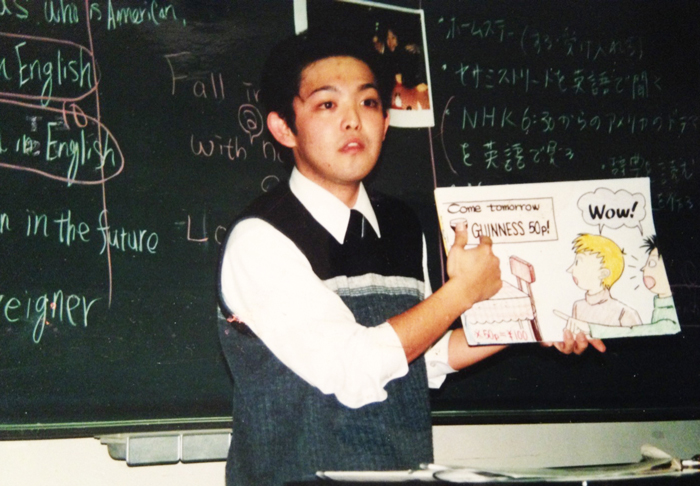
Uehara teaching English in a school; after 2001. Photo courtesy: Tomoyuki Uehara.
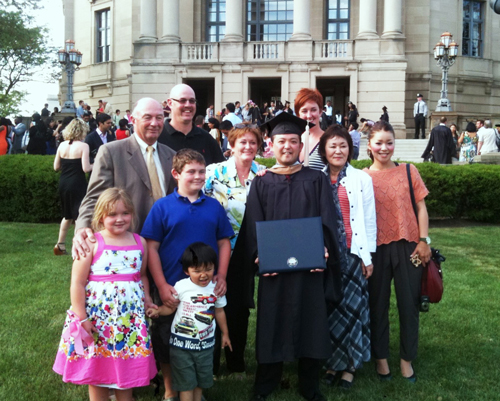
Graduation day for Uehara’s MBA at Weatherhead School of Management at Case Western Reserve University, Cleveland, OH; 2012. Photo courtesy: Tomoyuki uehara
Tell us about some of the adversities you encountered and how you overcame them.
One of the biggest challenges I faced was an unexpected two-year assignment in Germany. I was working in Japan as an assistant branch manager for On-Time Staffing that supplied personnel to U.S. military bases. The CEO (Chief Executive Officer) asked me to take a one-week business trip to review our new German branch. Once I arrived, everything changed. The business was in serious trouble and the CEO decided the branch needed new leadership. What surprised me most was that he chose me −a 24-year-old with limited management experience outside Japan and zero German language skills. He said he needed someone he could trust more than someone with experience. He told me, “I trust you and we will do anything to support you. We need you to be here.” And yes, just like in a movie the very next day he and the team flew back to Okinawa and left me there alone!
Suddenly, I was managing a struggling business, working extremely long hours, learning German labor laws, building relationships withover 200 temporary staff, and trying to secure new clients. It was chaotic, overwhelming, and far outside my comfort zone. I remember telling my boss many times that I wanted to quit but he never allowed it. Instead, he taught me a lesson that became one of the most important in my life. He said, “Tomo, you can quit when things go well. When you have overcome the hard times and everything is running smoothly, that’s when I will let you go.”
I did not understand at first and asked, “Why won’t you let me go?”
He replied, “If I let you go now, you will continue to quit whenever you face difficulties. I want you to face this hardship and grow from it. Once you overcome it, it will no longer be an obstacle, because you will know how to solve it.” That conversation was a turning point for me. Instead of running away from challenges, I learned to face them head-on. Ever since, I have believed that difficult moments are opportunities for growth and that mindset has stayed with me for life.
Where do you get the upbeat and positive attitude? Do you have down days?
I try to stay as positive as possible, and I get a lot of wonderful energy from people. Doing things for others makes me happy and energized. I truly love seeing people smile.
Yes, of course I have down days too. Usually, after a good night’s sleep, I forget the negative feelings. Over the years, I have learned how to reset myself even when I am really upset. By the next day I often do not remember why I felt that way.
When something unpleasant happens, I make a conscious effort to shift my mindset and think in a more positive direction. I have learned not to stay in a negative place for too long. I try to focus on what I can do to make the day better. The easiest way for me to do that is to talk to people who have great, positive energy.
What is some advice for kids and adults on how to be more positive, patient, and what to do in the meantime during adversities?
My advice is pretty simple:
First, do not give up just because someone says, “no.”
If you truly want something, keep searching until you find the person who says, “yes.” You control your dreams, not others. Share your goals with people who have walked a similar path. They will know exactly how to cheer you on and support you.
Second, focus on what you can control.
Even small steps forward can shift your mindset and create momentum.
Third, surround yourself with positive people.
Good energy is contagious and being around uplifting people helps you stay motivated during difficult times.
Fourth, remember that “luck” is not random.
I used to say I was simply lucky. However, through my experiences and through conversations with many successful people, I learned that luck happens when preparation meets opportunity. You have to work hard toward your goals so that when an opportunity appears, you are ready to grab it.
Fifth, take action.
One of the most important lessons I learned when I was younger, is this: It is not about whether you can or cannot do something. It is about whether you will or will not do it. Choosing to take action, no matter how small, builds confidence and keeps you moving.
How did you get involved with the Japanese community?
I became involved with the Japanese community through the Okinawa Kenjin Club. When I became president in 2016, it opened the door to connecting with community leaders across Washington. I have learned so much from them especially about the history and cultural contributions of the Japanese community.
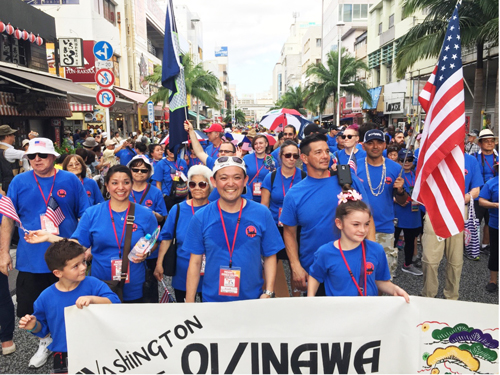
Okinawa Kenjin Club from WA participate in the parade of the World Uchinanchu Festival in Okinawa, Japan in 2016. Photo courtesy: Tomoyuki Uehara
Do you return to Japan often? If so, what do you do while visiting?
I try to visit Okinawa once a year, usually in early spring. I usually spend about a week with my family and friends. One of my favorite routines is going for a morning run along the beach and parks near my parents’ home in Ginowan City.
I also met with staff from Okinawa government offices to strengthen relationships with our Washington Okinawa Kenjinkai. Of course, I love enjoying an Orion beer at the beach! Whenever possible, I also explore different cities on mainland Japan.
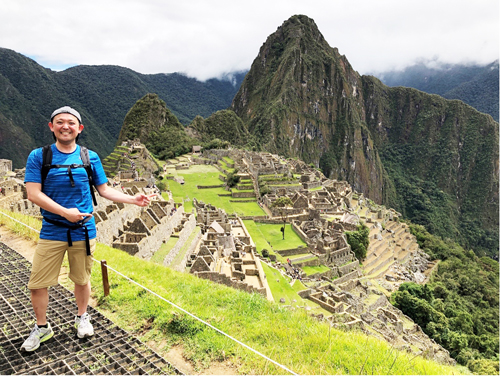
Visited Machu Picchu for my 40th birthday which was on my bucket list, 2018. Photo courtesy: Tomoyuki Uehara
How did you get involved in singing?
I have always loved music. I learned piano and played trumpet from elementary school. Singing, however, was never something I took seriously. I mostly sang casually at karaoke with friends. You know how Japanese people love karaoke! My friends and I used to go after school and sing for hours …sometimes eight hours straight! (I’m not sure how our voices survived!) That was really my first “training” in a very unofficial and very Japanese way.
How did you get involved with the Seattle Men’s Chorus and where has it taken you?
I never imagined joining a group like the Seattle Men’s Chorus (SMC), a highly respected organization filled with incredibly talented singers.
When I first moved to Seattle, I met a SMC member who heard me sing at karaoke and encouraged me to audition. I had never auditioned before, so it took me several years to build up the courage. Eventually, I auditioned for the 2019 season and I was lucky enough to be accepted! I now sing in the tenor 1 section.
Being part of SMC has been an amazing journey. Singing alongside so many talented performers has inspired me and given me tremendous confidence. It has encouraged me to try new things and continue stepping outside my comfort zone. It proves that it is never too late to try something new.
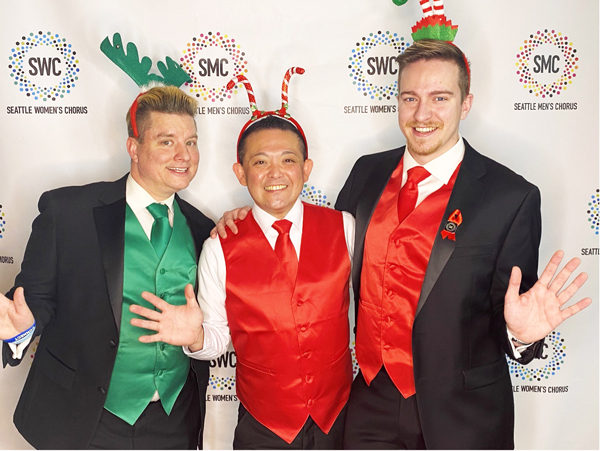
Seattle Men’s Chorus Holiday Show, 2019. Photo courtesy: Tomoyuki Uehara.
What are the other activities are you involved with?
When I can, I play keyboard with the Okinawa Kenjin Club’s sanshin group at various community events. I have also been involved in kickball, volleyball, and even an amateur brass band to play the trumpet. I really enjoy volunteering at local community events as well. It gives me a chance to meet new people and stay connected. I just love being around people with great energy, so I try to participate in as many activities as I can.
Do your activities and insurance work help each other out? In other words, are you able to gain more clients with your activities and/or does New York Life Insurance support your activities?
That is actually something I feel I could improve on. I usually do not talk much about my professional work when I am participating in community activities especially within the Okinawan group. As the president, I never wanted people to feel that I was using my position in a nonprofit setting to promote my business. So, I typically avoid bringing up my work unless someone asks me directly.
However, I also realize that I should share what I do because you never know who might benefit from my services. I am very passionate about educating people on financial literacy. Since I was once a high school teacher, I really enjoy the “providing guidance” aspect of my career now −helping people understand and make informed financial decisions.
How do you see your future and what would you like to do?
I never want to stop learning or trying new things when time allows (laughs). One major goal is to continue growing the Okinawa Kenjin Club in Washington to 500 households which would be over 1,000 members. It may sound like a big, audacious goal, and some people may laugh, but I do not want to ask, “Why can’t we?” Instead, I like to think, “Why NOT?”
We now have a wonderful younger generation promoting the club and their involvement is attracting even more youth. I am also creating a junior board to bring new ideas and eventually transition these members into future leadership roles. If this structure supports sustainable growth, I can confidently retire from my position and that is what I would call success.
Beyond the Okinawa Kenjin Club, I hope to support the broader Japanese community as well, especially by helping bridge the gap between first-generation Japanese immigrants and Japanese Americans. I want to create more opportunities for connection, understanding, and unity.
I also hope to continue exploring the world. I have traveled to 27 countries so far and there are many more to come! One of my biggest dreams is to visit Antarctica someday to see penguins in their natural habitat. I believe that staying curious and adventurous is an important part of living a full life.
Anything else you would like to share?
I feel incredibly grateful for all the opportunities and support I have received throughout my life from my family in Okinawa, my host family in the U.S., my mentors, my community, and the many people who believed in me even when I doubted myself. If there is one message I hope to share, it is that dreams do not have deadlines. You are never too old, too late, or too inexperienced to try something new.
If you stay curious, stay kind, work hard, and surround yourself with good people, life will take you places you never imagined. I am still learning, still growing, and still excited about what is ahead and I hope others feel inspired to continue chasing their own dreams as well.