Seattle Samurai Wins
Pacific Northwest Book Award
By Lily Hahm and Jamie Cheng,
Japanese Cultural & Community Center of Washington
NAP Contributors
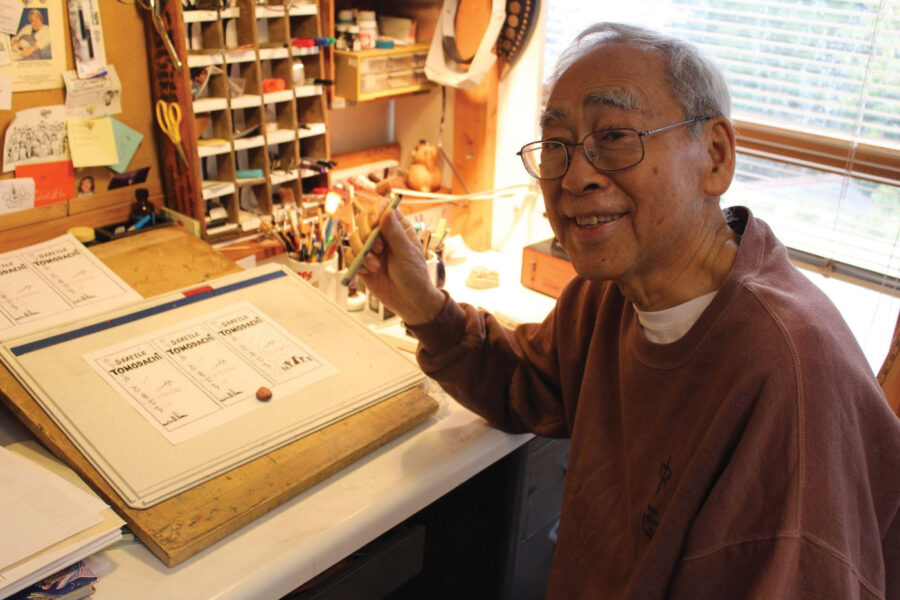
The late Sam Goto in his studio. Photo courtesy: Kelly Goto.
“What both of my parents were trying to do was to tell stories that would resonate with the next generation. So that these cultural legacies would live on. My dad thought, ‘oh, cartooning is a good way to do that.’ It’s a visual story.” — Kelly Goto
The belief in storytelling as preservation sits at the heart of the comic strip, Seattle Tomodachi, created by the late Sam Goto. Seattle Samurai: A Cartoonist’s Perspective of the Japanese American Experience by his daughter, author and designer Kelly Goto, was awarded the Pacific Northwest Book Award (PNBA) on January 7. It is a recognition that places her among some of the region’s most celebrated writers.
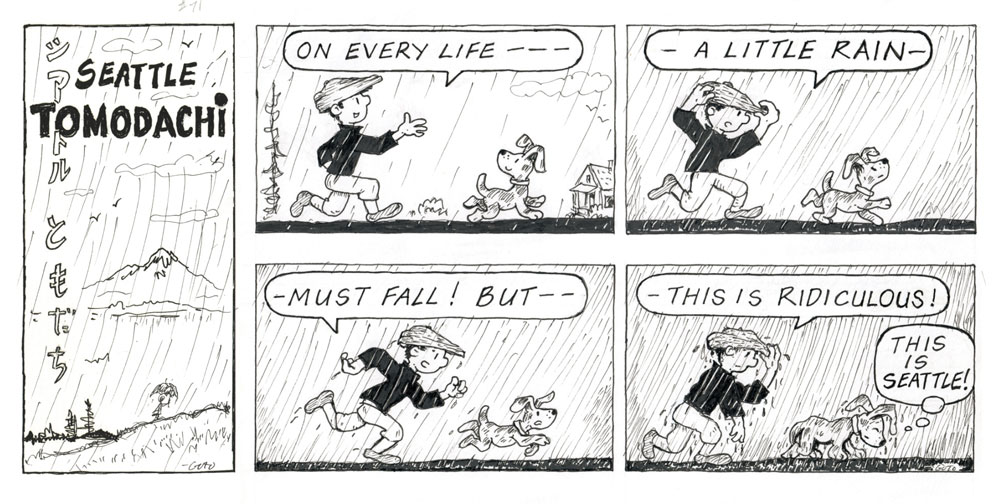
Seattle Tomodachi Raining. Image courtesy: Kelly Goto.
Seattle Samurai is a visual anthology centered on the life and artistry of Kelly Goto’s father, Shigeru “Sam” Goto. Though he spent his professional career as a dentist, Sam Goto was an artist at heart creating cartoons, rock carvings, and handmade jewelry throughout his life. Creativity was not secondary to his identity—it was how he processed the world around him. In his later years, Sam Goto’s wife, Dee, encouraged him to share his work publicly. That encouragement led to the creation of Seattle Tomodachi, a weekly comic strip published in The North American Post newspaper from 2012 to 2018.
Over those years, Sam Goto wrote and illustrated the strip loosely basing its narrative on the life of Seattle Nisei (second generation Japanese American), Shigeru Osawa, whom Dee Goto had met and interviewed years before. Through humor and visual storytelling, the comic chronicled everyday life in early 1900s Seattle while quietly addressing the broader realities of Japanese American history, identity, and resilience. Those comics formed the backbone of Seattle Samurai which Kelly Goto curated and contextualized. She weaved together her father’s work with family history and reflection. The result is both an intimate portrait and a broader cultural record preserving stories that might otherwise have faded with time.
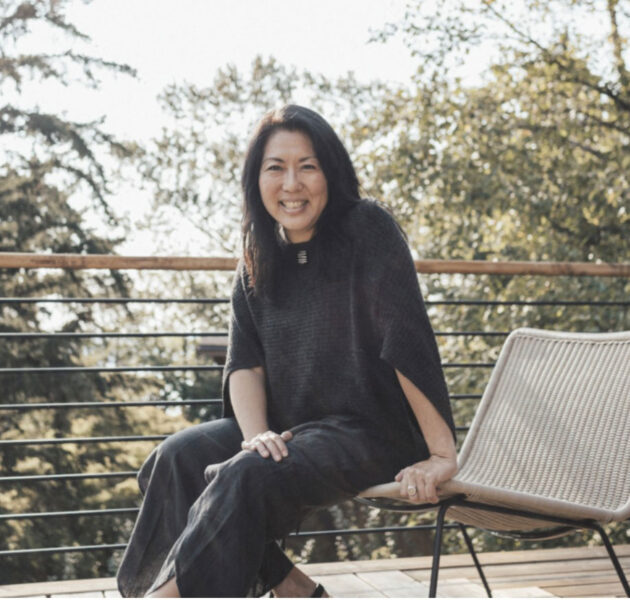
Kelly Goto outdoors. Photo courtesy: Kelly Goto.
The Goto family has a long and layered history in the area. Together, Dee and Sam Goto lived in Washington, Oregon, and Idaho. Their families worked as dairy farmers, shop owners, and lumberjacks. They contributed to the development of their communities while navigating the realities of being third generation Americans of Japanese ancestry in the nineteenth and twentieth centuries. “My mom and dad always said, ‘We are the product of our heredity, our environment, and our education,” Goto recalls. “They believed that the Pacific Northwest had a huge impact on who they are and where they came from.” That philosophy is embedded throughout Seattle Samurai where place is as integral as character.
Sam Goto’s comics were almost love letters to Seattle but were also critical. Rather than idealizing the city, his work reflects a relationship built on familiarity, growth, and survival. Through simple panels and recurring characters, he captured the texture of daily life. He acknowledged the historical and personal challenges faced not only by Japanese Americans but by immigrants across the globe.
Though Seattle Samurai was nominated for the 2025 Will Eisner Award, the PNBA nomination and selection came as a surprise to Kelly Goto. “It was an honor, just to be named by your independent bookseller peers,” she says. For the book to be recognized as something that was “speaking to them” affirmed the power of her father’s work that resonates beyond her own family. More than a tribute, Seattle Samurai serves as an intergenerational bridge. By preserving her father’s cartoons and placing them in a contemporary context, Kelly Goto ensures that these stories remain accessible to new audiences. The PNBA recognition underscores not only the literary value of the work but also the importance of visual storytelling as a means of cultural preservation.
Looking ahead, Kelly Goto hopes Seattle Samurai can be used in classrooms as a catalyst for students to explore their own histories. She imagines a 7th grader reading the book and asking, how could my family’s story be told this way? Perhaps by seeking out an older relative, the student would record memories before they are lost. The act of listening, she believes, is essential to preserving culture. To support this broader reach, Kelly Goto is working on a more affordable softcover edition of Seattle Samurai. The goal is practicality: a lighter, more portable, and less expensive version that is easier for libraries, schools, and individuals to access and share. While many institutions prefer hardcover books, the weight and cost of the original edition can be limiting. The new version, she hopes, will make the book more accessible and classroom-friendly. Encouragingly, libraries and universities are already responding. Copies are frequently checked out at the University of Washington, the Seattle Public Library, and even the San Francisco Public Library system.
To Kelly Goto, this is proof of the story’s connection with not only Japanese American culture but with all immigrant cultures. Her family represents the everyday immigrant and their story. In many ways that resonance reflects the very legacy her parents hoped to leave behind: stories that endure, adapt, and find their way into the hands of the next generation.
Join Kelly Goto in celebrating Seattle Samurai’s PNBA win at Ravenna Third Place Books, 6504 20th Ave NE, Seattle. It will be on Friday, February 27 at 7 p.m. for questions & answers, book signing, and conversation. This free public event welcomes readers and community members alike. RSVP is recommended by contacting thirdplacebooks.com or 206-525-2347.
Copies of Seattle Samurai can be purchased through various retailers including Hosekibako Japanese Resale Shop at 1414 S Weller St, Seattle or www.jcccw.org/hosekibako or 206-739-9017. It can also be ordered directly through the publisher, Chin Music Press, 1501 Pike Pl, #329, Seattle or chinmusicpress.com or 206-380-1947.
Established in 1964, the Pacific Northwest Book Awards recognizes original authorship across Washington, Oregon, Idaho, Montana, Alaska, and British Columbia. Past recipients include writers such as Ursula K. Le Guin and Erik Larson, authors of works such as A Wizard of Earthsea and The Devil in the White City, respectively.