Toshiko Hasegawa’s Commitment to Justice, Equity and Solidarity
By Barbara Mizoguchi
NAP Editor

Portrait of Toshiko Hasegawa
As you may know, Toshiko Hasegawa won re-election as the Port of Seattle Commissioner in Washington. She ran unopposed with 97.85 percent of the vote countywide. I had a chance to meet with Hasegawa to discuss her background, family, current work, and the future.
When asked about her family background, Hasegawa said she had just returned from a pilgrimage to Japan with her husband, children, father and stepmother. While there, they were all able to see the family’s homestead in Nagano, and visited the local temple and cemetery. There, she shared in her family’s custom of carefully tending to the family grave site which included modern and ancient headstones.
Within the temple, there is a list of names above the entryway. There, Hasegawa found her ancestor’s name as an active member of the temple generations ago. Hasegawa’s great grandfather worked on a ship and immigrated to the U.S. when he was 25 years old. He later married Sen Mishizawa who arrived as a “picture bride.” (women selected by a matchmaker who exchanged photographs with the immigrant). They lived in Seattle and had four children – one of them was Toshiko’s grandfather, Hiroshi.

Hasegawa cemetery plot with ancient excavated headstones behind newer headstones. Location: Zendo-ji Temple, Nagano, Japan. Photo credit: Port of Seattle.
Hiroshi was in high school when U.S. Executive Order 9066 was signed in 1942. All Japanese and Japanese Americans on the West Coast were suddenly incarcerated. His family lost everything. After the war, the family resettled in Seattle just in time for the school year to begin. Hiroshi eventually married Mine Nakashima and set down roots in Beacon Hill in Seattle. They had three children – one of them was Hasegawa’s father, Bob.
Bob was a trucker with United Parcel Service and eventually became Secretary Treasurer of the International Brotherhood Teamsters Local 174 (labor union.) He married, and raised Toshiko and daughter Mineko in the same Hasegawa house on Beacon Hill.
Hasegawa remembers riding in the back of a truck at four years old campaigning alongside her father for his teamster position. He led the public protest of the World Trade Organization, the garbage strike, and more.
For Hasegawa, growing up amongst labor reforms and collective action that provided results, gave her the ability to speak more strongly and more loudly for various groups. The local “Gang of Four” (Bernie Whitebear, Bob Santos, Roberto Maestas, and Larry Gossett associated with radical minority rights activism in the late 1960s and early 1970s in Seattle) stood in unison to get real results. She feels the examples and lessons from her family and community are where she inherited activism. Those who stood before her, sacrificed just like her ancestors who could have continued selling rice in Nagano but risked immigrating to America instead.
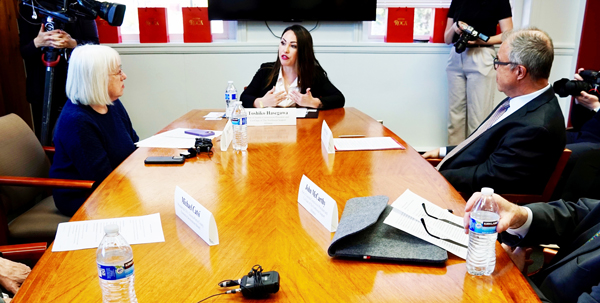
Business tariff roundtable convened by U.S. Senator Patty Murray in Tacoma to discuss the impacts of tariffs on businesses and local trade. Left to right: Michael Catsi, President & CEO, Tacoma-Pierce County Economic Development Board; Sen. Murray; Toshiko Hasegawa, former Port of Seattle President and Co-Chair of the NW Seaport Alliance; John Melin, CEO, Almond Roca; and John McCarthy, Port of Tacoma Commission President and Co-Chair of the NW Seaport Alliance. Photo credit: Port of Seattle.
Hasegawa also visited the hometown of her grandmother’s family in Wakayama. There, she explored the villages of Shirakawa-gō and Gokayama, designated as a World Heritage Sites by UNESCO. She stayed in Kii Katsuura, a peaceful fishing town with onsens (natural hot springs and public bath houses). Exploring the area, she learned that residents worked the land, fished the sea, and worked hard. During her grandparents’ days, everyone was going to America for a better life. However, Hasegawa thought, why leave? The area was idyllic and calm, – like her grandmother who was gentle and kind.
As many know, Hasegawa became the first Asian American woman elected to the Port of Seattle Commission in its over 110 -year history. When asked what is next for her second term, she shared the port’s role in creating opportunities and regional stability (given the U.S. president administration’s tariff policies, health care roll-backs, and attacks on immigrants.) “The Port is a place of opportunity. Local government is where we can and should lead on progressive policies that will protect our communities.”
For example, Hasegawa says millions of dollars have been invested at the port to connect youth with aviation and maritime careers; building and construction are paired with female and refugee apprentices; and diversity have created more goals instead of barriers in contracting. An internal assessment was done that improved salary raises and promotions at the port including an update to its Human Resources policies. A pilot program began to improve work-life balance. Free ORCA cards are being distributed that can be used for mass transit throughout King County to help port employees get to work. The port also established a Childcare Navigator Program and is currently exploring the feasibility of a brick-and-mortar facility for airport workers and the community throughout the county. In addition, Hasegawa cited implementation of the recently updated Welcoming Port Policy that she championed. Her belief is that the port is the heart of Seattle’s economy and workers are its lifeblood.
Hasegawa said she liked what artist and activist Erin Shigaki said at Day of Remembrance earlier this year, “We need to be the ally today that we wished our ancestors needed during World War II.”
“As a Japanese American, I’ve been raised to understand that I am part of something bigger than myself. My hope is that what we’ve been able to do at the port will have a ripple effect globally for industries – being a connector that brings nations together.” says Hasegawa. She finds it a rare honor to want to make her work count for future generations; to do the good that she can; giving a voice for the community; and above all, bring these values to the port.
We then discussed her work at CAPAA (Washington’s Commission on Asian Pacific American Affairs) in which she was the Executive Director for almost six years. It is a small, cabinet-level agency at the State of Washington. She was appointed by Governor Jay Inslee, becoming the youngest woman of color to serve in the governor’s cabinet. When Inslee announced his retirement, Hasegawa resigned and opened a small consulting firm, Yonsei Consulting.
It was her older sister Mineko who showed her the early path to youth involvement for civic empowerment. Mineko was involved in youth activities at Garfield High School (in Seattle) and got Hasegawa to participate in protests, Seattle Youth Involvement Network, and more. She says her sister was a guiding light for her.
When Hasegawa was asked what is next for her, she said she is looking for new ways to serve the community.She recently issued a press release announcing she is strongly considering a run for the King County Council District 2 seat recently vacated by King County Executive Girmay Zahilay. Despite the current political climate, she will protect and empower the community. At the port, she would continue to connect economic opportunities and hold the line – our values. She understands how people are fearful, tired, hurt, and angry but this is also the time to create something new. “Darkness is the cornerstone of our resilience, hope, and faith. Hasegawa said. “When the weight is unbearable, we lean on one another. This is what community is all about. It’s about coming together to set down roots and thrive. Through the pain and uncertainty, we have each other. We have never been more powerful. It is beautiful to hold us at our best.” Hasegawa says she is grateful for the community who continue to inspire her, and she is honored to serve.