New Permanent Home For Asia Pacific Cultural Center
By Barbara Mizoguchi
NAP Editor
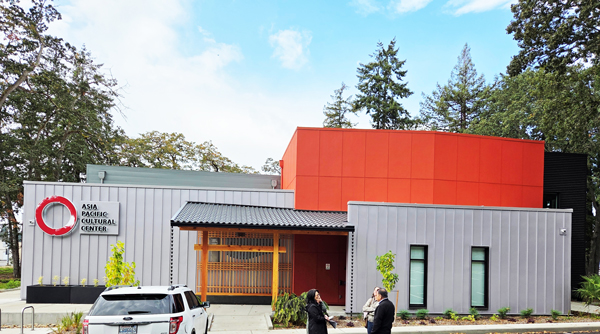
New permanent facility of APCC. Photo credit: Dave Asahara.
I recently had a chance to visit Asia Pacific Cultural Center’s (APCC) new facility in Tacoma, Washington which opened at the end of August. It was so good to see all the work done over the years from the very beginning. Back in 1996, I was one of the co-founders as a small group that regularly met in a downtown Tacoma café. We wanted to represent all cultures throughout Asia including India and the Pacific Islands. We also wanted it to be a non-profit organization that could support these communities in the area. It began with Samoan performances with the help of Lua Pritchard (current APCC Executive Director). We made sure activities were planned to represent a different country each time. Although I moved on and was no longer on the Board of Directors, the center continued growing with programs located throughout the city and offices in different locations. After 29 years, APCC now has a permanent place to call home with the help of many partnerships, contributors, and friends. It was heartwarming to see old and new friends who greeted me at the front entrance of this new facility.
The new facility was designed, developed, and constructed by SMR Architects in Seattle, Washington; Edge Developers, LLC in Seattle; and Korsmo Construction in Tacoma.
It covers 18,500 sq. ft. replacing a former facility that belonged to Parks Tacoma. The outside of the building may look new with its large, proud logo displayed up high but upon closer view, there is beautiful woodwork along the wall while approaching the entrance. In between are vertical, black strips with the name of each country that APCC represents – 47 to be exact.
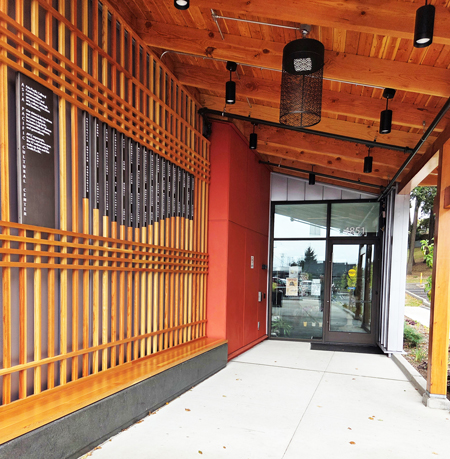
Entryway of new APCC facility. Photo credit: Dave Asahara.
After entering the facility, the space opens into a large, brightly lit reception area with a high ceiling. It was not pretentious but had a familiar feeling. Maybe it was the artwork surrounding the space or the tall display case behind the reception desk or the sofa to the left of the room. Maybe it was the facility renter already using the performance space nearby. Next to it is a professional kitchen for rental use and at the other end of the room is the entrance to the gift shop. Instead of the typical products seen in gift shops, this one will feature handmade items from the represented countries.
Across from the gift shop is a long hallway called the “Hall of Nations.” It is decorated with artwork and artifacts given to APCC throughout the years. These pieces are hung high down the long corridor. This is perfect since many are three-dimensional and prone to damage. On the opposite side are several display cases featuring some of the numerous awards received. (There was barely enough room in each case for the awards.) Above the display cases, covering their full length, are beautiful, exotic and rare ethnic instruments.
Continuing down the hall, the first room was the Jade Choe Gallery being set up to feature an international exhibition of Korean Minhwa paintings (traditional folk art) from eight artists in South Korea. There were two additional classrooms with television screens which can have simultaneous views. In fact, APCC Board of Directors Tina Huynh, University of Puget Sound Associate Professor of Music, is preparing a children’s class on how to play the ukulele in one of the rooms. At the end of the hall is the Albert Q. Cosio Dance Studio with barre rails and mirrors (Cosio is APCC board treasurer). Including dance is an unusual yet ingenious concept for most non-profit organizations. The room also opens to a small park with mature Oregon White Oak trees and grass. It is an ideal location where outdoor festivals can take place, and dancers can come inside to change costumes.
Upstairs has a balcony looking onto the lobby where artwork of clouds fills the entire ceiling and ethnic markings decorate the floor. There are also swirls of pink three-dimensional flowers decorating the lobby walls along with face masks from different countries. As that was distracting me, I almost missed the library that is open for anyone to access. The rest of the hallway includes the administrative offices.
As we returned to the lobby, I was impressed by the continuing educational programs; partnerships with donated kitchen equipment and electronics; and even Patsy’s Place. It is a new, low-income apartment building in Tacoma named after the APCC lead co-founder Patsy Surh O’Connell. The income from the apartment helps the APCC budget as well as long-term, weekly APCC facility rentals. Raising funds is equated with community help such as inheriting the former Seattle Chinese Post now called Washington Chinese Post. The newspaper was donated by former publishers Assunta Ng and John Liu.
As an excuse to visit this new facility, I would suggest attending one of its events, workshops or bringing your children and/or grandchildren to a class or two. Learning about different Asian cultures is interesting and fun. The friendly board and staff make it easy to ask questions, to learn, and to dig deeper. “This is our home, but this is also your home. APCC is here for the community,” said Pritchard. “We welcome all! Please, come join us!”
For more information, see: www.asiapacificculturalcenter.org.
ASIA PACIFIC CULTURAL CENTER
MISSION STATEMENT
Our mission is to bridge communities and generations through art, culture, education, and business.
OVERVIEW
Asia Pacific Cultural Center (APCC) is a center for cultural exchange providing
programs and services that promote the greater awareness, understanding, equity, and inclusion of the Asian and Pacific Islander people. This community includes
immigrants, refugees, children and youth, seniors and elders, low-income, and all
groups who are a part of the Asia Pacific community. Our founders recognized the
need for cross-cultural understanding in their community, and in 1996 they founded APCC to address this need.
We are a 501(c)3 non-profit organization located in Tacoma, Washington, serving the Greater Puget Sound area and beyond. APCC proudly represents and serves the Asia Pacific people from 47 different countries, providing a wide range of programs and
activities, many of which are free or very low cost of admission. APCC brings people
together in the spirit of acceptance and understanding, helping to build a stronger,
healthier, more vibrant community for present and future generations.