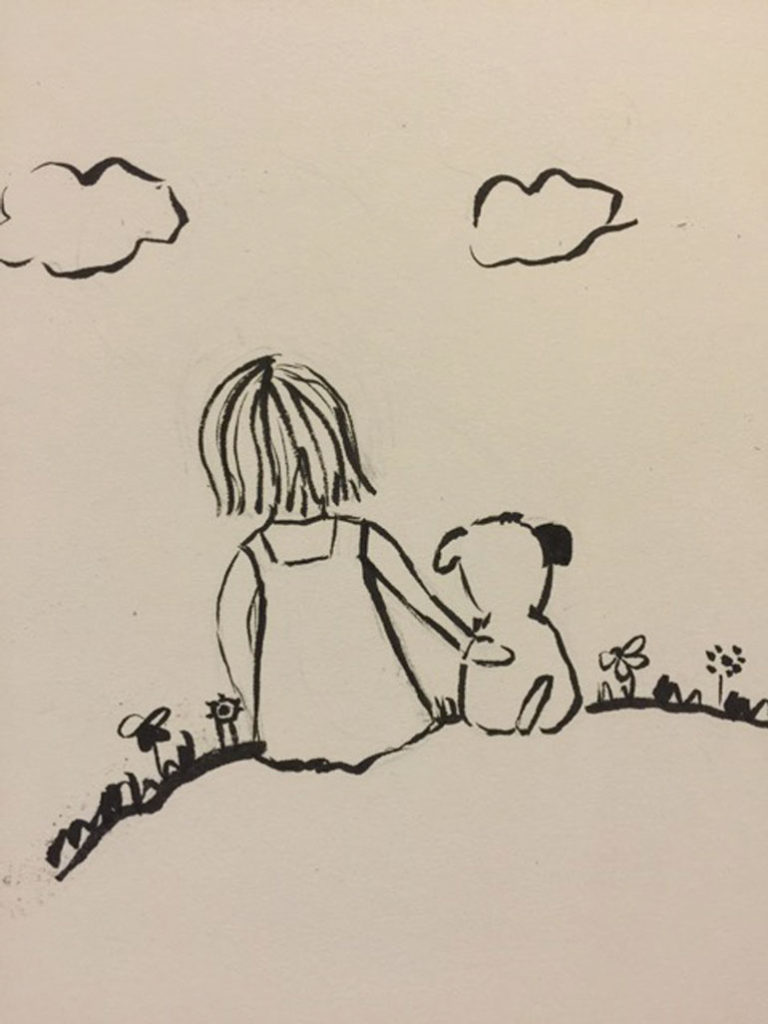
Kay Hirai and her dog at a park in Seattle.Photo and images courtesy of Kay Hirai
When I walked into Studio 904 Hair Design and Spa, my first impression wasn’t of barber chairs and hair products, but of bento boxes, holiday cards, crafts and Japanese tea cups. They were raffle prizes, auction items and gifts, all for the benefit of Kay Hirai’s Angels for the Animals fundraiser. Hirai is a Kyushu-born local business owner who describes herself as a “socially responsible entrepreneur, author, and artist.” She came to the United States as a young girl just entering middle school–entangled in family secrets and already a survivor of the hardships of wartime and postwar Japan. There, Hirai had faced prejudice for having a mother who was an American citizen. Her best, and oftentimes only, friend was a small, white terrier called Shiro. In America, she walked into a brand new school unable to speak or read English. Today, Hirai has 38 years of business ownership, two books and dozens of successful projects behind her. She maintains a blog, makes dolls and Christmas ornaments, runs multiple fundraisers a year and is a proud mentor to her employees and other young people.
Illustration of Hirai and Shiro in “Keiko’s Journey.”
Hirai’s latest book, “Keiko’s Journey: A World War II Memoir,” tells the first part of her story–an incredible tale of family intrigue, her mother’s strength and her own struggle to grow up. In anticipation of its release and a regular column soon to be published in this newspaper, The North American Post asked Hirai a few questions about her life and motivations.
Why did you decide to write “Keiko’s Journey”?
“It was difficult to write this story and to dig up everything out of my past. I didn’t want to remember it! But for years, I had been thinking about my mother, and I wanted to clear her name. In Japan, she got called all kind of names. Her own husband thought she was messing around, and he would beat her up. My real father’s family didn’t like her because she snuck me out of the country, but she didn’t have a choice. I always thought that everyone should die with a happy ending, but she never did, even though she was a remarkable woman. So I wanted to write this book for her, to tell her story.”
What about your story do you think other people will connect to?
“I feel like there are probably a lot of people who feel like me, living here. I never really felt like I belonged to here or belonged to there. I remember going to Hawaii, where Japan had attacked Pearl Harbor; and then I went to Japan and my uncle would say ‘Oh, this was a beautiful castle before the Americans bombed the heck out of it.’ No matter where you go, you feel like the enemy.
“Or you want to talk about your past but nobody understands what you’re talking about. I remember these festivals, but no one knows what they are. All my friends here, they remember the internment camps, but I have no one to really talk to.”
How have your experiences shaped your life and business today?
“I think it’s all come together to form the philosophy I work with—the way I treat people and how industrious I am. I believe in kaizen, the Japanese idea of lifelong learning and improvement, and I run my salon that way. I believe in always trying to give a helping hand to those in need, because in a way I feel like I was spared a life during the war, so now I have to make a difference.
“We do these fundraisers every year part of our business marketing. That’s why I call myself a
social entrepreneur. I do everything to help the good of society. I try to be a real good employer and help people with their career progression. I love mentoring people.”
A book event and signing featuring “Keiko’s Journey,” will be held at the Nagomi Tea House at on Dec. 13 at 2:30 pm, accompanied by refreshments, music and a discussion on wartime Japan. Hirai is also hosting a Holiday Angel Event and book signing at her salon, Studio 904, on Dec. 5. Further details can be found on the calendar page.
Illustration of Hirai and Shiro in “Keiko’s Journey.”
Ingredients: Rice 2 cups Kokuho Rose US#1 Extra Fancy Grade (Grocery Special $16.99 / 15lb)
Hayashi Sauce ½ box S&B Tasty Hayashi Rice Sauce Mix (Grocery Aisle 4) ½ lb Sukiyaki beef (Meat Dept. Special $7.99/lb) 2 cups Yellow Onion (Produce Dept) – slice thinly 1 cup Crushed Tomatoes (Grocery Aisle 4B) 1 cup White Mushrooms (Produce Dept) – small dice 1 T Sho Chiku Bai Sake (Grocery Special $6.99 1.5L) 2 cups Beef Stock / Water (Grocery Aisle 4A) 1 tsp Vegetable oil (Grocery Aisle 4A
Garnish Miyazaki Takuan/Pickled Daikon Radish (Grocery Special $3.69) Ellenos All Natural Greek Yogurt (Available at Ellenos Counter
Rice: Rinse well, soak grains for at least 20 minutes prior to cooking. Once finished cooking, immediately uncover and fluff the rice by tossing with a spatula until every grain is separated. Let rest for five minutes and serve.
Hayashi Sauce: Heat oil in a pan and stir fry onions until golden brown. Add beef and mushrooms and cook for two minutes. Add cooking sake and allow to evaporate. Add stock/water, crushed tomatoes and bring to a simmer, then add the sauce mix. Cook until demi glaze sauce comes to the desired consistency and serve with rice. Garnish with pickled radish, takuan and a dollop of yogurt.
[Editor’s Note] This is a joint project with the Uwajimaya Seattle. The writer will appear at the store for cooking demo with this recipe this Friday. He can be reached at robertgiulietti@uwajimaya.com.
We need more people like Min Yasui in the world — who are willing to stand up for what is right, for whom principles of justice are more important than personal comfort. I’m honored to be able to work on this film, about a man whose story needs to be heard by a wider audience.” — Will Doolittle, co-director, Never Give Up!
November 2 is the Day of the Dead in Mexico, and I live in the very fiesta-prone town of San Miguel de Allende. It is not a sad day but a colorful and joyous holiday. Families and institutions build beautiful altars to their deceased loved ones, often opening their doors to the public to share in their homages and celebrations. So I decided to officially inaugurate an online homage and celebration for my late father, Minoru Yasui, on the Day of the Dead, in order to share the work our team is doing on the film Never Give Up! and to launch a fundraising campaign to finish it at minoruyasuifilm.org.
Minoru Yasui. Photo courtesy of Holly Yasui.
I’ve always wanted to make a film about my dad, but wasn’t able to devote the amount of time necessary until I retired. Once I decided to dedicate myself to this project, the pieces fell into place. Will Doolittle, an Oregon filmmaker with extensive experience in documentary work agreed to co-direct and do camerawork and editing; and social media maven George Takei, of Star Trek fame and currently starring in his Broadway musical Allegiance, agreed to do the narration. This year, because of an increasing workload, I contacted Kelley Baker, a former student at USC where I was a graduate teaching assistant, to help out as Associate Producer. Kelley also has a lifetime of experience as an independent filmmaker. Shoji Kameda, a friend of Will’s and an internationally renowned musician, has agreed to write an original score for the film. This stellar team is working on the project because they feel that Min Yasui’s inspiring story needs to be told to a wider audience. Min Yasui was an extraordinary person who stood up to the greatest power in the world, the U.S. government, because he believed with all his heart and soul in the democratic ideals of liberty and justice for all—and he continued, all his life, to fight for those ideals. He never gave up! In 1942, he initiated a legal test case by deliberately violating military orders that resulted in the imprisonment of 120,000 persons of Japanese ancestry in U.S. concentration camps. He spent 9 months in solitary confinement awaiting the appeal of his case to the U.S. Supreme Court, which ruled against him, but he continued to defend the human and civil rights of all people.
Minoru Yasui’s handwritten letter from jail, 1942. Photo courtesy of Holly Yasui.
In Denver, where he relocated after the war, he helped to found and participated in a myriad of community organizations, fighting for the human and civil rights of Blacks, Latinos, Native Americans, religious minorities, immigrants, children and youth, senior citizens and low-income people; he also initiated and was active in national networks and international exchanges. During the last years of his life, Min Yasui devoted himself totally to the redress movement. He reopened his legal case in 1983. He attended thousands of meetings, made hundreds of speeches and wrote thousands of letters in support of redress. When he died in 1986, his legal case was in appeal. His family took his case to the U.S. Supreme Court, but they refused to hear it in 1987, the bicentennial of the U.S. Constitution, which Yasui had so steadfastly defended all his life. Two years after his death, Congress passed the Civil Liberties Act of 1988, which included a government apology and reparations for all survivors of the U.S. concentration camps. During the push for redress, many of Min Yasui’s interviews and speeches were filmed for national news, local stations and ‘home movie’ recordings. Now, more than 30 years later, only a handful of clips survive—but they speak volumes. I’m lucky that my Aunt Yuka, my dad’s favorite ‘baby sister,’ saved hundreds of family photographs and documents, including handwritten letters from jail! My dad also saved voluminous papers, now held by the Auraria Archives in Denver, Colorado, so I have a wealth of materials I’m using in the film.
Minoru Yasui with his mother and youngest sister, Yuka, 1935. Photo courtesy of Holly Yasui.
Yasui on Yasui
In 1988, my cousin Lise Yasui produced an Academy Award-winning film, Family Gathering. When I asked her about outtakes—footage filmed but not used in the final cut—Lise came up with an impressive list of materials, but all in old formats, which are extremely expensive to transfer to modern media. So I used a few clips from the film itself, an interview done in our Aunt Yuka’s kitchen. Lise says of her uncle: “He always insisted that his fight to right the injustices of the 1940s was not an attempt to rewrite the past but to make the future a safe place for human rights and personal dignity.”
Promotional image for Never Give Up! Minoru Yasui and the Fight for Justice. Photo courtesy of Holly Yasui.
Other recordings
I also contacted former Salt Lake City television news producer Michael Goldfein for permission to use his short piece Citizen Min. Says Goldfein, who is now in Washington DC writing a historical study about government policies toward Japanese Americans during World War II: “The life and legacy of Minoru Yasui is indisputably one of the great stories of heroism in America’s civil rights history. In 1983, as a young reporter, I had the opportunity to tell his story. The trip I took with him, visiting the site of his arrest in Portland and his ultimate internment in Minidoka, was a touchstone moment in my life. Min’s enduring passion for fairness needs to be seen and heard.” In 1985 Steven Okazaki’s documentary Unfinished Business, about the re-opening of three Japanese American legal cases—Yasui, Hirabayashi, and Korematsu—was nominated for an Academy Award. Okazaki interviewed Yasui at his brother’s farm in Hood River. Says Okazaki: “Min Yasui was brilliant, dapper, funny, controversial, and inspiring. I don’t know of anyone who was so principled, so absolute in his faith in justice, and the necessity to speak up for and live by one’s beliefs. I met him over thirty years ago and was struck by the power of his personality, warmth and decency. I had to smile and wonder if he was real. Thirty years later, I know he was the real thing.” A former professor at the University of California-San Diego, Jim Lin, contacted me through an online magazine. Jim had several videocassettes of Min’s rousing presentations at the first Asian American studies program, which Lin organized. Recorded in the spring of 1986, just months before he was diagnosed with cancer, those tapes are among the last made of the great orator. They illustrate better than any other footage I’ve been able to find the passion and conviction of Min Yasui’s oratory. In 2014, Will Doolittle and I shot interviews in Oregon, California and Denver with twenty people who knew Min Yasui and/or his work during different periods of his life. Once we started editing, it became apparent the material merited a longer format than the 15-30 minutes originally planned. Thus, the decision to raise funds for an hour-long film. We are seeking $50,000 to complete Never Give Up! and for 2016 events planned for the centennial of the birth of Min Yasui, as well as a school curriculum about this American hero whose life and work can be an inspiration for generations.
Editor’s note: The article was originally posted in the Japanese American National Museum’s Discover Nikkei at www.discovernikkei.org. Holly Yasui is a freelance writer, editor and translator, and currently working on a tribute to her father Min Yasui in 2016, the centennial of her father’s birth. She would greatly appreciate help from any readers who have materials, especially recordings of Minoru Yasui that they might be willing to loan for this project. She can be reached through Discover Nikkei at editor@discovernikkei.org
Japanese fashion brand Uniqlo opened its new Bellevue store on Nov. 6 attracting long lines of fans throughout the morning.
The store is the first store to open in the Northwest region, but it is one of the biggest of the U.S. stores, according to Uniqlo, which also plans to open a Seattle store in the future if the Bellevue business goes well.
A Bellevue store pre-opening event was held on Nov. 5 with local representatives including Consul General Masahiro Omura and Seattle Seahawks Wide Receiver Jermaine Kearse.
The North American Post’s 1956 Matsutake Contest concluded with an award’s ceremony. Consul General Yoshikawa, center, presented the Consulate Cup to contest winner Shigeru Matsumoto, left, in the photo taken by Henry Miyake. The North American Post President Takemitsu Kubota, right, also holds a special trophy from the Consul General.
As a young Japanese American, Stephen Kitajo tries to do new things. The local-born Yonsei (fourth generation Japanese American) became a co-chair of the Minidoka Pilgrimage Planning Committee this August, which will prepare for the 12th annual history educational tour to the Japanese American incarceration camp site in Idaho. Kitajo, who has been involved with the group since 2012 as a youth scholarship recipient, has also worked at the Japanese Cultural Community Center of Washington. “A big part of the reason why I started activities like Minidoka Pilgrimage and JCCCW is my curiosity,” said Kitajo, who had few chances to directly hear experiences or stories from his parents or grandparents. “My parents didn’t really have stories, because their parents didn’t talk about anything. I wish I had asked my dad before he passed away, and I wish I was part of it. And my mother wasn’t able to be involved, she is just too busy. “When I had a chance to be involved, I thought it would be a good thing,” he continued. “Because it gave me a chance, literally I could share my stories and experiences with my parents because they didn’t get any stories from their parents.” Because he has a strong interest in the Nikkei (Japanese Americans), Kitajo studied Asian American studies and history at Pacific Lutheran University. He later learned how history and culture could be connected by working at the JCCCW. “JCCCW focused on a lot of culture, but basically a big part of some culture is history,” he said. “History helps to shape culture. To learn culture and history is kind of a similar goal.
Stephen Kitajo, fifth right, is a core member of the annual Minidoka Pilgrimage Planning Committee. Photo courtesy of Minidoka Pilgrimage Planning Committee.
“When I was growing up, I used to think am I Japanese American, or am I American?” he added. “And when I was older and started really to be comfortable with the idea, I realized I don’t need to try to fit into either one. The culture I was growing up in is separate from American culture and Japanese culture.” He said that his experiences led him to the answer. “When I was walking by myself through the city or something, people tried to talk with me in Japanese, thinking I was Japanese from Japan,” he said. “However, when I was walking with Japanese friends, they knew immediately to speak in English. They were just seeing me in a different way.” “I’m totally different from people in Japan, and just as much as with other Americans,” he added. “So I think it just took a while to figure that out and be confortable with that.” In describing Japanese American culture, Kitajo explained that it “encompasses a wide range of values, beliefs, expectations and appearances. “It is probably different for everyone who considers themselves to be Japanese American,” he said. “For myself, Japanese American culture is the history of Japanese Americans in the United States and how it is a part of my own story. All of the traditions, food, holidays, music and the arts, values, beliefs and expectations that my ancestors held are still a part of my life today. “They might not be as big a part of my life as they were in my ancestors’ lives, but they will always be a part of me. I try to be mindful of why these things were important enough to my ancestors to want to pass on because it helps me understand how Japanese American culture came to be what it is today. Then I also consider how Japanese American culture has changed in the past, continues to change today and will always change in the future. All of this comes together when I think of Japanese American culture.” This easily relates to the Minidoka Pilgrimage Planning Committee’s activities. “I have never worked with a group of people who were more passionate and more willing to do whatever is necessary to ensure that the memories of Minidoka and the incarceration of Japanese Americans during World War II are never forgotten,” he said. “I want to see the pilgrimage continue to grow,” he said. “It’s not just enough to keep doing the same things. We always have to look for ways to involve more people and different people, to do different things because we want people to come back every year. “So next year, I will do things differently than this year.”
From left, Elaine Ikoma Ko, Diane Fukami, Debra Nakatomi and Dale Kaku at the film event on Oct. 31. Photo by Maiya Gessling/The North American Post
“Stories from Tohoku,” a documentary examining “stories of inner strength and resilience, grace and acceptance, differences between East and West, and the enduring bonds between the people of Japan and Americans of Japanese ancestry” in the face of Japan’s recovery and rebuilding following the March 2011 earthquake, tsunami and nuclear disaster was screened at the NVC Memorial Hall on Oct. 31 to an audience of almost 100 people.
Produced by Dianne Fukami and Debra Nakatomi of San Francisco and Los Angeles, the touching movie follows the individual stories of restaurant owners, parents and single adults, many of whom still, more than three years later, are utterly uncertain about their future.
Originally intended to show how funding raised by Japanese American non-profit organizations in the United States was helping Tohoku survivors, the film quickly became about the people of Tohoku themselves, instead; as the filmmakers realized how few of their stories had been told and how much is left to be rebuilt, even as the tragedy fades from popular memory.
Fukami and Nakatomi also screened a four-minute trailer of their next documentary, a feature on Secretary of Transporation Norman Mineta.
More information can be found at www.storiesfromtohoku.com
The Legacy of Justice project at Hirabayashi Place, the new apartment coming to the International District, is asking for help to make 1,000 cranes for a public art project by Randy Jones. The origami installation will be hung in the lobby of the apartment.
The Legacy of Justice project will feature education and public art installations at Hirabayashi Place to “enlighten visitors about Gordon Hirabayashi’s courageous stance for justice, and contribute to the hopeful possibility that a horrible injustice like the World War II incarceration of Japanese Americans will never happen again.
“We hold up Gordon Hirabayashi’s civic courage, unwavering commitment to social justice, and quiet persistence in the face of adversity, as an inspiration and reminder of the power that each of holds to take a stand for justice,” the project committee states.
There will be seven public art projects in and around the apartment including Jones’ “Stand Up for Justice.”
The folded cranes can be sent to Interim CDA, 310 Maynard St., Seattle, WA 98104. The cranes should be donated with a written message of hope for social justice on a piece of paper. More information can be found at jwasberg@interimcda.org.
Japanese Community Service of Seattle’s (JCS) annual fundraising event, Musical Bridge Concert IV, will be held on Nov. 22 at Renton IKEA Performing Arts Center.
The JCS has been involved with the community in promoting culture, tradition and friendship, and one of its core projects is to organize Japanese and local music talents to feature in its annual Musical Bridge Concert.
This year, Japanese singer songwriter Shinji Harada and his band will join with local gospel group Total Experience Gospel Choir. Harada, who has a strong family connection to Seattle since his grandparents immigrated here, has given several performances and concerts in the Seattle area.
Other musicians and performers will include the local chorus Evergreen Glee Club, Okinawa Kenjin Kai Taiko, soprano singer Fumi Tagata and misic duo Vicious Petals.
The event will be held from 1 – 3 p.m. $20 for general admission, $10 for seniors and students and free for those over 85 and under 7. More information and tickets can be found at (206) 323-0250, admin@jcsseattle.org or www.jcsseattle.org.
Energy experts from Japan and Washington State discuss the possiblity for renewable energy in the U.S. and Japan on Oct. 28 in Bellevue.Photo by Shunya Uetsuji/ The North American Post
The Japan-America Society of the State of Washington held a business round table to discuss the future of clean energy in Japan and the United States at Bellevue City Hall on Oct. 28
Daisuke Kitazawa, associate professor of the Department of Mechanical Systems, Institute of Industrial Science of the University of Tokyo, was the keynote speaker at the event while Kenji Ushimaru, president of Infra Innovations and JETRO senior advisor; Perry England, vice president of building performance of MacDonald-Miller Facility Solutions; and Susan Petty, president and CTO of AltaRock Energy joined as panelists. Kelly Ogilvie, senior policy advisor of the Office of Governor Jay Inslee was the moderator.
Kitazawa introduced Japan’s energy situation since the Great East Japan Earthquake of March 11, 2011, and the approaches taken since then and issues of clean energy in Japan, especially marine energy which is his research field.
He highlighted five points: technological development, high efficiency and low cost, social acceptance in utilization for isolated islands, and large scale or array, as challenges for developing marine energy in Japan. In addition, he pointed out the possibility that new clean energy development has not developed quickly thus far because of the Japanese government’s focus on nuclear power.
Ushimaru mentioned the potential of solar and wind power as key factors for new energy to make up for the shut down of nuclear power plants in Japan in addition to resolving environmental issues and supporting economic growth.
He inferred that Japan and the United States could work together to develop technology for solar power and wind power generation systems. He explained that the United States has a strong foundation in solar energy while Japan has a strong wind power platform, which survived the 2011 earthquake and tsunami.
“I would like to see U.S. and Japanese companies collaborate together not to install these renewable resources in only Japan or the U.S, but to push into a growing outside market,” he said. “I would like to see business collaboration between Japan and the U.S.”
Successful examples for energy efficient buildings were also outlined by England while Betty shared information about geothermal energy.
According to Betty, Japan has a high potential for geothermal energy from volcanoes, a cost effective alternative for a county that has faced competitive natural gas prices.
Sponsored by the Sasakawa Peace Foundation and National Association of Japan America Societies, the event also included networking among participants as they found ways for Japan and the U.S. to move forward together.
Japanese American Citizens League Seattle Chapter has been working closely with Representatives of the Muckleshoot Indian Tribe on the event “beqelšuɫ:” to raise awareness within the AAPI community about the history, heritage and legacy of the Muckleshoot Indian Tribe.
The AAPI and Native American communities have a proud legacy of communion and camaraderie. Throughout history, discriminatory laws and social circumstances stimulated the mixing of these two communities in the labor workforce, in marriage, and in socio-political advocacy.
The Muckleshoot Indian Tribe contributes to AAPI organizations around the state that support community advancement. However, our communities less frequently work together in joint advocacy efforts, and little is understood regarding the history, heritage and contemporary issues of Native Americans and the Muckleshoot Indian Tribe.
The goal of the workshop is to bring into focus another group with a proud legacy, raise awareness of Native American life in Washington, hear the story of the Muckleshoot Indian Tribe in their own words and explore ways in which our communities can work together in the future. Most importantly, we hope to express gratitude for the community support they have offered to us.
At the event, attendees will welcome a variety of panelists from the Muckleshoot Indian Tribe, enjoy a variety of Native American cultural performances and feast in a community potluck with dishes from Seattle’s many different ethnic groups, provided by AAPI organizations beneficiary of the Muckleshoot Indian Tribe’s philanthropy.
“The event will be held on November 21, a date which coincides with Native America Heritage month. It is the weekend before Thanksgiving, a date we feel represents the generosity of Native American peoples,” said Toshiko Hasegawa, past Seattle JACL president and current chapter board member. “We are excited to demonstrate our gratitude and appreciation for their legacy.”
RSVP is required to attend. More information can be found through Hasegawa at toshikograce@me.com.
White River Buddhist Temple in Auburn held its annual fall bazaar ,drawing many community and local residents to enjoy food, produce and crafts that the church members prepared for the occasion. The attendees enjoy mingling with each other at the church’s “family reunion” event. Photo by Joe Watanabe
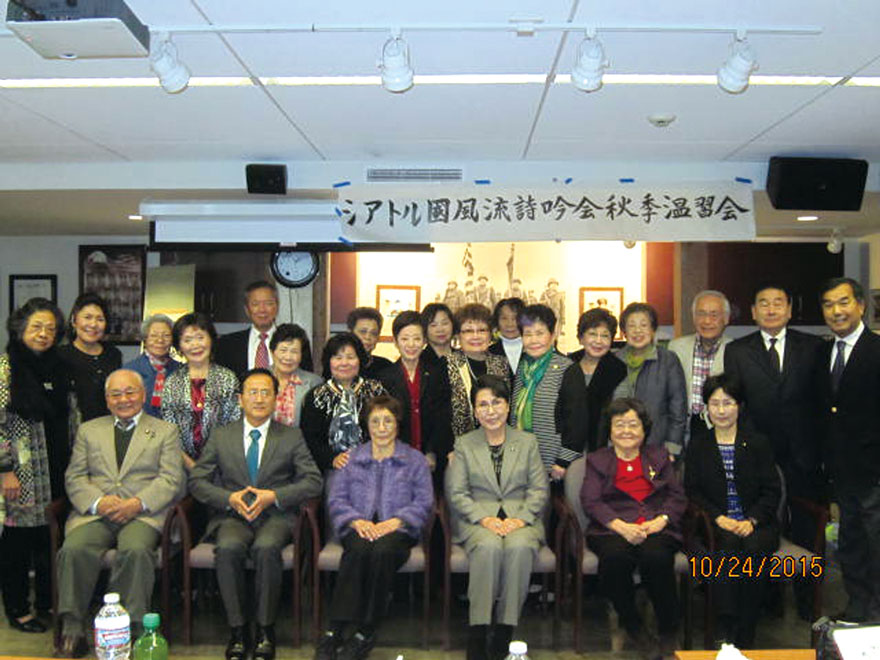
Seattle Kokufu Kai, a local Japanese poetry chanting club, held its fall meeting at NVC Memorial Hall on Oct. 24. Including master instructor and 93-year-old Kokujo Sudo, 24 members performed for each other at the semiannual event. The attendees enjoyed lunch and karaoke entertainment after the meeting. Photo courtesy of Seattle Kokufu Kai
This is the fourth feature on a recent group tour to Japan co-sponsored by this newspaper and the Hokubei Hochi Foundation. We are pleased with the positive experiences from the tour, and believe it will help growing interest in visiting Japan. If you wish for more information on the North American Post group tours to Japan, please contact: elaine@hokubeihochi.org.
Making friends in Asakusa in Tokyo. Photo courtesy of Cheryl Lamphere
By Cheryl Lamphere For The North American Post
Japan was never high on my list of countries to visit. Strange, right? I mean, I am half Japanese after all! I studied the language, love sushi and have been to several Bon Odoris throughout my life. Yet for some reason, visiting the country itself was never super appealing. Then my mom mentioned wanting to visit Japan, as she’d never been either. I knew this trip had to happen and we were fortunate enough to sign up with the North American Post tour.
I began researching and asking others who’d visited how they felt about Japan. I consistently heard how amazing it was, and how they wanted to go back one day. I started getting excited! Will I learn something about myself on this trip? Will I feel more Japanese? What about all of the cultural things I had only learned about in Japanese class?
Fast forward to the day we exited the train in Tokyo. Our group entered a crowded sea of busy Japanese people who were maneuvering the masses, commuting to work. The first thing I noticed was that despite the lost, bright-eyed, obvious-tourist look about us, the locals welcomed us with grace and kindness. It quickly reminded me of my first time getting off the subway in NYC, only to be pushed and trampled upon by the busy commuters. I questioned how two groups of people, with the same goal, behaved so differently.
After being in Japan for a few days, I realized how different the culture was compared to any other country I had known. People bowed to us everywhere, from 7-11 to the local bakery to the train attendants. Every place we encountered was extremely clean. I never saw garbage in the streets, yet trashcans were not commonplace. I found myself stuffing my pockets with litter until I was able to properly dispose of it. And public toilets? Pretty sure they were cleaner than my toilets at home!
I had one profound moment that I’ll never forget – losing my rail pass in Tokyo. We often had to show our pass when leaving the train station, but this time I couldn’t locate my pass. Totally gone. Elaine and Shigeki, two of our guides, told me not to worry, because the Japanese people are honest and likely turned it in. I doubted them, of course, because the pass was worth well over $200! Well, 30 minutes and a couple officer calls later, my rail pass was found. It had been turned in nowhere near the spot we’d gotten off the train. I remember Shigeki giving me a big hug, after running around the station, while I got a bit teary eyed. THIS was the type of scenario I’d only heard about in Japanese class. My faith in humanity had been restored, and I was so humbled to experience the honesty of the Japanese people first hand.
To sum things up, Japan blew me away. It exceeded all my expectations and presumptions I had prior to visiting. Japan is not just another modern country with all the niceties of America; it’s a place full of deep culture that’s remained true through the years. A place where I could identify a bit more – recognizing mannerisms from my Japanese side, seeing other “hapas” like myself, and understanding and bonding with my mom more than ever. Japan, I miss you greatly, and cannot wait to return someday soon!
Five University of Washington students have recently received scholarships from the UW Nikkei Alumni Association. The alumni group held its annual meeting on Oct. 10 at NVC Memorial Hall, presenting the $3,000 William Nakamura Medal of Honor Scholarship to Kari Nasu, and the $2,500 alumni scholarship to Ben Ito, Emma Mitsui, Jordan Nakamura and Shanwa Okamoto.
According to the UW Nikkei Alumni Association, the scholarship program began in 1965 and has presented 244 awards for a total of $360,600. Alumni member Sharon Maeda was also recognized for the 2015 Distinguished Alumnus Award that night.
There are days when I wake up with an “ear worm,” which means there is a song or melody going through my head even though there is no music playing. It is usually a very catchy song and the funny thing is that it is almost never the same song. This “condition” can last for hours but eventually fades away without any lasting effects. Then there are the rhythms of the mind. I can hear in my mind various drum beats and they go with me virtually all the time day and night. These beats make me want to play drums or tap out beats on a chair or table where I am seated. They are cool, catchy and friendly beats. “Folk rhythms,” if you will. Some days I wake up and want to hear serious jazz or Afro Cuban music. Other days I want funk, R & B, or Blues depending on the mood or feeling of that day. I suppose we like different foods on different days as we have the luxury of a wide variety of cuisines at our disposal. The funny thing about the music and rhythms of the world is that the differences between the various genres and cultures is fast becoming quite vague. Popular dance beats cut right across all the different civilizations that are known to us and have been spread around quickly via the mass media. You can find drums, guitars, flutes and singers in just about every corner of the globe. Music has long been recognized for its therapeutic value and is known for its ability to affect mood, trigger memories and foster loving associations. Many doctors believe that certain forms of music can help you tap into your own innate ability to heal your heart. It is no surprise that over the last few decades the healing power of music has been studied and utilized by countless health care givers with good results. When one thinks about the function of music in our society and others around the world, several ideas come to mind. Some people look at music as a way to make money which can be quite tenuous at times. Others see it as a way to “decorate our environment” using beautiful sounds. I like the idea that musical endeavors will usually bring people together for an enjoyable time and always enhances the spirit of the party. It should be noted that performing live music not only promotes camaraderie amongst the band members but also raises the adrenaline levels of both the audience and the performers. This type of euphoria is a natural high, which is the best kind and what musicians and performers live for.
[Editor’s Note] Deems Tsutakawa is a local Sansei musician. He can be reached at deemst@deemsmusic.com
The 15th Broadway High School Alumni Conference will be held on Nov 13 at 8 pm at Edison School, bringing together many Issei and Nisei to remember the old days.
The conference recognizes classes from several years in the past, and the classes of 1904, 1909, 1914, 1919, 1924, 1929, 1934 and 1944 will be featured this year. The alumni from these years are encouraged to attend the event.
Last year, several alumni members were named to the Broadway Hall of Fame. As a 1909 graduate and former Japanese Diet member Juji Kasai was recognized in the Fall of Fame.
The younger generation may be unfamiliar with Broadway High School, but it is what is now Edison School, which was established in June 1946 as a vocational school. Many Issei and Nisei graduated or attended the high school, so it is a memorable and unforgettable school for elderly Nikkei.
Four JET Program returrnees share their stories and experiences from Japan during the reception on Oct. 22. Photo by Shuna Uetsuji The North American Post
The Consulate-General of Japan in Seattle and local Nikkei community welcomed back JET Program participants upon their return to Seattle on Oct.22 at Consul General Masahiro Omura’s official residence.
The reception began with a speech by Omura and four program returnees who spoke about their experiences in each of their respective regions of Japan. Joshua Drewry, who worked as an Assistant Language Teacher in Akita Prefecture, said that he enjoyed seeing various festivals in Japan.
Drewry also shared his experience on running workshops for English teachers in Japan.
“English teachers in Akita are usually very good,” said Drewry, who thought back to his life in Akita, now his other hometown. “I miss everything. I can only say that I am homesick.”
At the reception, Japanese international students, who received the TOBITATE scholarship from the Japanese government, networked with community members to promote the future success of the U.S.-Japan relation.
Bruce Harrell, Seattle City Council incumbent, District No. 2
Nikkei politicians have faced mix results in the initial counting of votes for Nov. 3’s general election. Seattle City Councilman Bruce Harrell, whom The North American Post interviewed on Oct. 29, is leading opponent Tammy Morales by 8 points and almost 1,000 votes in District 2, including the Chinatown-International District and Beacon Hill, as of the 4:30 p.m. update on Nov. 4. Bryan Yambe of the Fife City Council acquired more than 75% of the vote to remain in office as of Tuesday night’s 8:00 update.
Bryan Yambe, Fife City Council , Position No. 1
However, King County Assessor Lloyd Hara, whom The North American Post interviewed on Oct. 22, is 12 points and almost 30,000 votes behind opponent John Wilson, his former chief deputy. Current Seattle Councilman John Okamoto, who was appointed in April as the temporary replacement for Sally Clark, who resigned, did not seek re-election, as promised, and will step down in January. If current trends hold, the Seattle City Council will feature a female majority as well as a Japanese American representative in Harrell, a Native American representative in Debora Juarez, a member of Blackfeet Nation, and Latina representation in Lorena Gonzales. Though all five incumbents, including Harrell, Kshama Sawant, Mike O’Brien, Sally Bagshaw and Council President Tim Burgess, seeking reelection are in the lead, the council will see at least four new members and be younger overall than the current council. Other high profile ballot measures include the proposed Move Seattle transportation levy, which has a 57% lead, campaign finance Initiative-122, which is ahead by 60% and the King County Best Starts Levy, which has a slimmer lead of 53%. Seattle City Council Districts No. 1-4 are all close races, with Shannon Braddock and Sawant carrying just 53% of the vote. For regular updates visit www.kingcounty.gov/elections, http://www.co.pierce.wa.us/ and http://www.sos.wa.gov/elections. Results will be certified on Nov. 24.
Baseball and softball may well return to Tokyo’s 2020 Olympics after being ousted after 2008, along with the new additions of skateboarding, surfing, karate and climbing. The proposal would add 18 new events, evenly split between men and women, and 474 more athletes to the Olympic Games.
The International Olympic Committee issued new rules last year allowing host cities and countries to recommend locally popular and traditional sports for inclusion in the games. Baseball, softball and karate were strong favorites, and organizers hope that the likes of skateboarding and surfing will appeal to youth. Karate will get the most coverage, with a proposed eight medal events, two in kata and six in kumite sparring.
The final sumo tournament of 2015, the Kyushu Basho at the Fukuoka Kokusai Center, will run from Nov. 8-22. Yokozuna Hakuho, who pulled out of September’s Autumn Basho early due to a left knee injury and Yokozuna (1st rank) Harumafuji, who missed the entire Autumn Basho and most of the Nagoya Basho in July due to a right elbow injury, will return to the ring to face Yokozuna Kakuryu.
Kakuryu won the Autumn Basho at the famous Ryogoku Kokugikan in Tokyo in their absence, his first title has a yokozuna, in a playoff match against ozeki (2nd rank) Terunofuji.
This will be Hakuho’s 50th tournament, putting him fourth on the all-time list. He is already the most successful wrestler in the history of sumo with 35 career titles.
From left to right on above; a Japanese sign in Nihonmachi (photo by Tatsuro Hoshina/ The North American Post) and a historic Nihonmachi photo in 1919 (Courtesy of MOHAI, PEMCO Webster & Stevens Collection): on bottom; Nihonmachi supporters gather for a BBQ party on Sunday at Chiyo’s Garden (photo by Yuki Yamamoto) and a soon-to-come street car featuring with a Japantown (photo by Tatsuro Hoshina/ The North American Post).
There had, for decades, been many Japanese signs and Japanese was spoken by local merchant and visitors who came and went on the street. In the late afternoon, workers might come back to share the Japanese public bath, sento, to refresh themselves and enjoy swapping stories about their day. These nostalgic scenes are from Nihonmachi, located in a part of the current International District. From the late 19th century, the population of Japanese immigrants sharply increased while they resided in the area and came to build Japantown. Nisei (second generation Japanese Americans) who were born and grew up in Nihonmachi still have strong and lasting memories of the time, including Tosh and Toshi Okamoto. “We often hung out in Jackson Café,” Tosh recalled. Toshi added, “Remember, the Niku-dofu set meal at Main Shokudo restaurant was really good.” Tosh agreed with a big smile. The couple’s conversation described the good old days of Nihonmachi, which was a lively and comfortable place for Japanese Americans. It is hard to imagine now, but the map indicates that Japanese businesses once spread out from Elliot Bay to Seventh Avenue or from Yesler Way to Lane Street. “From eating food to buying medicine, we could use Japanese and find Japanese style services anywhere in Nihonmachi” Toshi said. While many Issei faced a language barrier elsewhere, the area was a safe place for them.
Sudden Disappearance
As Japantown grew, Japanese immigrants faced other difficulties in American societies, especially with the worsening of U.S.-Japan relation. The attack on Pearl Harbor, beginning the war between the two countries, changed everything in Nihonmachi and other West Coast cities. Tosh Okamoto still remembers the countless anti-aircraft balloons that flew over Puget Sound to prevent Japanese bombers. In 1942, the local Nikkei community disappeared completely due to incarceration. Countless Japanese signs were replaced with English signs by new tenants and businesses, except for the few places owned by Japanese Americans. Through the loss and hardship of the old Nihonmachi, the Nikkei, however, encouraged themselves with words like “Gaman” and “Shikata ga nai,” recalled Tosh Okamoto. “We Nisei who were born in the United States didn’t learn about this way of thinking from American society,” he said. “But Issei everyday taught us this Japanese way of perseverance. With this education, we could overcome adversity.” But the community had begun to spread out. At the time, Issei grew old and didn’t speak English well. Going to local hospitals was difficult for them because of the language barrier. Tosh Okamoto and other volunteers stood up, saying “Let’s help each other and make a comfortable environment for Issei, like in Nihonmachi.” Issei concerns, current Nikkei Concerns, was established in 1975, to draw the community together again. Today, local community supporters and organizations have been working on Nihonmachi retroactive activities including bringing back Japanese street signs. But recovery is not an easy task. “Our community has increased in population,” Okamoto said, “but Sansei (third generations) and Yonsei (fourth generations) are already blended into American society. So we don’t need that kind of community any longer.”
A historic Japantown photo displayed at Panama Hotel Tea & Coffee House. Photo courtesy of Panama Hotel.
More Activities around Nihonmachi
On South Jackson Street, a soon-to-come street car features a Japantown design, but it may be hard to imagine the historic Nihonmachi from decades ago.
Over 100 years ago, many jumped onto immigrant ships with just the clothes they wore, and lived strongly enough to build “Japan” in the United Sates.
After facing hardships, the community achieved the furthering of minority rights. Nihonmachi is disappearing into history, but, the stories should not be forgotten.
Community supporters met on Sunday at the “Nihonmachi Autumn Celebration,” a community BBQ event, at Chiyo’s Garden in the Jackson building.
Over 40 participants enjoyed “Zin-Gis-Khan” style BBQ, a soul food of the Hokkaido area. The event included an educational tour at KOBO at Higo and a clean-up around Jackson building.
The event was held by Japanese international students, Japantown community representatives and SCIDpda.
“It will be great if we can keep annual community event like this going,” said Binko Chong Bisbee of KOBO at Higo.
Japanese and Japanese Americans, who have the same ancestors, might only have a few chances to learn about each other and each other’s complicated histories. But attendees of the Sunday event believe that these kinds of gatherings will be a great opportunity to recognize history and build a better relationship.
“We Japanese American need to learn about Japanese, Japanese need to learn about Japanese Americans,” said Paul Murakami, a Jackson Building warden.
In addition to the autumn celebrtion on Sunday, local musician Paul Kikuchi and his friends will perform the “Songs of Nihonmachi” at the Panama Hotel Tea & Cafe today. More information can be found on the calendar page.
Mitsubishi Aircraft Corporation and Mitsubishi Heavy Industries, Ltd. (MHI) have established a new website in preparation for the first flight of the first flight test aircraft of the MRJ (Mitsubisi Regional Jet), their next-generation regional jet. Because Mitsubishi Aircraft does not plan to arrange for a special viewing area for the general public, a live webcast is scheduled at the new website to show takeoff and landing at Nagoya Airport on the day of the first flight. Mitsubishi is promoting the jet’s clean-sheet design, fuel efficiency, range capability and comfort, saying “no middle seats means no compromise in passenger comfort with the widest economy seat available.” For more information visit www.flythemrj.com or the webcast at http://www.ustream.tv/channel/NtahYVsFWxG
The second phase of the Wing Luke Museum’s Bruce Lee exhibit, “Do You Know Bruce?,” began last month featuring the life of Bruce Lee. The three-year long series marked its second year and, this time, is focusing on the impact of Bruce Lee on the media and film industry during times of racial stereotypes and barriers against Asians. The exhibit features his life in Seattle, with rare photos of the apartment where Lee held a Kung Fu class for students and met his wife Linda, and of his earlier studio in Seattle’s Chinatown. Paraphernalia from the films and media he appeared in are exhibited on the first and second floors, including The Green Hornet, which was his first big title. The display contains posters and toys, and also a Japanese record of The Green Hornet’s theme song. He was Kato in The Green Hornet, a Japanese American, and won a great deal of attention. But though he had a successful life, his widow Linda said during the media preview on Oct. 3, “He always struggled until he succeeded as an actor.” In those times, there was a strong trend in the media industry of Chinese actors playing villains, which was the chief cause of many of Lee’s difficulties. Despite that situation, he was determined to act as more than a stereotypical Chinese character. “He always emphasized expressing himself and said ‘Embrace who you are,'” Linda Lee said. The collector Jeff Chinn, who donated his collection to this exhibition, added, “When I was an elementary school student, there was a strong influence of racism. Classmates made fun of me and I felt bad. But everyone began talking to me soon after Bruce Lee became a superstar. “Thanks to him, I could be proud of myself for being Chinese,” he continued. Amid so many racial stereotypes, Bruce Lee left a very strong influence on Asian people by becoming a superstar. There is no doubt that there were a lot of people encouraged by Bruce Lee, as Chinn was. More information about the exhibit can be found at www.wingluke.org.
By Shihou Sasaki
The North American PostNori Aoki, right, joins the Seattle Mariners for the 2016 season and is introduced by General Managner Jerry Dipoto on Dec. 3 at Safeco Field. Photo by Ben VanHouten/Seattle Mariners
Seattle’s Japanese icon for the next year will be a new face — Nori Aoki. The 33-year-old Japanese baseball player signed with the Mariners for $5.5 million in 2016 in addition to an option for 2017.
Aoki joined a press conference last Thursday with General Manager Jerry Dipoto at Safeco Field, saying that he joined the team to enjoy “coffee” but also to “win the World Series.”
Aoki was born in Hyuga, Miyazaki, and played for the Yakult Swallows for eight years in Japan where he was named as an All-star seven times. His consistent stats have continued in the big leagues as he has played for the last four years as a leadoff hitter.
“Adding Nori addresses our desire to be more athletic in the outfield, as well as more contact oriented in the batter’s box,” said Dipoto. “His consistency, versatility and energetic style of play will fit us very well.”
Dipoto added that the team plans to rotate five outfielders depending on their situation and opponent, but Aoki will play most every game and all three positions.
Aoki will be the ninth Japanese player to play for the Mariners following Mac Suzuki, Kazuhiro Sasaki, Ichiro Suzuki, Shigetoshi Hasegawa, Masao Kida, Kenji Johjima, Munenori Kawasaki and Hisashi Iwakuma.
Iwakuma was expected to stay in Seattle as Dipoto said resigning him was a priority, but media reported that the Japanese pitcher who played for the Mariners for four years and pitched a no-hitter this year will leave for the Los Angeles Dodgers and a $45 million contract for three years.
The local community has had a good relationship and memories with Iwakuma through an annual community Japan Night with the Mariners and his welcome party in 2013.
The community has already started discussing how to build the same good relationship with Aoki. The Nikkei Community Network, a coalition of the local Nikkei community organizations and businesses, had a meeting last Thursday and agreed to reach out to Aoki and the Mariners about a welcome event as the group did for Iwakuma and former manager Don Wakamatsu.
Hisashi Iwakuma marked 47-25 and two saves with a 3.17 ERA from 2012 – 2015, including a memorable no-hitter on Aug. 12.
By Maiya Gessling
The North American Post
It’s taken a five year detour, but on Wednesday the Japan Aerospace Exploration Agency’s (JAXA) “Akatsuki” space probe sucessfully entered into orbit around Venus, after its first attempt to do so failed in 2010.
JAXA reports that the Akatsuki, meaning “dawn,” is in good shape, and it has already sent back preliminary images of Venus. Over the next while, JAXA will gradually adjust the probe’s orbit from about 13 days to nine days, bringing it closer to the planet. This will allow for clearer photos and other more accurate measurements, as the Akatsuki investigates Venus’ atmosphere and volcanic surface.
In 2010, the $205 million gold, box-shaped probe missed Venus’ gravitational pull and shot past it towards the sun. Now, it is scheduled to settle into orbit and begin regular operations in April 2016.
Just a week ago, another Japanese probe, the Hayabusa 2, passed by Earth to use it’s gravitational pull as a sort of slingshot to propel it towards an asteroid. It was launched a year ago on a six-year mission to bring back mineral samples from “Ryugu,” the name of a mythical Japanese castle that was given to the tiny asteroid.
By Yukio Tazuma
For The North American PostGive me your tired, your poor, Your huddled masses yearning to breathe free, The wretched refuse of your teeming shore, Send these, the homeless, tempest-tossed to me, I lift my lamp beside the golden door.” (Inscription on the Statue of Liberty, by Emma Lazarus)
In 2014, U.S. Supreme Court Justice Antonin Scalia said the internment of Japanese-Americans during World War II was wrong, but something similar could easily happen during a future conflict. He also cited a Latin expression meaning, “In times of war, the laws fall silent.”
Scalia told students and faculty of the University of Hawaii “…you are kidding yourself if you think the same thing will not happen again…That’s what was going on – the panic about the war and the invasion of the Pacific and whatnot. That’s what happens. It was wrong, but I would not be surprised to see it happen again, in time of war. It’s no justification, but it is the reality,” according to the Associated Press.
Back in 1942, ethic Japanese (Nikkei) were forced out of the West Coast. This action was planned by John McCloy, Assistant Secretary of War under Secretary of War Henry Stimson. McCloy managed it with E.O. 9066, signed by President Franklin Roosevelt. It ultimately incarcerated 120,000 Nikkei into U.S. Concentration Camps. U.S. Attorney General Francis Biddle opposed it saying it was infringing on the Nikkei’s civil rights. McCloy replied, “…the Constitution is just a scrap of paper to me.” He was correct, laws can be ignored by powerful influence. Unless those in power enforce the Constitution, its provisions are just “paper protection,” as James Madison said in pressing for the Bill of Rights in 1789. Biddle, then conceded, approving the order to his later regret. In a 1944 suit, the Supreme Court recognized the right of the Army to order the exclusion of Nikkei from military areas. The only exception was Justice Hugo Black, who dissented, saying that the principle of racial discrimination in an emergency is a “loaded weapon ready for the hand of any authority that can bring forward a plausible claim of an urgent need.”
This November, Paris suffered horrific terrorist attacks that killed 130 people and injured 368. Islamic State of Iraq and the Levant (ISIL) claimed responsibility for the attacks. French President François Hollande said the attack was “an act of war,” planned in Syria. Europeans re-evaluated their policy toward refugees fleeing terrorism. Anti-Islamic feelings prevailed. Borders were tightened or closed.
The U.S. reacted to the Paris attack. Republican Presidential candidates proposed closing U.S. mosques, and Donald Trump, not to be outdone, said he would monitor all Muslims. Roanoke Virginia Mayor David Bowers (D) stated on Nov. 18, “…I am convinced that is…imprudent to assist…Syrian refugees to…Virginia…I’m reminded that President Franklin D. Roosevelt felt compelled to sequester Japanese…after the bombing of Pearl Harbor, and it appears that the threat of harm to America from Isis now is just as real and serious as that from our enemies then.” (He later apologized for his misleading remarks.) Similar statements were made by Tennessee State Representative Glen Casada (R), and Rhode Island State Senator Elaine Morgan (R). And, 30 Republican and one Democratic governors declared their state borders closed to refugees. (States have no say in this matter.) The U.S. House of Representatives passed a bill to stop any more Syrian and Iraqi refugees fleeing violence from resettling in the U.S. (Without U.S. Senate concurrence, and Presidential signing, it will not pass.) After the signing of the Civil Liberties Act of 1988 by President Ronald Reagan, the U.S. government formally apologized and approved reparations to all surviving Nikkei unlawfully incarcerated during World War II. In 1990, President George H.W. Bush began awarding the redress payments.
The dean of the University of Hawaii law school, Avi Soifer said he believed Justice Scalia was suggesting Americans always be vigilant and that the law alone can’t be trusted to provide protection. “We do need a court that sometimes will say there are individual or group rights that are not being adequately protected by the democratic process,” he said. As Bruce Ackerman, Yale professor of law and political science, said “It should not allow the prevailing panic to create a system that threatens, over time, to destroy the basic freedoms that distinguish the West from its ideological competitors.” Even France, showing tremendous compassion, has declared its commitment to continue accepting Syrian refugees.
As for the U.S., in paraphrasing Robert Orben – aliens have always been a problem in the United States. Pocahontas, Sitting Bull or Tonto might say: “Tell me about it, Columbus.”
Editor’s Note:
Yukio Tazuma was born in Seattle and has lived in the Puget Sound region almost all of his life, except for the three years he was confined in the Minidoka concentration camp in Idaho with other Japanese Americans during World War II. Before his retirement, he worked as a graphic artist at The Boeing Co. He can be reached at ydentsuma@gmail.com
Tanpopo no Kai, a Japanese women’s club in the South Puget Sound area, gathered for its annual end-of year-party at La Quinta Inn & Suites on Nov. 28. About 130 attendees enjoyed lunch and performances including karaoke and dance. The club will mark its 30th anniversary in 2016, and President Yuko Toth said that the group will continue to support friendship among its members and community service. Photo courtesy of Tanpopo no Kai
タコマ地域の日系婦人会「たんぽぽの会」による恒例の忘年会が11月28日、タコマ市内のラキンタ・インで開かれた。約130人が出席、年末を迎えて賑やかな会となった。来年は発足30周年を迎え、トース裕子会長のあいさつでは、同会の使命でもある会員相互の親睦、地域社会への貢献などを続けていく力強い抱負が語られた。食事のあとの演芸では、踊りや歌などが舞台で披露され、各会員の元気な姿が印象に残る会となった。
(写真提供 = たんぽぽの会)
Just a few days before Japanese Prime Minister Shinzo Abe is due in India for an official visit from Dec. 11-13, Japan has beat out China to win the contract to build India’s first bullet train. The train tracks will be built between the cities of Mumbai and Ahmedabad, a 500 km (310 mi) route, and will cost about $14.6 billion. Abe is expected to offer to lend more than $8.1 billion of the total. Indian officials have said that their decision was based on the “easy and affordable” financing terms offered by Japan. China, meanwhile, is conducting feasibility studies on longer high speed rail tracks between Chennai and Delhi and New Delhi and Mumbai. The rail deal will come with an exclusive yen loan program that will help to support Japanese companies in India and Japanese-Indian collaborations. One condition will require project contracts to use at least 30 percent Japanese-made materials.
The world is still reacting to the terrorist attacks in Paris that took place last month, and in response, Japan is launching it’s planed Counterterrorism Unit-Japan (CTU-J) now instead of in April. The CTU-J is led by the prime minister’s office but is under the Foreign Ministry. In practice, a staff of 20 officials from the Ministry of Foreign Affairs, Ministry of Defense, National Police Agency and other bodies will be deployed on diplomatic missions overseas in the Middle East, North and West Africa, Southeast Asia and South Asia. Japan is planning to host several international events, the most high profile being the 2020 Summer Olympics in Tokyo. They will also host the Rugby World Cup in 2019 and the Group of Seven Summit in Mie Prefecture as soon as May. The summit will bring together the leaders of Britain, Canada, France, Germany, Italy, Japan and the United States. These upcoming events have sparked discussions on increased security for months, including the establishment of the CTU-J, an executive board dedicated to international terrorism chaired by Deputy Chief Cabinet Secretary Kazuhiro Sugita and further monitoring and surveillance on suspected domestic terrorists and possible cyber-threats. The Ministry of Justice is also introducing legislation to expand wiretapping and strengthen border control. Suga hopes to expand a register of skilled engineers who can be called upon to counter cyber-attacks to 30,000 names by 2020. The government plans to implement a certification system in 2017 to support this system of engineers.