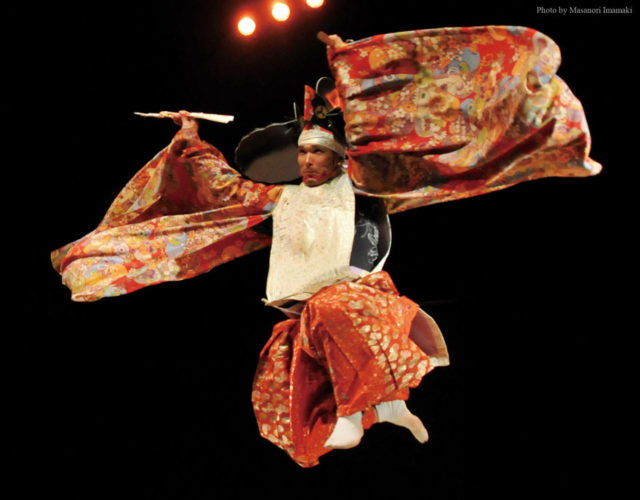
Akira Katogi of Wariki brings Japanese traditional arts to the modern stage. Photo courtsey of Wariki.
After a successful sold out concert last year, the Bellevue World Taiko Festival will return for the second time. Japan Creative Arts run by Asako and Ringtaro Tateishi of the School of Taiko will present the musical event in January, featuring the Japanese performance ensemble Wariki. Local performers including Chikiri, the Tateishi family’s group, will also take the stage.
Wariki has been exploring the possibilities of transforming Japanese on-stage traditions since 2001. It is led by Akira Katogi, a drummer and dancer, with Shunsuke Kimura, a Japanese flute and tsugaru shamisen player, music composer and director, and Etsuro Ono, a shamisen player and composer. Despite international performing experience, this will be their first appearance in the Pacific Northwest.
Japan consists of many islands, and each region is even divided by mountains and rivers that have served to preserve a variety of different cultures and customs, said Katogi. Expressing rhythm, style, sound and fashion from the depth of Japan’s tradition and rich history, Wariki has transformed their original forms to fill a contemporary stage.
Katogi said that the Japanese traditional arts have developed and innovated in each era for their own preservation, and collaboration with contemporary music and overseas performances are part of this process.
“If we want to preserve and develop our traditions rather than just handing them down, collaboration and such exchange activities are necessary,” he said. The Bellevue World Taiko Festival is aiming to form collaborations with talented artist from Japan, Seattle and the United States, said Asako Tateishi, director of Japan Creative Arts.”Through music, we want to build a strong bridge with Japan and raise more people’s interest in Japanese culture,” she said.
Katogi, who performed with Ringtaro Tateishi over 10 years ago, also said that the concert will be an opportunity to learn how a Japanese taiko drummer from the famous Ondekoza school has been changed and what he still keeps of himself as an artist after living abroad.
In support of promoting Japanese culture in Seattle, Katogi said, “We are also looking forward to finding what potential Wariki can show through the performance.”
The concert will be held at 1:30 p.m. and 6:30 p.m. on Jan. 16 at Meydenbauer Center Theatre in Bellevue. Workshops for taiko, shinobue and tsugaru shamisen performers will be featured on Jan. 17 at Bellevue Children’s Academy. Tickets and more information can be found on the calendar page or at www.worldtaikofestival.org.
10 sheets Takaokaya Ariake Nori (Grocery Aisle 6B) Garnish Redondo’s Portuguese Sausage (Meat Dept Special $4.99 ea) Lee Kum Kee Sriracha Mayo (Grocery Special $2.19)
Sushi rice: Rinse well, soak grains for at least 20 minutes prior to cooking. Once finished cooking, immediately uncover and add toasted sesame seeds and seasoned rice vinegar and incorporate into every grain. Allow to rest until rice temperature comes down to about body temperature.
Okinawan Sweet Potato puree: Peel potatoes and cut into one inch pieces. Steam or simmer in salt water and drain when soft. Mash potato and mix with tofu, mirin, mayonnaise and tsuyu for easy dispensing into the appetizer.
Appetizer form: Create one bite rice balls with hitokuchi mold (from gift dept.) wrap in nori. Top with okinawan puree, garnish with Portuguese sausage (sliced and cooked) and dollop of sriracha mayo.
[Editor’s Note] This is a joint project with Uwajimaya Seattle. The writer will appear at the store for a cooking demo with this recipe on Friday. He can be reached at robertgiulietti@uwajimaya.com.
Earning such headlines as CNN’s “Japan defies world as ‘research’ ship embarks on minke whale kill,” Newsweek’s “Japan Resumes Killing Whales as the World Looks on, Helpless” and the Washington Post’s “A Japanese vessel is set to kill 333 whales for ‘research – but is science really behind the hunt?,” Japan has, as indicated, sent it’s first whaling fleet in more than a year to the Antarctic. It’s task, despite a contrary ruling from the International Court of Justice (ICJ) and fierce objections by nations such as Australia and New Zealand, is to kill 333 minke whales in the name of studying their health and migration patterns. An information sheet from Japan’s Fisheries Agency and Ministry of Foreign Affairs calls this program the “New Scientific Whale Research Program in the Antarctic Ocean,” or NEWREP-A, and includes measures taken “in light of the reasoning and conclusions of the ICJ Judgement.” Japan claims that “it is not feasible to obtain age data by the currently available non-lethal research methods” and “the sample size of Antarctic minke whales for the lethal research is determined by statistical testing and is limited to the number of samples with which age-at-sexual maturity data, not obtainable by the currently available non-lethal research methods, can be estimated with sufficient accuracy.” NEWREP-A is scheduled to run for 12 years and could kill 4,000 whales.
A gristly Japanese phenomenon is making headlines around the world, as beat-up wooden fishing boats carrying dead bodies wash up onto Japanese shores, presumably from North Korea. Nearly a dozen have washed up near the country’s northwestern coast over the last month, including one with six skulls and an intact body, to make a total of 34 this year alone. Japan found 65 of these boats in 2014 and 80 in 2013, according to the Japanese coast guard. No one has connected the boats to North Korea in any official capacity, but coast guard officials say that they carry equipment, nets and signs with Korean writing, and one sign was even found that said “Korean People’s Army,” the North Korean Army. Reuters cited evidence of the remnants of cloth from a North Korean flag, and there is common speculation that these are fishing boats that sailed too far from home in an attempt to fill government quotas. The boats are 33-40 feet long and in poor condition, supposedly atypical to South Korea or Japan. Most of these ghost ships arrive in the fall and winter as prevailing winds blow in from the northwest. The latest handful were found near Ishikawa and Fukui Prefectures.
The first time I interviewed Bon Yagi, the New York City businessman who has built an empire of 13 Japanese specialty restaurants featuring everything from soba to sake, he tried to sell me something completely unexpected: a Toto Washlet toilet. Though the topic at hand was his sake specialty restaurant Sakagura, when I happened to mention I was in the midst of bathroom renovations at home he couldn’t resist the business opportunity. “Let me know if you’re interested in a Washlet,” he reminded me politely at the end of our conversation. Acting as the local agent for the premier purveyor of Japanese toilet technology is a mere side business for Yagi, but one he practices with the same entrepreneurial zeal that’s made him the benevolent overlord to a mini-empire of Japanese restaurants centered in Manhattan’s East Village and covering the gamut of native food genres. Most entrepreneurs “are very successful in one concept,” notes Saori Kawano, the founder and president of New York City-based Korin Japanese Trading Corp, and like Yagi, a self-made first-generation success story. “But he has many different concept restaurants. When I asked him why, he said, ‘I just want to open restaurants that I want to eat at.’”
Yonekichi’s salmon rice burger
So he’s built Rai Rai Ken for ramen, handmade gyoza, and fried rice; Shabu Tatsu for shabu-shabu; Soba-ya, for handmade soba; and Sake Bar Decibel for sake and Japanese-style tapas. Those longing for a Japanese-style grilled-to-order rice burger can minister to their homesickness at Yonekichi, which serves a skillfully prepared saikyo salmon rice burger (photo above) slathered with white miso and layered with pickled daikon and shiso leaf. If your hankerings lean toward authentic curry rice, Curry-Ya is where you can supplement your veggie or beef curry with deliciously crispy potato croquettes, natto, or fried oysters. Hi-Collar offers a taste of Japanese-style siphon coffee, and at Cha-An, a selection of okayu (rice porridge), savory and sweet toasts, and Japanese desserts is always available.
Rice burger stand Yonekichi, East Village, New York.
Yagi was also one of the first purveyors of okonomiyaki, the crispy savory pancakes that are enjoying a moment of popularity in fad-chasing New York now. And he expanded his takoyaki (battered and fried octopus) stand Otafuku in January 2014, adding taiyaki (azuki bean-stuffed fish-shaped pancakes) to the menu and renaming the place Otafuku x Medetai. “He’s the emperor of the East Village Japanese scene, an under-the-radar type of guy who deserves a lot more credit but doesn’t seek it,” says Rick Smith, who benefited from Yagi’s advice as he was planning to open his East 9th Street Japanese sake shop Sakaya with his wife Hiroko in 2007. Yagi, whose uncle operated a sake and soy sauce brewery in Chiba, placed his sake bar Sakagura (boasting the largest sake list in the city at over 200 labels) in midtown because Japanese consulate members told him the East Village was “too dangerous” for them to travel to. He drew on his memories of his uncle’s brewery to create a faux pounded dirt (doma) floor and restrooms that look like giant hooped sake casks. That sense of quirky creativity and individuality—as well as Yagi’s mission of bringing Japan to New York—pervades everything he does. On his company website, a heading reads, “Enjoy Japan Without Airfare.” Even the company name, T.I.C. Group Restaurants, can be interpreted in different ways. Yagi’s daughter Sakura, 28, who has become operations manager for all of his business dealings (“I support people ‘on the ground’ and put out fires when they arise,” she explains), says “It stands for Total Information Center, but I like to think it stands for Tokyo in Change.” She’s overseeing an expansion of the business way uptown, with branches of Curry-Ya and Rai Rai Ken opening in West Harlem in anticipation of City College of New York’s new medical school opening next year. Although her father was against her joining the business, when he was diagnosed with prostate cancer in 2012 Sakura gave notice at the public relations firm she was working for and talked her parents into letting her make the move. Yagi’s wife Tomoko was already an instrumental part of the business, monitoring food quality at several of the group’s restaurants and supplying some of her own recipes for savory and sweet dishes. Their son Daihachi, 21, a student at the University of St. Andrews in Scotland, helped out at the T.I.C. offices over the summer after working as an apprentice on a sustainable farm in Brooklyn.
The Yagi family at the awards ceremony for the Outstanding 50 Asian Americans in Business, June 2015. Bon Yagi was a recipient. L-R: Son Daihachi, wife Tomoko, Yagi, and daughter Sakura.
As Sakura has taken on more responsibility, her parents have come to appreciate her contribution. “It’s the best oyakoko (display of filial piety) for me to give them the time to enjoy themselves,” she says. Although they are “very non-traditional as parents,” and “a lot more vocal about their appreciation of my contributions,” Sakura notes she has made it a project to help her parents along in their westernization. Once shy about displays of affection such as hugging, their daughter inaugurated the family hug by saying to them, “Guys, this is what we’re doing from now on.” Her parents eventually grew so fond of hugging, she says, “sometimes the first thing they do is go in for a hug.” To be part of the T.I.C. empire is also to be drawn into a family circle of sorts. Chizuko Nikawa-Helton, sake sommelier and founder of Sake Discoveries, worked as a sake sommelier at Sakagura for four years. She recalls how Yagi encouraged her to begin hosting sake tasting events at the restaurant and helped launch her career as a sake promoter. When she could barely speak English, Yagi suggested she hold her first tasting at the restaurant. “He totally encouraged me and stood behind me,” she recalls. At the end of the evening, Yagi gave a speech in which he noted the recent loss of Nikawa-Helton’s father to cancer. She was so touched by his support and encouragement, she recalls, “I couldn’t stop crying.”
Sake casks at Sakagura, midtown Manhattan.
All photos are courtesy of Nancy Matsumoto.
Edtor’s note: This is the first part of the article originally posted on the Japanese American National Museum’s Discover Nikkei at www.discovernikkei.org. The writer is a New York City-based freelance writer whose website is www.nancymatsumoto.com and blog is http://nancymatsumoto.blogspot.com. She is currently working on the English-language publication of her grandparents’ book of tanka poetry, Michigan Kohan.
There is an old Blues standard called “Nobody Knows You When You’re Down and Out”. It was written by Jimmy Cox back in the twenties and recorded by many artists over the years. The lyrics tell a story of someone, who was riding high and spending money like there was no tomorrow and then hit hard times. When he ran out of money he also ran out of friends. Like many of the great Blues songs of the last century, it is about people going through tough times. It seems that whenever there is a wave of immigration by a large ethnic group, the first generation arrivers to the North American continent have to establish themselves, which is usually quite different and tenuous. As time goes by, it seems that each subsequent generation has it a little better than the previous one. I believe the Japanese Americans of the new millennium are much the same in the fourth and fifth generations of Yonsei and Gosei if you prefer have far better economic and educational opportunities than the Issei and Nisei ever had. There is an old Japanese term, Gaman, of Zen Buddhist origin which means “enduring the seemingly unbearable with patience and dignity.” Most of us have had situations in our lives wherein we have dealt with tough times and circumstances and this rings true to just about everyone I know. My good friend and fellow musician Kevin Boyd had seen his share of ups and downs in his business career. Although he is doing fine these days with his job and family life he went through a tough patch back a few years ago. He used to tell me that “one is at their best when one is at their worst.” The true meaning is of course that when times are really bad you have to dig down inside yourself and find your strongest survival energies to get through tough times. I have personally found this to be a useful concept.
[Editors Note]
Deems Tsutakawa is a local Sansei musician. He can be reached at deemst@deemsmusic.com
Sarah Baker is a Seattle-born Japanese American woman, who was elected as the next president of Japanese American Citizens League Seattle Chapter. Baker calls herself a “Shin-Sansei,” because her ancestors came to the United States after World War II, so they did not experience incarceration.
Sarah Baker, president-elect of the JACL Seattle Chapter. Photo courtesy of Sarah Baker.
Her grandmother came to the United States from Japan after the Korean War. Baker said it is difficult to describe the differences between those who came to America before and after the war. “A lot of Sansei talked about their parents legacies, but I don’t have that,” she said. “Recently I asked my grandmother, did you experience any hate crime or racism, she said no. When she moved to Seattle, I think people on the west coast were used to idea of Japanese and Japanese Americans, because of the location.” Baker is not sure her grandmother answered truthfully or not, but if her grandmother really failed to experience racism, it means Japanese Americans face many different situations. She looked back and spoke about her involvement in JACL in June 2014. “I met a Japanese American friend in social justice class in high school who was already involved in JACL, so she invited me to a meeting,” Baker said. “I signed up for a membership immediately because they gave me a scholarship to go to the national convention. Two weeks later, after my first meeting, I went to the national convention in San Jose. It was really cool. “Now the JACL has over one hundred chapters, but a lot of chapters’ demographic is older,” she continued. “I think the Seattle chapter is one of biggest chapters in the states, but it’s membership is growing older as well.” She also said that it had been difficult to figure out what local projects they wanted to support. “Right now, we just really want to be a partner of other community organizations,” she said. In fact, Baker hosted Asian Pacific Islander LGBTQ events this June. On Nov. 21, they hosted the Muckleshoot Tribe Workshop. “Japanese Americans had similar historical struggles, so we should support each other as community organizations,” Baker said. “If we do that, we can have a voice, have a stand.”
Sarah Baker, center, volunteers for JACL Seattle’s annual clean up at Aki Kurose Middle School. Photo courtesy of Sarah Baker.
Before she joined the JACL, Baker didn’t have many chances to think about her ethnicity. Like other youth, she was interested in Japanese pop culture and the like. “When I went to my first JACL meeting, it was very interesting because I didn’t have a lot of perspective from Japanese Americans in my life,” she said. “Seeing life of other Japanese Americans really surprised me because I noticed we have a lot of things in common. It’s really nice, people can understand my culture.” Baker already had interest in social justice, so for her, the JACL is a perfect place, bringing together both Japanese American culture and social justice. Currently, Baker is also Student Body President of North Seattle College. She works with 35 students to represent students’ voices, saying “Currently, we are discussing tuition because it is so expensive.” Baker became Student Body President because when she entered the Bachelor program at North Seattle College, she wanted to be more involved on campus. “I think I’m in a good position to speak up because I already got one degree there, and now I’m trying to get one more degree,” she said. “I want make a difference and help to build the community.” She also explained about becoming a leader for people of color, especially women–“I know there need to be more women of color in leadership positions. For that reason, that’s one of the things to keep me going and doing the things I do because we need more representation.” “What being Japanese American means for me is kind of a big theme, because it means my whole life,” she continued. “When I grew up, my grandmother baby-sat me. So I was growing up in Japanese language and Japanese culture. I think being able to use Japanese language and English at the same time feels ‘Japanese American’ to me. For example like, this ticket is takai (expensive). I think this is a very Japanese American culture. “I think it is also Japanese American culture to eat American and Japanese mixed food. My grandmother made breakfast, with bacon and rice and furikake (rice seasoning) or sometimes mochi.” Of the future, Baker says, “There is a kind of an age gap, like myself and the younger generation don’t know a lot of older history and culture. I hope we can continue pop events like Obon and to bring youth together.” She also added her goal as JACL Seattle’s next president, saying “My goal is to get more youth members and engage other communities of color.”
“A lot of Sansei talked about their parents legacies, but I don’t have that,” she said. “Recently I asked my grandmother, did you experience any hate crime or racism, she said no. When she moved to Seattle, I think people on the west coast were used to idea of Japanese and Japanese Americans, because of the location.” Baker is not sure her grandmother answered truthfully or not, but if her grandmother really failed to experience racism, it means Japanese Americans face many different situations. She looked back and spoke about her involvement in JACL in June 2014. “I met a Japanese American friend in social justice class in high school who was already involved in JACL, so she invited me to a meeting,” Baker said. “I signed up for a membership immediately because they gave me a scholarship to go to the national convention. Two weeks later, after my first meeting, I went to the national convention in San Jose. It was really cool. “Now the JACL has over one hundred chapters, but a lot of chapters’ demographic is older,” she continued. “I think the Seattle chapter is one of biggest chapters in the states, but it’s membership is growing older as well.” She also said that it had been difficult to figure out what local projects they wanted to support. “Right now, we just really want to be a partner of other community organizations,” she said. In fact, Baker hosted Asian Pacific Islander LGBTQ events this June. On Nov. 21, they hosted the Muckleshoot Tribe Workshop. “Japanese Americans had similar historical struggles, so we should support each other as community organizations,” Baker said. “If we do that, we can have a voice, have a stand.” Before she joined the JACL, Baker didn’t have many chances to think about her ethnicity. Like other youth, she was interested in Japanese pop culture and the like. “When I went to my first JACL meeting, it was very interesting because I didn’t have a lot of perspective from Japanese Americans in my life,” she said. “Seeing life of other Japanese Americans really surprised me because I noticed we have a lot of things in common. It’s really nice, people can understand my culture.” Baker already had interest in social justice, so for her, the JACL is a perfect place, bringing together both Japanese American culture and social justice. Currently, Baker is also Student Body President of North Seattle College. She works with 35 students to represent students’ voices, saying “Currently, we are discussing tuition because it is so expensive.” Baker became Student Body President because when she entered the Bachelor program at North Seattle College, she wanted to be more involved on campus. “I think I’m in a good position to speak up because I already got one degree there, and now I’m trying to get one more degree,” she said. “I want make a difference and help to build the community.” She also explained about becoming a leader for people of color, especially women–“I know there need to be more women of color in leadership positions. For that reason, that’s one of the things to keep me going and doing the things I do because we need more representation.” “What being Japanese American means for me is kind of a big theme, because it means my whole life,” she continued. “When I grew up, my grandmother baby-sat me. So I was growing up in Japanese language and Japanese culture. I think being able to use Japanese language and English at the same time feels ‘Japanese American’ to me. For example like, this ticket is takai (expensive). I think this is a very Japanese American culture. “I think it is also Japanese American culture to eat American and Japanese mixed food. My grandmother made breakfast, with bacon and rice and furikake (rice seasoning) or sometimes mochi.” Of the future, Baker says, “There is a kind of an age gap, like myself and the younger generation don’t know a lot of older history and culture. I hope we can continue pop events like Obon and to bring youth together.” She also added her goal as JACL Seattle’s next president, saying “My goal is to get more youth members and engage other communities of color.”
As one of the nation’s longest-running public mochi tsuki events, the Bainbridge Island Japanese American Community (BIJAC) welcomes everyone to the 27th annual community celebration on Jan. 3 from 11 a.m. – 3 p.m. at IslandWood, located at 4450 Blakely Avenue NE where staff and volunteers will offer tours of the award-winning School in the Woods. Highlights include performances from the acclaimed Seattle taiko drum group Kokon Taiko and the award-winning historical exhibit “Kodomo No Tameni – For the Sake of the Children.
The Seattle Mariners have been busy in the days leading up to baseball’s winter meetings, and most recently agreed to terms with free agent outfielder Norichika Aoki on Wednesday. Financial details are not yet known, but the deal is for one year with an option for a second year and is pending a physical. Aoki, who hit for a .287 batting average (BA) and .353 on base percentage (OBP) for the San Francisco Giants in 2014, was sidelined in August when he was hit in the head by a pitch. He suffered from concussion symptoms for the remainder of the season. Aoki has been remarkably consistent through his four years in the big leagues, playing for the Milwaukee Brewers, Kansas City Royals and Giants. He appeared in the World Series for the Royals in 2014 and was having a career year in 2015, with a .305 BA and .365 OBP, before the hit by pitch. The Giants declined his $5.5 million option for 2016 to make Aoki a free agent. As of Tuesday, Hiroshima Carp pitcher Kenta Maeda in Japan has asked, again, for his team to post him for MLB clubs this off season, and it is likely the Carp will finally do so. Maeda is 27 years old and finished the 2015 season with a 2.09 earned run average (ERA) and 15-8 win-loss record. He won the Sawamura Award for Japan’s top pitcher, as he did in 2010. Maeda is not as highly regarded as aces such as Daisuke Matsuzaka, Yu Darvish and Masahiro Tanaka, but he has a career 2.39 ERA in Japan and a 97-67 overall record. He hasn’t recorded an ERA over 3 since 2009, and has pitched up to 216 innings in a season. Similarly to Hisashi Iwakuma, he is seen as a solid, mid-rotation starter at the MLB level, and has gained significant interest from the Arizona Diamondbacks. Iwakuma himself is a question mark. As expected, he declined the Mariners $15.8 million qualifying offer earlier this month in hopes of securing a multi-year deal. Since then rumors have linked him to the New York Yankees, Royals, Chicago Cubs and back to the Mariners. The Mariners have called signing the right-hander fan favorite, who posted a 3.54 ERA, 9-5 record and a no-hitter in 2015, a “priority.”
Daiso, a Japanese dollar store chain, will open its seventh store in Washington at the Roosevelt Square in Seattle.
The store will have an opening event on Dec. 19 and 20 featuring goodie bags for 100 customers each day, musical performances and raffle for variety prizes. The raffle winners will be announced at 6 p.m. on Dec. 20 at the store as well as the Daiso Japan in California in Facebook.
The location will be in the same block with the Whole Foods Market, a central Roosevelt District and near the future Link Light Rail station. The Daiso has been offering average over 10,000 variety of house hold products, with mostly $1.50, at over 3,400 stores including over 600 internationally. According to the Daiso, average 10 – 20 stores open every month globally.
Kay Hirai and her dog at a park in Seattle.Photo and images courtesy of Kay Hirai
When I walked into Studio 904 Hair Design and Spa, my first impression wasn’t of barber chairs and hair products, but of bento boxes, holiday cards, crafts and Japanese tea cups. They were raffle prizes, auction items and gifts, all for the benefit of Kay Hirai’s Angels for the Animals fundraiser. Hirai is a Kyushu-born local business owner who describes herself as a “socially responsible entrepreneur, author, and artist.” She came to the United States as a young girl just entering middle school–entangled in family secrets and already a survivor of the hardships of wartime and postwar Japan. There, Hirai had faced prejudice for having a mother who was an American citizen. Her best, and oftentimes only, friend was a small, white terrier called Shiro. In America, she walked into a brand new school unable to speak or read English. Today, Hirai has 38 years of business ownership, two books and dozens of successful projects behind her. She maintains a blog, makes dolls and Christmas ornaments, runs multiple fundraisers a year and is a proud mentor to her employees and other young people.
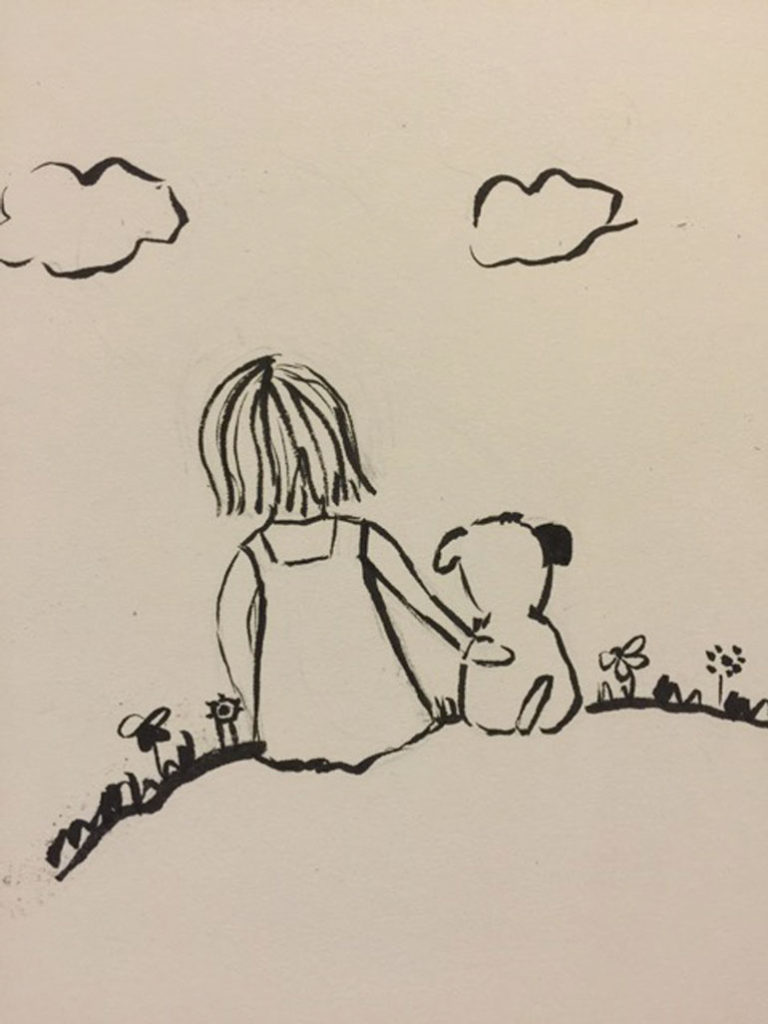
Illustration of Hirai and Shiro in “Keiko’s Journey.”
Hirai’s latest book, “Keiko’s Journey: A World War II Memoir,” tells the first part of her story–an incredible tale of family intrigue, her mother’s strength and her own struggle to grow up. In anticipation of its release and a regular column soon to be published in this newspaper, The North American Post asked Hirai a few questions about her life and motivations.
Why did you decide to write “Keiko’s Journey”?
“It was difficult to write this story and to dig up everything out of my past. I didn’t want to remember it! But for years, I had been thinking about my mother, and I wanted to clear her name. In Japan, she got called all kind of names. Her own husband thought she was messing around, and he would beat her up. My real father’s family didn’t like her because she snuck me out of the country, but she didn’t have a choice. I always thought that everyone should die with a happy ending, but she never did, even though she was a remarkable woman. So I wanted to write this book for her, to tell her story.”
What about your story do you think other people will connect to?
“I feel like there are probably a lot of people who feel like me, living here. I never really felt like I belonged to here or belonged to there. I remember going to Hawaii, where Japan had attacked Pearl Harbor; and then I went to Japan and my uncle would say ‘Oh, this was a beautiful castle before the Americans bombed the heck out of it.’ No matter where you go, you feel like the enemy.
“Or you want to talk about your past but nobody understands what you’re talking about. I remember these festivals, but no one knows what they are. All my friends here, they remember the internment camps, but I have no one to really talk to.”
How have your experiences shaped your life and business today?
“I think it’s all come together to form the philosophy I work with—the way I treat people and how industrious I am. I believe in kaizen, the Japanese idea of lifelong learning and improvement, and I run my salon that way. I believe in always trying to give a helping hand to those in need, because in a way I feel like I was spared a life during the war, so now I have to make a difference.
“We do these fundraisers every year part of our business marketing. That’s why I call myself a
social entrepreneur. I do everything to help the good of society. I try to be a real good employer and help people with their career progression. I love mentoring people.”
A book event and signing featuring “Keiko’s Journey,” will be held at the Nagomi Tea House at on Dec. 13 at 2:30 pm, accompanied by refreshments, music and a discussion on wartime Japan. Hirai is also hosting a Holiday Angel Event and book signing at her salon, Studio 904, on Dec. 5. Further details can be found on the calendar page.
Illustration of Hirai and Shiro in “Keiko’s Journey.”
Ingredients: Rice 2 cups Kokuho Rose US#1 Extra Fancy Grade (Grocery Special $16.99 / 15lb)
Hayashi Sauce ½ box S&B Tasty Hayashi Rice Sauce Mix (Grocery Aisle 4) ½ lb Sukiyaki beef (Meat Dept. Special $7.99/lb) 2 cups Yellow Onion (Produce Dept) – slice thinly 1 cup Crushed Tomatoes (Grocery Aisle 4B) 1 cup White Mushrooms (Produce Dept) – small dice 1 T Sho Chiku Bai Sake (Grocery Special $6.99 1.5L) 2 cups Beef Stock / Water (Grocery Aisle 4A) 1 tsp Vegetable oil (Grocery Aisle 4A
Garnish Miyazaki Takuan/Pickled Daikon Radish (Grocery Special $3.69) Ellenos All Natural Greek Yogurt (Available at Ellenos Counter
Rice: Rinse well, soak grains for at least 20 minutes prior to cooking. Once finished cooking, immediately uncover and fluff the rice by tossing with a spatula until every grain is separated. Let rest for five minutes and serve.
Hayashi Sauce: Heat oil in a pan and stir fry onions until golden brown. Add beef and mushrooms and cook for two minutes. Add cooking sake and allow to evaporate. Add stock/water, crushed tomatoes and bring to a simmer, then add the sauce mix. Cook until demi glaze sauce comes to the desired consistency and serve with rice. Garnish with pickled radish, takuan and a dollop of yogurt.
[Editor’s Note] This is a joint project with the Uwajimaya Seattle. The writer will appear at the store for cooking demo with this recipe this Friday. He can be reached at robertgiulietti@uwajimaya.com.
We need more people like Min Yasui in the world — who are willing to stand up for what is right, for whom principles of justice are more important than personal comfort. I’m honored to be able to work on this film, about a man whose story needs to be heard by a wider audience.” — Will Doolittle, co-director, Never Give Up!
November 2 is the Day of the Dead in Mexico, and I live in the very fiesta-prone town of San Miguel de Allende. It is not a sad day but a colorful and joyous holiday. Families and institutions build beautiful altars to their deceased loved ones, often opening their doors to the public to share in their homages and celebrations. So I decided to officially inaugurate an online homage and celebration for my late father, Minoru Yasui, on the Day of the Dead, in order to share the work our team is doing on the film Never Give Up! and to launch a fundraising campaign to finish it at minoruyasuifilm.org.
Minoru Yasui. Photo courtesy of Holly Yasui.
I’ve always wanted to make a film about my dad, but wasn’t able to devote the amount of time necessary until I retired. Once I decided to dedicate myself to this project, the pieces fell into place. Will Doolittle, an Oregon filmmaker with extensive experience in documentary work agreed to co-direct and do camerawork and editing; and social media maven George Takei, of Star Trek fame and currently starring in his Broadway musical Allegiance, agreed to do the narration. This year, because of an increasing workload, I contacted Kelley Baker, a former student at USC where I was a graduate teaching assistant, to help out as Associate Producer. Kelley also has a lifetime of experience as an independent filmmaker. Shoji Kameda, a friend of Will’s and an internationally renowned musician, has agreed to write an original score for the film. This stellar team is working on the project because they feel that Min Yasui’s inspiring story needs to be told to a wider audience. Min Yasui was an extraordinary person who stood up to the greatest power in the world, the U.S. government, because he believed with all his heart and soul in the democratic ideals of liberty and justice for all—and he continued, all his life, to fight for those ideals. He never gave up! In 1942, he initiated a legal test case by deliberately violating military orders that resulted in the imprisonment of 120,000 persons of Japanese ancestry in U.S. concentration camps. He spent 9 months in solitary confinement awaiting the appeal of his case to the U.S. Supreme Court, which ruled against him, but he continued to defend the human and civil rights of all people.
Minoru Yasui’s handwritten letter from jail, 1942. Photo courtesy of Holly Yasui.
In Denver, where he relocated after the war, he helped to found and participated in a myriad of community organizations, fighting for the human and civil rights of Blacks, Latinos, Native Americans, religious minorities, immigrants, children and youth, senior citizens and low-income people; he also initiated and was active in national networks and international exchanges. During the last years of his life, Min Yasui devoted himself totally to the redress movement. He reopened his legal case in 1983. He attended thousands of meetings, made hundreds of speeches and wrote thousands of letters in support of redress. When he died in 1986, his legal case was in appeal. His family took his case to the U.S. Supreme Court, but they refused to hear it in 1987, the bicentennial of the U.S. Constitution, which Yasui had so steadfastly defended all his life. Two years after his death, Congress passed the Civil Liberties Act of 1988, which included a government apology and reparations for all survivors of the U.S. concentration camps. During the push for redress, many of Min Yasui’s interviews and speeches were filmed for national news, local stations and ‘home movie’ recordings. Now, more than 30 years later, only a handful of clips survive—but they speak volumes. I’m lucky that my Aunt Yuka, my dad’s favorite ‘baby sister,’ saved hundreds of family photographs and documents, including handwritten letters from jail! My dad also saved voluminous papers, now held by the Auraria Archives in Denver, Colorado, so I have a wealth of materials I’m using in the film.
Minoru Yasui with his mother and youngest sister, Yuka, 1935. Photo courtesy of Holly Yasui.
Yasui on Yasui
In 1988, my cousin Lise Yasui produced an Academy Award-winning film, Family Gathering. When I asked her about outtakes—footage filmed but not used in the final cut—Lise came up with an impressive list of materials, but all in old formats, which are extremely expensive to transfer to modern media. So I used a few clips from the film itself, an interview done in our Aunt Yuka’s kitchen. Lise says of her uncle: “He always insisted that his fight to right the injustices of the 1940s was not an attempt to rewrite the past but to make the future a safe place for human rights and personal dignity.”
Promotional image for Never Give Up! Minoru Yasui and the Fight for Justice. Photo courtesy of Holly Yasui.
Other recordings
I also contacted former Salt Lake City television news producer Michael Goldfein for permission to use his short piece Citizen Min. Says Goldfein, who is now in Washington DC writing a historical study about government policies toward Japanese Americans during World War II: “The life and legacy of Minoru Yasui is indisputably one of the great stories of heroism in America’s civil rights history. In 1983, as a young reporter, I had the opportunity to tell his story. The trip I took with him, visiting the site of his arrest in Portland and his ultimate internment in Minidoka, was a touchstone moment in my life. Min’s enduring passion for fairness needs to be seen and heard.” In 1985 Steven Okazaki’s documentary Unfinished Business, about the re-opening of three Japanese American legal cases—Yasui, Hirabayashi, and Korematsu—was nominated for an Academy Award. Okazaki interviewed Yasui at his brother’s farm in Hood River. Says Okazaki: “Min Yasui was brilliant, dapper, funny, controversial, and inspiring. I don’t know of anyone who was so principled, so absolute in his faith in justice, and the necessity to speak up for and live by one’s beliefs. I met him over thirty years ago and was struck by the power of his personality, warmth and decency. I had to smile and wonder if he was real. Thirty years later, I know he was the real thing.” A former professor at the University of California-San Diego, Jim Lin, contacted me through an online magazine. Jim had several videocassettes of Min’s rousing presentations at the first Asian American studies program, which Lin organized. Recorded in the spring of 1986, just months before he was diagnosed with cancer, those tapes are among the last made of the great orator. They illustrate better than any other footage I’ve been able to find the passion and conviction of Min Yasui’s oratory. In 2014, Will Doolittle and I shot interviews in Oregon, California and Denver with twenty people who knew Min Yasui and/or his work during different periods of his life. Once we started editing, it became apparent the material merited a longer format than the 15-30 minutes originally planned. Thus, the decision to raise funds for an hour-long film. We are seeking $50,000 to complete Never Give Up! and for 2016 events planned for the centennial of the birth of Min Yasui, as well as a school curriculum about this American hero whose life and work can be an inspiration for generations.
Editor’s note: The article was originally posted in the Japanese American National Museum’s Discover Nikkei at www.discovernikkei.org. Holly Yasui is a freelance writer, editor and translator, and currently working on a tribute to her father Min Yasui in 2016, the centennial of her father’s birth. She would greatly appreciate help from any readers who have materials, especially recordings of Minoru Yasui that they might be willing to loan for this project. She can be reached through Discover Nikkei at editor@discovernikkei.org
Japanese fashion brand Uniqlo opened its new Bellevue store on Nov. 6 attracting long lines of fans throughout the morning.
The store is the first store to open in the Northwest region, but it is one of the biggest of the U.S. stores, according to Uniqlo, which also plans to open a Seattle store in the future if the Bellevue business goes well.
A Bellevue store pre-opening event was held on Nov. 5 with local representatives including Consul General Masahiro Omura and Seattle Seahawks Wide Receiver Jermaine Kearse.
The North American Post’s 1956 Matsutake Contest concluded with an award’s ceremony. Consul General Yoshikawa, center, presented the Consulate Cup to contest winner Shigeru Matsumoto, left, in the photo taken by Henry Miyake. The North American Post President Takemitsu Kubota, right, also holds a special trophy from the Consul General.
As a young Japanese American, Stephen Kitajo tries to do new things. The local-born Yonsei (fourth generation Japanese American) became a co-chair of the Minidoka Pilgrimage Planning Committee this August, which will prepare for the 12th annual history educational tour to the Japanese American incarceration camp site in Idaho. Kitajo, who has been involved with the group since 2012 as a youth scholarship recipient, has also worked at the Japanese Cultural Community Center of Washington. “A big part of the reason why I started activities like Minidoka Pilgrimage and JCCCW is my curiosity,” said Kitajo, who had few chances to directly hear experiences or stories from his parents or grandparents. “My parents didn’t really have stories, because their parents didn’t talk about anything. I wish I had asked my dad before he passed away, and I wish I was part of it. And my mother wasn’t able to be involved, she is just too busy. “When I had a chance to be involved, I thought it would be a good thing,” he continued. “Because it gave me a chance, literally I could share my stories and experiences with my parents because they didn’t get any stories from their parents.” Because he has a strong interest in the Nikkei (Japanese Americans), Kitajo studied Asian American studies and history at Pacific Lutheran University. He later learned how history and culture could be connected by working at the JCCCW. “JCCCW focused on a lot of culture, but basically a big part of some culture is history,” he said. “History helps to shape culture. To learn culture and history is kind of a similar goal.
Stephen Kitajo, fifth right, is a core member of the annual Minidoka Pilgrimage Planning Committee. Photo courtesy of Minidoka Pilgrimage Planning Committee.
“When I was growing up, I used to think am I Japanese American, or am I American?” he added. “And when I was older and started really to be comfortable with the idea, I realized I don’t need to try to fit into either one. The culture I was growing up in is separate from American culture and Japanese culture.” He said that his experiences led him to the answer. “When I was walking by myself through the city or something, people tried to talk with me in Japanese, thinking I was Japanese from Japan,” he said. “However, when I was walking with Japanese friends, they knew immediately to speak in English. They were just seeing me in a different way.” “I’m totally different from people in Japan, and just as much as with other Americans,” he added. “So I think it just took a while to figure that out and be confortable with that.” In describing Japanese American culture, Kitajo explained that it “encompasses a wide range of values, beliefs, expectations and appearances. “It is probably different for everyone who considers themselves to be Japanese American,” he said. “For myself, Japanese American culture is the history of Japanese Americans in the United States and how it is a part of my own story. All of the traditions, food, holidays, music and the arts, values, beliefs and expectations that my ancestors held are still a part of my life today. “They might not be as big a part of my life as they were in my ancestors’ lives, but they will always be a part of me. I try to be mindful of why these things were important enough to my ancestors to want to pass on because it helps me understand how Japanese American culture came to be what it is today. Then I also consider how Japanese American culture has changed in the past, continues to change today and will always change in the future. All of this comes together when I think of Japanese American culture.” This easily relates to the Minidoka Pilgrimage Planning Committee’s activities. “I have never worked with a group of people who were more passionate and more willing to do whatever is necessary to ensure that the memories of Minidoka and the incarceration of Japanese Americans during World War II are never forgotten,” he said. “I want to see the pilgrimage continue to grow,” he said. “It’s not just enough to keep doing the same things. We always have to look for ways to involve more people and different people, to do different things because we want people to come back every year. “So next year, I will do things differently than this year.”
From left, Elaine Ikoma Ko, Diane Fukami, Debra Nakatomi and Dale Kaku at the film event on Oct. 31. Photo by Maiya Gessling/The North American Post
“Stories from Tohoku,” a documentary examining “stories of inner strength and resilience, grace and acceptance, differences between East and West, and the enduring bonds between the people of Japan and Americans of Japanese ancestry” in the face of Japan’s recovery and rebuilding following the March 2011 earthquake, tsunami and nuclear disaster was screened at the NVC Memorial Hall on Oct. 31 to an audience of almost 100 people.
Produced by Dianne Fukami and Debra Nakatomi of San Francisco and Los Angeles, the touching movie follows the individual stories of restaurant owners, parents and single adults, many of whom still, more than three years later, are utterly uncertain about their future.
Originally intended to show how funding raised by Japanese American non-profit organizations in the United States was helping Tohoku survivors, the film quickly became about the people of Tohoku themselves, instead; as the filmmakers realized how few of their stories had been told and how much is left to be rebuilt, even as the tragedy fades from popular memory.
Fukami and Nakatomi also screened a four-minute trailer of their next documentary, a feature on Secretary of Transporation Norman Mineta.
More information can be found at www.storiesfromtohoku.com
The Legacy of Justice project at Hirabayashi Place, the new apartment coming to the International District, is asking for help to make 1,000 cranes for a public art project by Randy Jones. The origami installation will be hung in the lobby of the apartment.
The Legacy of Justice project will feature education and public art installations at Hirabayashi Place to “enlighten visitors about Gordon Hirabayashi’s courageous stance for justice, and contribute to the hopeful possibility that a horrible injustice like the World War II incarceration of Japanese Americans will never happen again.
“We hold up Gordon Hirabayashi’s civic courage, unwavering commitment to social justice, and quiet persistence in the face of adversity, as an inspiration and reminder of the power that each of holds to take a stand for justice,” the project committee states.
There will be seven public art projects in and around the apartment including Jones’ “Stand Up for Justice.”
The folded cranes can be sent to Interim CDA, 310 Maynard St., Seattle, WA 98104. The cranes should be donated with a written message of hope for social justice on a piece of paper. More information can be found at jwasberg@interimcda.org.
Japanese Community Service of Seattle’s (JCS) annual fundraising event, Musical Bridge Concert IV, will be held on Nov. 22 at Renton IKEA Performing Arts Center.
The JCS has been involved with the community in promoting culture, tradition and friendship, and one of its core projects is to organize Japanese and local music talents to feature in its annual Musical Bridge Concert.
This year, Japanese singer songwriter Shinji Harada and his band will join with local gospel group Total Experience Gospel Choir. Harada, who has a strong family connection to Seattle since his grandparents immigrated here, has given several performances and concerts in the Seattle area.
Other musicians and performers will include the local chorus Evergreen Glee Club, Okinawa Kenjin Kai Taiko, soprano singer Fumi Tagata and misic duo Vicious Petals.
The event will be held from 1 – 3 p.m. $20 for general admission, $10 for seniors and students and free for those over 85 and under 7. More information and tickets can be found at (206) 323-0250, admin@jcsseattle.org or www.jcsseattle.org.
Energy experts from Japan and Washington State discuss the possiblity for renewable energy in the U.S. and Japan on Oct. 28 in Bellevue.Photo by Shunya Uetsuji/ The North American Post
The Japan-America Society of the State of Washington held a business round table to discuss the future of clean energy in Japan and the United States at Bellevue City Hall on Oct. 28
Daisuke Kitazawa, associate professor of the Department of Mechanical Systems, Institute of Industrial Science of the University of Tokyo, was the keynote speaker at the event while Kenji Ushimaru, president of Infra Innovations and JETRO senior advisor; Perry England, vice president of building performance of MacDonald-Miller Facility Solutions; and Susan Petty, president and CTO of AltaRock Energy joined as panelists. Kelly Ogilvie, senior policy advisor of the Office of Governor Jay Inslee was the moderator.
Kitazawa introduced Japan’s energy situation since the Great East Japan Earthquake of March 11, 2011, and the approaches taken since then and issues of clean energy in Japan, especially marine energy which is his research field.
He highlighted five points: technological development, high efficiency and low cost, social acceptance in utilization for isolated islands, and large scale or array, as challenges for developing marine energy in Japan. In addition, he pointed out the possibility that new clean energy development has not developed quickly thus far because of the Japanese government’s focus on nuclear power.
Ushimaru mentioned the potential of solar and wind power as key factors for new energy to make up for the shut down of nuclear power plants in Japan in addition to resolving environmental issues and supporting economic growth.
He inferred that Japan and the United States could work together to develop technology for solar power and wind power generation systems. He explained that the United States has a strong foundation in solar energy while Japan has a strong wind power platform, which survived the 2011 earthquake and tsunami.
“I would like to see U.S. and Japanese companies collaborate together not to install these renewable resources in only Japan or the U.S, but to push into a growing outside market,” he said. “I would like to see business collaboration between Japan and the U.S.”
Successful examples for energy efficient buildings were also outlined by England while Betty shared information about geothermal energy.
According to Betty, Japan has a high potential for geothermal energy from volcanoes, a cost effective alternative for a county that has faced competitive natural gas prices.
Sponsored by the Sasakawa Peace Foundation and National Association of Japan America Societies, the event also included networking among participants as they found ways for Japan and the U.S. to move forward together.
Japanese American Citizens League Seattle Chapter has been working closely with Representatives of the Muckleshoot Indian Tribe on the event “beqelšuɫ:” to raise awareness within the AAPI community about the history, heritage and legacy of the Muckleshoot Indian Tribe.
The AAPI and Native American communities have a proud legacy of communion and camaraderie. Throughout history, discriminatory laws and social circumstances stimulated the mixing of these two communities in the labor workforce, in marriage, and in socio-political advocacy.
The Muckleshoot Indian Tribe contributes to AAPI organizations around the state that support community advancement. However, our communities less frequently work together in joint advocacy efforts, and little is understood regarding the history, heritage and contemporary issues of Native Americans and the Muckleshoot Indian Tribe.
The goal of the workshop is to bring into focus another group with a proud legacy, raise awareness of Native American life in Washington, hear the story of the Muckleshoot Indian Tribe in their own words and explore ways in which our communities can work together in the future. Most importantly, we hope to express gratitude for the community support they have offered to us.
At the event, attendees will welcome a variety of panelists from the Muckleshoot Indian Tribe, enjoy a variety of Native American cultural performances and feast in a community potluck with dishes from Seattle’s many different ethnic groups, provided by AAPI organizations beneficiary of the Muckleshoot Indian Tribe’s philanthropy.
“The event will be held on November 21, a date which coincides with Native America Heritage month. It is the weekend before Thanksgiving, a date we feel represents the generosity of Native American peoples,” said Toshiko Hasegawa, past Seattle JACL president and current chapter board member. “We are excited to demonstrate our gratitude and appreciation for their legacy.”
RSVP is required to attend. More information can be found through Hasegawa at toshikograce@me.com.
White River Buddhist Temple in Auburn held its annual fall bazaar ,drawing many community and local residents to enjoy food, produce and crafts that the church members prepared for the occasion. The attendees enjoy mingling with each other at the church’s “family reunion” event. Photo by Joe Watanabe
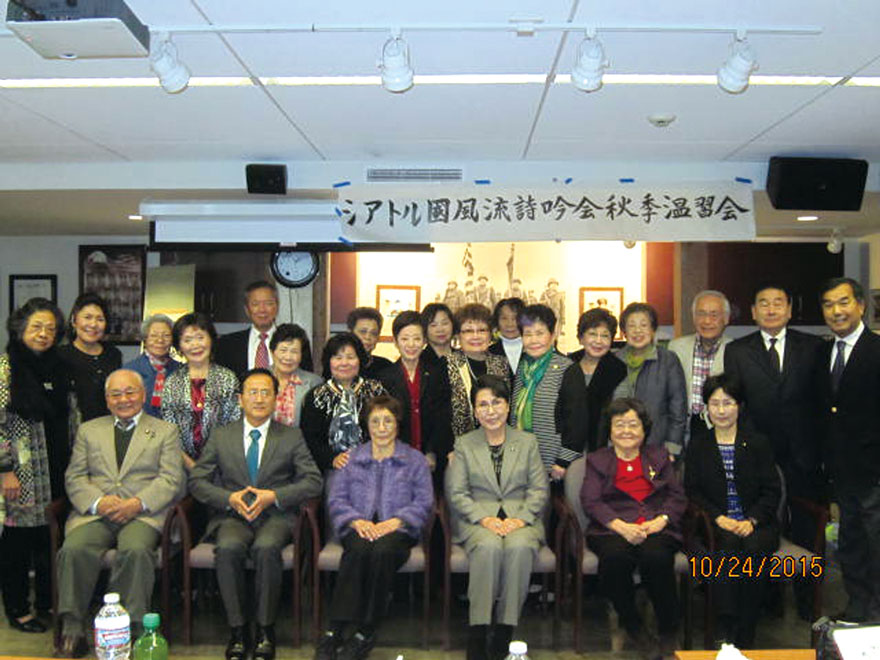
Seattle Kokufu Kai, a local Japanese poetry chanting club, held its fall meeting at NVC Memorial Hall on Oct. 24. Including master instructor and 93-year-old Kokujo Sudo, 24 members performed for each other at the semiannual event. The attendees enjoyed lunch and karaoke entertainment after the meeting. Photo courtesy of Seattle Kokufu Kai
This is the fourth feature on a recent group tour to Japan co-sponsored by this newspaper and the Hokubei Hochi Foundation. We are pleased with the positive experiences from the tour, and believe it will help growing interest in visiting Japan. If you wish for more information on the North American Post group tours to Japan, please contact: elaine@hokubeihochi.org.
Making friends in Asakusa in Tokyo. Photo courtesy of Cheryl Lamphere
By Cheryl Lamphere For The North American Post
Japan was never high on my list of countries to visit. Strange, right? I mean, I am half Japanese after all! I studied the language, love sushi and have been to several Bon Odoris throughout my life. Yet for some reason, visiting the country itself was never super appealing. Then my mom mentioned wanting to visit Japan, as she’d never been either. I knew this trip had to happen and we were fortunate enough to sign up with the North American Post tour.
I began researching and asking others who’d visited how they felt about Japan. I consistently heard how amazing it was, and how they wanted to go back one day. I started getting excited! Will I learn something about myself on this trip? Will I feel more Japanese? What about all of the cultural things I had only learned about in Japanese class?
Fast forward to the day we exited the train in Tokyo. Our group entered a crowded sea of busy Japanese people who were maneuvering the masses, commuting to work. The first thing I noticed was that despite the lost, bright-eyed, obvious-tourist look about us, the locals welcomed us with grace and kindness. It quickly reminded me of my first time getting off the subway in NYC, only to be pushed and trampled upon by the busy commuters. I questioned how two groups of people, with the same goal, behaved so differently.
After being in Japan for a few days, I realized how different the culture was compared to any other country I had known. People bowed to us everywhere, from 7-11 to the local bakery to the train attendants. Every place we encountered was extremely clean. I never saw garbage in the streets, yet trashcans were not commonplace. I found myself stuffing my pockets with litter until I was able to properly dispose of it. And public toilets? Pretty sure they were cleaner than my toilets at home!
I had one profound moment that I’ll never forget – losing my rail pass in Tokyo. We often had to show our pass when leaving the train station, but this time I couldn’t locate my pass. Totally gone. Elaine and Shigeki, two of our guides, told me not to worry, because the Japanese people are honest and likely turned it in. I doubted them, of course, because the pass was worth well over $200! Well, 30 minutes and a couple officer calls later, my rail pass was found. It had been turned in nowhere near the spot we’d gotten off the train. I remember Shigeki giving me a big hug, after running around the station, while I got a bit teary eyed. THIS was the type of scenario I’d only heard about in Japanese class. My faith in humanity had been restored, and I was so humbled to experience the honesty of the Japanese people first hand.
To sum things up, Japan blew me away. It exceeded all my expectations and presumptions I had prior to visiting. Japan is not just another modern country with all the niceties of America; it’s a place full of deep culture that’s remained true through the years. A place where I could identify a bit more – recognizing mannerisms from my Japanese side, seeing other “hapas” like myself, and understanding and bonding with my mom more than ever. Japan, I miss you greatly, and cannot wait to return someday soon!
Five University of Washington students have recently received scholarships from the UW Nikkei Alumni Association. The alumni group held its annual meeting on Oct. 10 at NVC Memorial Hall, presenting the $3,000 William Nakamura Medal of Honor Scholarship to Kari Nasu, and the $2,500 alumni scholarship to Ben Ito, Emma Mitsui, Jordan Nakamura and Shanwa Okamoto.
According to the UW Nikkei Alumni Association, the scholarship program began in 1965 and has presented 244 awards for a total of $360,600. Alumni member Sharon Maeda was also recognized for the 2015 Distinguished Alumnus Award that night.
There are days when I wake up with an “ear worm,” which means there is a song or melody going through my head even though there is no music playing. It is usually a very catchy song and the funny thing is that it is almost never the same song. This “condition” can last for hours but eventually fades away without any lasting effects. Then there are the rhythms of the mind. I can hear in my mind various drum beats and they go with me virtually all the time day and night. These beats make me want to play drums or tap out beats on a chair or table where I am seated. They are cool, catchy and friendly beats. “Folk rhythms,” if you will. Some days I wake up and want to hear serious jazz or Afro Cuban music. Other days I want funk, R & B, or Blues depending on the mood or feeling of that day. I suppose we like different foods on different days as we have the luxury of a wide variety of cuisines at our disposal. The funny thing about the music and rhythms of the world is that the differences between the various genres and cultures is fast becoming quite vague. Popular dance beats cut right across all the different civilizations that are known to us and have been spread around quickly via the mass media. You can find drums, guitars, flutes and singers in just about every corner of the globe. Music has long been recognized for its therapeutic value and is known for its ability to affect mood, trigger memories and foster loving associations. Many doctors believe that certain forms of music can help you tap into your own innate ability to heal your heart. It is no surprise that over the last few decades the healing power of music has been studied and utilized by countless health care givers with good results. When one thinks about the function of music in our society and others around the world, several ideas come to mind. Some people look at music as a way to make money which can be quite tenuous at times. Others see it as a way to “decorate our environment” using beautiful sounds. I like the idea that musical endeavors will usually bring people together for an enjoyable time and always enhances the spirit of the party. It should be noted that performing live music not only promotes camaraderie amongst the band members but also raises the adrenaline levels of both the audience and the performers. This type of euphoria is a natural high, which is the best kind and what musicians and performers live for.
[Editor’s Note] Deems Tsutakawa is a local Sansei musician. He can be reached at deemst@deemsmusic.com
The 15th Broadway High School Alumni Conference will be held on Nov 13 at 8 pm at Edison School, bringing together many Issei and Nisei to remember the old days.
The conference recognizes classes from several years in the past, and the classes of 1904, 1909, 1914, 1919, 1924, 1929, 1934 and 1944 will be featured this year. The alumni from these years are encouraged to attend the event.
Last year, several alumni members were named to the Broadway Hall of Fame. As a 1909 graduate and former Japanese Diet member Juji Kasai was recognized in the Fall of Fame.
The younger generation may be unfamiliar with Broadway High School, but it is what is now Edison School, which was established in June 1946 as a vocational school. Many Issei and Nisei graduated or attended the high school, so it is a memorable and unforgettable school for elderly Nikkei.
Four JET Program returrnees share their stories and experiences from Japan during the reception on Oct. 22. Photo by Shuna Uetsuji The North American Post
The Consulate-General of Japan in Seattle and local Nikkei community welcomed back JET Program participants upon their return to Seattle on Oct.22 at Consul General Masahiro Omura’s official residence.
The reception began with a speech by Omura and four program returnees who spoke about their experiences in each of their respective regions of Japan. Joshua Drewry, who worked as an Assistant Language Teacher in Akita Prefecture, said that he enjoyed seeing various festivals in Japan.
Drewry also shared his experience on running workshops for English teachers in Japan.
“English teachers in Akita are usually very good,” said Drewry, who thought back to his life in Akita, now his other hometown. “I miss everything. I can only say that I am homesick.”
At the reception, Japanese international students, who received the TOBITATE scholarship from the Japanese government, networked with community members to promote the future success of the U.S.-Japan relation.
Bruce Harrell, Seattle City Council incumbent, District No. 2
Nikkei politicians have faced mix results in the initial counting of votes for Nov. 3’s general election. Seattle City Councilman Bruce Harrell, whom The North American Post interviewed on Oct. 29, is leading opponent Tammy Morales by 8 points and almost 1,000 votes in District 2, including the Chinatown-International District and Beacon Hill, as of the 4:30 p.m. update on Nov. 4. Bryan Yambe of the Fife City Council acquired more than 75% of the vote to remain in office as of Tuesday night’s 8:00 update.
Bryan Yambe, Fife City Council , Position No. 1
However, King County Assessor Lloyd Hara, whom The North American Post interviewed on Oct. 22, is 12 points and almost 30,000 votes behind opponent John Wilson, his former chief deputy. Current Seattle Councilman John Okamoto, who was appointed in April as the temporary replacement for Sally Clark, who resigned, did not seek re-election, as promised, and will step down in January. If current trends hold, the Seattle City Council will feature a female majority as well as a Japanese American representative in Harrell, a Native American representative in Debora Juarez, a member of Blackfeet Nation, and Latina representation in Lorena Gonzales. Though all five incumbents, including Harrell, Kshama Sawant, Mike O’Brien, Sally Bagshaw and Council President Tim Burgess, seeking reelection are in the lead, the council will see at least four new members and be younger overall than the current council. Other high profile ballot measures include the proposed Move Seattle transportation levy, which has a 57% lead, campaign finance Initiative-122, which is ahead by 60% and the King County Best Starts Levy, which has a slimmer lead of 53%. Seattle City Council Districts No. 1-4 are all close races, with Shannon Braddock and Sawant carrying just 53% of the vote. For regular updates visit www.kingcounty.gov/elections, http://www.co.pierce.wa.us/ and http://www.sos.wa.gov/elections. Results will be certified on Nov. 24.
Baseball and softball may well return to Tokyo’s 2020 Olympics after being ousted after 2008, along with the new additions of skateboarding, surfing, karate and climbing. The proposal would add 18 new events, evenly split between men and women, and 474 more athletes to the Olympic Games.
The International Olympic Committee issued new rules last year allowing host cities and countries to recommend locally popular and traditional sports for inclusion in the games. Baseball, softball and karate were strong favorites, and organizers hope that the likes of skateboarding and surfing will appeal to youth. Karate will get the most coverage, with a proposed eight medal events, two in kata and six in kumite sparring.